RSS Feed

Author Archives: Maia

Chaplains Speak Out on “Don’t Ask, Don’t Tell” Repeal

Posted on

I am heartened whenever I hear about an individual or a group of people who use their credibility and voice to speak up for something, to put their necks out for a cause bigger than themselves.

Sometimes this is called “being an ally,” sometimes it’s called advocacy, sometimes it’s just simply doing what’s right. It’s easier to not speak up, and most of the time people don’t look much beyond their own interests.

But when it does happen, I think it’s a modern manifestation of the bodhisattva ideal.

Last week, I attended the annual conference of the Association of Professional Chaplains in Dallas, TX. I was there on behalf of the Upaya Buddhist Chaplaincy Training Program. I don’t consider myself a chaplain, at least not in the traditional sense, so this was not my “tribe,” so to speak. Even so, I enjoyed meeting people and learning more about this profession.

Earlier in the week, I had mentioned to a student in our program that I had been following a couple of news stories this past year that involved chaplains and I was surprised and disappointed that the APC didn’t seem to have expressed an opinion on them. One was the repeal of “Don’t Ask, Don’t Tell,” the other was the growing presence of Muslim chaplains on college campuses and other settings.

In both cases, fear-based fundamentalists grabbed on to these events and turned them into an opportunity to spread their distorted points of view. [Distorted in my opinion, anyway.] In the case of gays serving openly in the military, the position was that chaplains were having their rights violated. In the case of Muslim chaplains, well, there wasn’t anything remotely close to a rational objection… the responses were racist, pure and simple.

Here was the perfect opportunity for a professional body of chaplains to refute these destructive beliefs. And yet I hadn’t seen anything in the media. Well, it turns out I was wrong. The APC actually did make a statement on DADT, and I was told that APC president David Johnson also spoke out in strong support of Muslim chaplains.

It may be that the APC needs some more savvy media help to get these statements better press coverage, but I am gratified to know that at least they put this out.

So in the interest of helping to spread the word, I’ll share the statement on DADT with you here:

November 4, 2010

The largest organization of professional chaplains in the United States, in a statement issued today, says that the beliefs of a faith group about homosexuality do not preclude a chaplain from serving “both God and the U.S. armed forces,” as claimed by some retired military chaplains who do not want the “don’t ask, don’t tell” policy revoked.

Association of Professional Chaplains President, Rev. Dr. David Johnson, D.Min. BCC, says, “All board certified chaplains (BCC) must abide by our Code of Ethics, which requires serving people without discrimination on the basis of sexual orientation. Our Code further prohibits chaplains from imposing doctrinal positions or spiritual practices on those they serve.”

Chaplain Valerie Storms, M.Div. BCC, president-elect, says, “Chaplaincy is grounded in the common belief in the dignity of every person and the ability of each person to experience the presence of a loving Creator in a time of crisis, hardship or circumstances that bring them into the presence of a chaplain. We do not work as promoters of a particular faith tradition but as ministers of hope to all in need.”

Quote of the Week: Sister Chân Không

Posted on

Sister Chân Không, who was born in 1938 in Ben Tre, Vietnam, is one of the pioneers of socially engaged Buddhism. She is best known for her collaboration with Vietnamese Zen teacher Ven. Thich Nhat Hanh.

A student of Thây’s since 1959, she assisted him in establishing the Van Hanh University and the School for Youth and Social Service (SYSS) in Vietnam.

In 1966, Sister Chân Không was ordained as one of the first members of the Order of Interbeing. Throughout the Vietnam War, she was at Thay’s side and helped him to organize the Buddhist Peace Delegation which campaigned for peace in Vietnam during the Paris Peace Talks.

Since the end of the war, Sister Chân Không has continued to be involved in support efforts for the people of Vietnam. Her autobiography, Learning True Love: How I Learned to Practice Social Change in Vietnam, was originally published in 1993 and released in a revised edition in 2007.

This quote comes from an interview with Alan Senauke and Susan Moon which appeared in Turning Wheel magazine in Winter of 1994. What I love about it is the encouragement to stay with simple steps in working toward peace and justice… a welcome reminder during our own time of so much social transition and turmoil.

Sometimes I feel overwhelmed. But I try to work one day at a time. If we just worry about the big picture, we are powerless. So my secret is to start right away doing whatever little work I can do. I try to give joy to one person in the morning, and remove the suffering of one person in the afternoon. That’s enough.

When you see you can do that, you continue, and you give two little joys, and you remove two little sufferings, then three, and then four. If you and your friends do not despise the small work, a million people will remove a lot of suffering. That is the secret. Start right now.

___________________________________

If you enjoyed this post, I invite you to visit my other website: The Liberated Life Project — a personal transformation blog with a social conscience.

More on Japan: Joanna Macy and Thich Nhat Hanh

Posted on
ZIZO-BOSATU(KSITIGARBHA Bodhisatva) wood colou...

Jizo Bodhisattva / Image via Wikipedia

This past week, both Joanna Macy and Ven. Thich Nhat Hanh have written some beautiful words in response to the crisis in Japan. Each of them helps us to remember the larger context of this disaster, and of our lives and practice.

First, the letter from Joanna, who is no stranger to the dangers of nuclear power and radiation. In 1992, she spent time with the people  of Novozybkyov, a village about 100 miles from Chernobyl. Joanna and her late husband, Fran Macy, have been dedicated to the cause of nuclear disarmament and guardianship for many years.

Dear Ones,

In this hour of anguish we reach out to our Japanese colleagues and all beings of that noble and stricken land.  As our hearts unite in prayer for them, we experience our own non-separation from the immeasurable suffering inflicted by the successive earthquakes and tsunamis, and by the nuclear catastrophe these have triggered.

Having just begun the last week of my three-month retreat, I break silence to give voice to my solidarity with you all.  By speaking to you, I remind myself of what we can remember in this time of grief and fear.

It helps me to remember what I learned in Novozybkov with survivors of Chernobyl: that is that there are two basic responses to massive collective trauma.  One response is to let it destroy our trust in life and in each other, plummeting us into division, blame and despair.  The other is to let the shared cataclysm strengthen us into greater solidarity, and deepen our knowledge of our mutual belonging in the web of life. Your communications are evidence already of that second response.  Indeed the Work That Reconnects has been preparing us for it.

We remember to breathe.  As we have practiced, we breathe through the reports as we hear and the images of disaster. This helps us simply take in what is happening, and not be blocked by horror or the desire to fix or flee.

We also breathe with those who are caught up in this tragedy, in the intensity of panic, shock, and loss. Feel how this breathing-with helps your heart-mind fearlessly and tenderly embrace them.

You see, if we understand and accept the Great Unraveling, we can let it break us open to greater realizations of our innate solidarity.  That this realization in itself is a kind of “enlightenment” has been brought home to me in my retreat by two great teachers of Japan.

One is the 13th century Zen master Dogen.  He illumines our connections with the ancestors and the future ones, so that we can experience these connections in the immediate present moment.  So does the other figure, the archetypal bodhisattva Ksitigarbha, who is beloved in Japan, where he/she is known as Bodhisattva Jizo, with images .everywhere  Both of them help us realize that we are not alone in this moment of time, but surrounded by past and future generations ready to help.  We who inhabit the present can do what they cannot: that is to make choices and take action/  But the past and future ones are right at our side with support and guidance.

Also, to hold steady and open in this anguished time, try the Spiral of the Work That Reconnects. As I take in the catastrophe in Japan, the Spiral serves to ground my heart-mind, and widen its dimensions.  It brings gratitude for all those at work to bring support and clear reporting.  It helps me honor the heartbreak, to simply open to it and let it reveals our true nature and mutual belonging. It shows me how solidarity can move us forward, and offer us practical, immediate steps to alleviate suffering and enact safe, sustainable, and sane energy policies. An obvious urgency is to stop US Government subsidies and loan guarantees to nuclear industries, including bills that are before Congress now.

As radiation from Fukushima spreads, I know that protection of self and family is on our minds.  I’m asking Anne to append here two kinds of information: about health measures, and some links to breaking news from Japan. See our page dedicated to this issue: http://joannamacy.net/nuclearguardianship/fukushima-dai-ichi-2011.html

Love,
Joanna

And here is the letter from Thich Nhat Hanh:

Dear Friends in Japan,

As we contemplate the great number of people who have died in this tragedy, we may feel very strongly that we ourselves, in some part or manner, also have died.

The pain of one part of humankind is the pain of the whole of humankind. And the human species and the planet Earth are one body. What happens to one part of the body happens to the whole body.

An event such as this reminds us of the impermanent nature of our lives. It helps us remember that what’s most important is to love each other, to be there for each other, and to treasure each moment we have that we are alive. This is the best that we can do for those who have died: we can live in such a way that they continue, beautifully, in us.

Here in France and at our practice centers all over the world, our bothers and sisters will continue to chant for you, sending you the energy of peace, healing and protection. Our prayers are with you.

Thich Nhat Hanh

___________________________________

If you enjoyed this post, I invite you to visit my other website: The Liberated Life Project — a personal transformation blog with a social conscience.

Quote of the Week: Ven. Thich Nhat Hanh

Posted on

photo by Don Farber

This week’s quote comes from Vietnamese Zen master Ven. Thich Nhat Hanh, whose bio appears on this Jizo Chronicles post.

In light of the news coming from Japan over these past few days, these words — from Thây’s book Being Peace — are especially relevant and poignant:

Many of us worry about the situation of the world. We don’t know when the bombs will explode. We feel that we are on the edge of time. As individuals, we feel helpless, despairing. The situation is so dangerous, injustice is so widespread, the danger is close. In this kind of a situation, if we panic, things will only become worse. We need to remain calm, to see clearly. Meditation is to be aware, and to try to help….

Our world is something like a small boat. Compared with the cosmos, our planet is a very small boat. We are about to panic because our situation is no better than the situation of the small boat in the sea. You know that we have more than 50,000 nuclear weapons. Humankind has become a very dangerous species. We need people who can sit still and be able to smile, who can walk peacefully. We need people like that in order to save us. Mahayana Buddhism says that you are that person, that each of you is that person.

___________________________________

If you enjoyed this post, I invite you to visit my other website: The Liberated Life Project — a personal transformation blog with a social conscience.

Bodhisattva Action Alert: Ways to Help Japan

Posted on


Member of Japan Self-Defence Forces carries a man in Natori city, in Miyagi prefecture March 12, 2011. REUTERS/Yomiuri

When disasters or crises hit Asian Buddhist countries, I believe that we as Western Buddhists are offered a way to re-pay the gift of dharma that has been shared with us so generously by our dharma brothers and sisters in the East.

Now, the people of Japan are in great need in the wake of the devastating earthquake and tsunami of March 11. Some of my Buddhist blogging colleagues have collected lists of ways to help with the relief efforts in Japan:

If you’re looking for a reputable and respected Buddhist organization to support, I’d highly recommend making a donation to the Buddhist Compassion Relief Tzu Chi Foundation. Tzu Chi is one of the world’s first socially engaged Buddhist organizations and they have done tremendous relief work at other natural disaster sites, including the 2010 earthquake in Haiti. Tzu Chi has announced that it has set up a command center to prepare for launching relief aid to Japan.  You can learn more and make a donation here.

Great, Big, Crazy Love — Bodhisattvas Abound!

Posted on

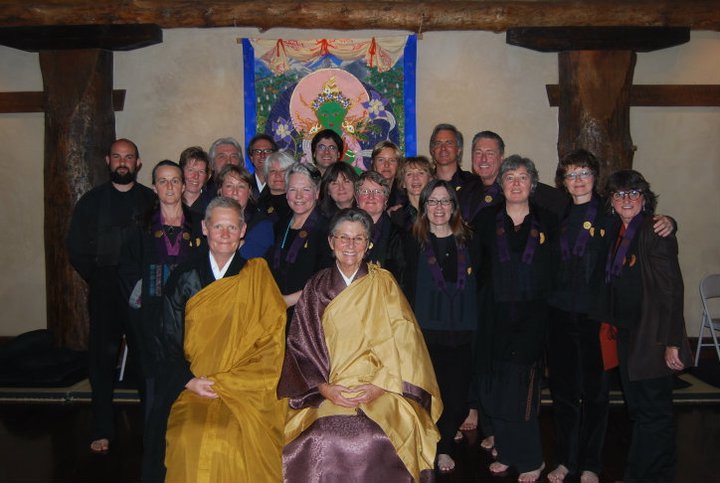
2011 Upaya Buddhist Chaplaincy Graduates (photo by Lynette Monteiro)

I’m in the midst of an intensive training time for Upaya Zen Center’s Buddhist Chaplaincy Program, so I’ve been absent from the blogging world for a while.

This past Sunday, we graduated 18 inspiring people who are re-defining what it means to be a chaplain. I’m so proud to be involved in the program and a witness to each of their journeys. One of those graduates is Penny Alsop, who has created a beautiful website called Great Big Crazy Love. As Penny writes,

Great Big Crazy Love is the virtual manifestation of bearing witness to the joys and sufferings of our world. Born of the inspiration of an improbable Buddhist chaplain trained at the Upaya Zen Center, trips to the Gulf of Mexico in response to the explosion of the Deep Water Horizon rig, visits to prisons and the desire to help fund spiritual first-response efforts, she drew the circle wide enough for everyone’s story.

I invite you to enjoy Penny’s Great Big Crazy Love to see and hear more of the stories of these people that I am proud to call my friends and colleagues. And go out there and create some of your own great, big, crazy love!

________

If you enjoyed this post, I invite you to visit my other website: The Liberated Life Project — a personal transformation blog with a social conscience.

The Buddha and the Budget — Continued!

Posted on
Mediation Bridge

Photo: Mark Riechers / Flickr Creative Commons

Something amazing is happening in Wisconsin. If you’ve been following the news, you’ll know that for the past two weeks, tens of thousands of protesters have been gathering in and around the Statehouse in Madison, expressing to Gov. Walker their passionate support for public employee unions and the right to collective bargaining.

From everything I can see, it’s been a nonviolent movement — which I believe is what lends it power and credibility. And over the last few days, I’ve gotten some indication that at least some of the folks there are using mindfulness practice to ground their actions.

This morning, Sharon Salzberg tweeted this photo from the New York Times, and the photo above is one that I pulled off of Flickr (it was taken on February 22).

One of the students in the Upaya Buddhist Chaplaincy Program, which I direct along with Roshi Joan Halifax, lives in Madison and sent the following a couple email of days ago:

We are truly at ground zero in this struggle for union rights and fairness in balancing the budget.  Susan and I just returned from the state capitol where we walked, chanted, laughed, and braved the snowfall with about 200,000 of our closest friends!  It is really inspiring to see so many people from every walk of life, and every age from babies to elders so unified in their intention.  There is definitely a war going on here, created by the union-bashing tactics of our newly elected Republican governor.  And at a deeper level there is a great feeling of unanimity, nonviolence, goodwill, and hope that is truly inspiring.  I believe we take one step backwards for every two steps forward.  Both are in clear evidence in Wisconsin, and in many other capital cities across America today.

As an antiwar and civil rights activist in the 60’s I organized and attended many rallies and marches.  We were young, and mainly without elders for guidance, so we often acted unskillfully.  Today it is very different.  Young activists have elders for guidance and stability.  The protesters enjoy a broad range of support.  We are nonviolent, committed, and having a good time, even with the stakes so high.  And our actions are informed by ethical principles and spiritual practices which act as beacons as we move into the confusion and darkness of backlash and regression.  This struggle will be a long and difficult one.  Thank you again for your support.

People often question what is “Buddhist” about socially engaged Buddhism. I think this is a wonderful case study in what it looks like. In a way, it’s almost irrelevant what political position, if any, these people hold on the budget issue and on unions. I’d like to think that their peaceful presence at the Wisconsin capitol is contributing to some kind of sanity in the atmosphere there, in what could easily become a volatile situation. I am grateful that they are holding a space of nonviolence and equanimity in the midst of everything.

The Buddha and the Budget

Posted on

In which I offer you a couple of insights from wise people about what’s going on with the U.S. Congress and the federal budget, and share some ideas about what to do.

Quote #1, from Ven. Bhikkhu Bodhi


Speak up for the poor both in this country and abroad. The budget cuts made by the House will have devastating impacts on those most in need of help. Help make the U.S. a country of compassion, not of savage selfishness. Urge the Senate to preserve the funding allocations that can help the poor.

_________

Quote #2, from economist, Nobel Prize recipient, and New York Times columnist Paul Krugman:

There are three things you need to know about the current budget debate. First, it’s essentially fraudulent. Second, most people posing as deficit hawks are faking it. Third, while President Obama hasn’t fully avoided the fraudulence, he’s less bad than his opponents — and he deserves much more credit for fiscal responsibility than he’s getting.

…by proposing sharp spending cuts right away, Republicans aren’t just going where the money isn’t, they’re also going when the money isn’t. Slashing spending while the economy is still deeply depressed is a recipe for slower economic growth, which means lower tax receipts — so any deficit reduction from G.O.P. cuts would be at least partly offset by lower revenue.

The whole budget debate, then, is a sham. House Republicans, in particular, are literally stealing food from the mouths of babes — nutritional aid to pregnant women and very young children is one of the items on their cutting block — so they can pose, falsely, as deficit hawks….

The bottom line, then, is that while the budget is all over the news, we’re not having a real debate; it’s all sound, fury, and posturing, telling us a lot about the cynicism of politicians but signifying nothing in terms of actual deficit reduction. And we shouldn’t indulge those politicians by pretending otherwise.

What to Do

“When spider webs unite, they can tie up a lion.”
~Ethiopian Proverb

Be inspired by the massive display of peaceful people power in Wisconsin. Make your voice be heard and be visible.

1) Sign this petition:

http://www.one.org/us/actnow/2011budget/?rc=2011budgetfb

2) Educate yourself and others on what’s really going on

Many Republicans in Congress are using this budget debate to their political benefit, as Krugman notes, and throwing up a smoke screen that obscures what else is going on.

For example, did you know that nearly two-thirds of U.S. corporations don’t pay any income taxes, instead using tax loopholes and offshore tax havens? This while many corporations enjoy record profits and taxpayer-funded bailouts.

If as much effort was made to increase revenue through collecting some of these corporate taxes as is being spent on cutting from those most in need, we’d be closer to a balanced budget.

Another great source of information is the National Priorities Project. Want to find out how your taxes are being spent? Try out this tool where you plug in the amount of taxes you paid and then can see what percentage goes toward things like military, health care, foreign aid, etc. Do these allocations align with your priorities and values?

3) Organize, organize, organize! February 26 Day of Action

The House of Representatives has voted on the budget. Congress is currently on a break; when the U.S. Senate re-convenes on February 28 it will discuss and vote on the budget. From now until then, it’s time to organize.

US Uncut is a new movement (inspired by UK Uncut) that is about taking action against unnecessary and unfair cuts to public services across the US. US Uncut is organizing an International Day of Action on Feb 26.

Check this web page to see if there is an action scheduled for your community. If not, you can sign up to start one and find lots of great resources on this page.

____________

If you enjoyed this post, I invite you to visit my other website: The Liberated Life Project — a personal transformation blog with a social conscience.