RSS Feed

Author Archives: Maia

On Elephants, People, and Landmines

Posted on

Following up from my last post about elephants in Thailand, I wanted to share with you a short video taken by one of my travel companions, Mary Ann Bennett. At the bottom of this post, I suggest two important action steps you can take to help ban landmines.

The video shows one of the elephants at the Friends of the Asian Elephant Hospital, near Lampang, who was a victim of landmines along the Thai-Burma border. She is being treated here by one of the technicians. If I remember correctly, she came to the hospital several months ago and we learned that it would take many more months for her foot to heal.

A warning — this video is heart-wrenching. But in the spirit of bearing witness, I invite you to watch it and keep in mind the many people and animals that are maimed by landmines across the world.

One source estimates that 721 Burmese civilians were casualties of landmines in 2008, and worldwide, 41% of all mine casualties were children. While many of the wounded die, the majority of victims survive (88% in Burma in 2008) but are left permanently maimed. (Information from Physicians for Human Rights.)

What can we do?

Dispatch from Thailand: Elephants, Humans, Suffering, and Freedom from Suffering

Posted on

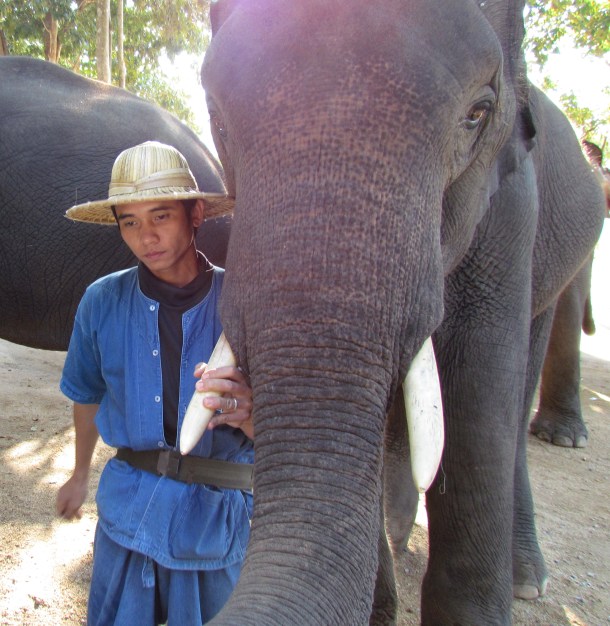
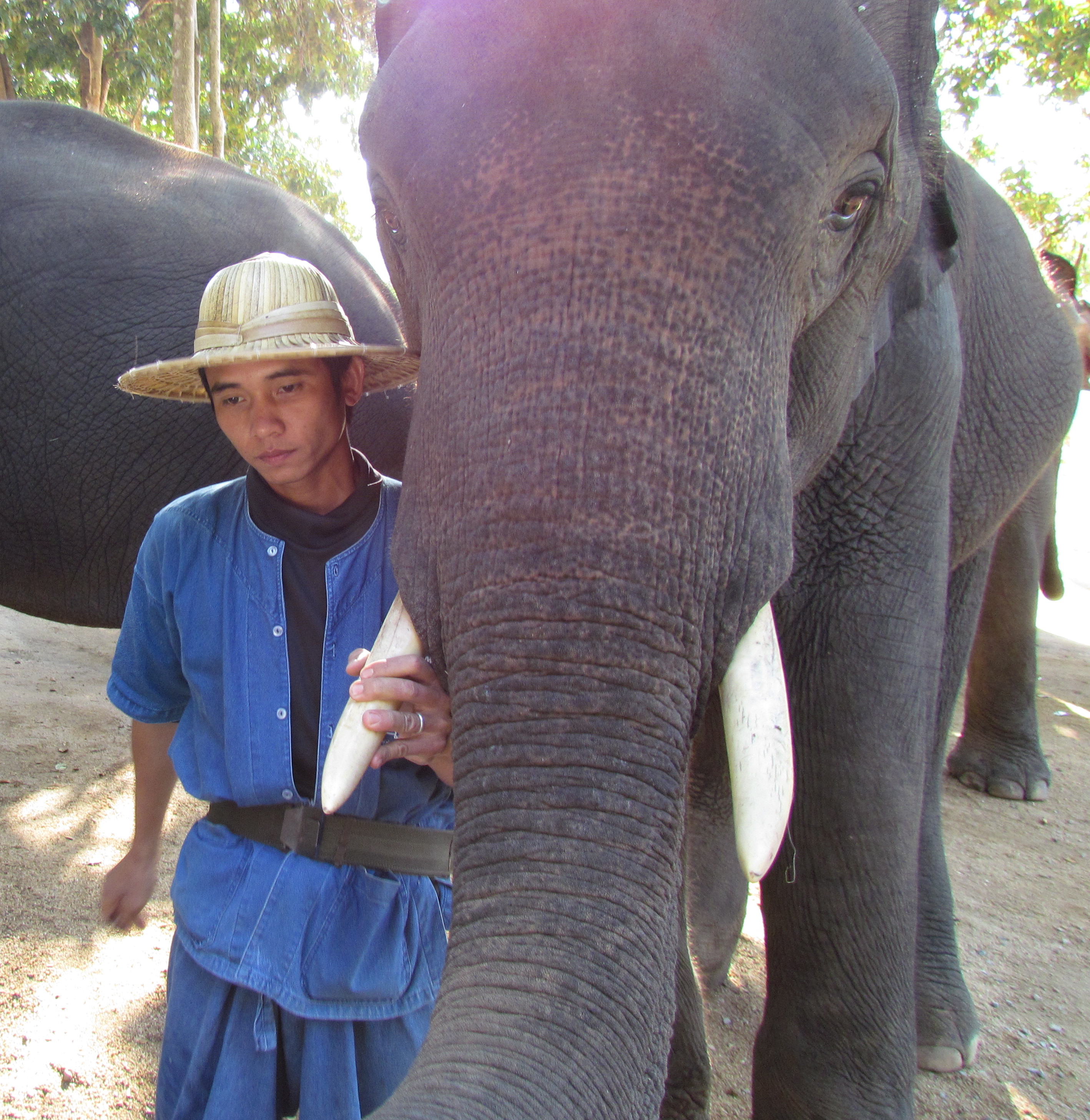
Photo: Mary Ann Bennett

As you may know, I’ve been traveling in northern Thailand for the past three weeks. I’ve written about this trip here and here on my other blog, The Liberated Life Project.

For my Jizo Chronicles readers, I thought you might enjoy a more in-depth look at Buddhism in Thailand as well as the main reason I took this trip, to commune with elephants. This first post focuses on the elephants. It’s a long one that I’ve adapted from a paper I wrote for Upaya Zen Center‘s Buddhist Chaplaincy Training Program. I hope you find it informative and interesting…

_________________________

While I have long been drawn to elephants, I don’t feel that I am all that connected to the natural world as I go through the course of my life, dharma practice, and chaplaincy training.

This may have something to do with my formative years – I was firmly rooted in a medium-sized city (Pasadena), embedded in a major metropolis (Los Angeles). I was surrounded by sidewalks and freeways growing up and felt most at home walking through the city. My family did a lot of traveling – back and forth to the Midwest to see grandparents – but we stayed in motels all the way, with no camping or other intimate experiences with nature.

In my adult years, I’ve had a strong orientation to justice issues concerning people, but have felt less of an imperative around the environment. I’ve always felt somewhat guilty about this… like I should feel passionate around environmental issues, but honestly, if pressed, I would choose people over nature.

Even writing this I realize how silly that is, as there is no way to separate people and the environment… people are part of nature, and vice versa. This dichotomy exists only in my mind (and is held largely by our culture). But clearly this is a dimension that I need to explore more deeply. And so this pilgrimage to spend time with Asian elephants, led by musician Jami Sieber, seemed like a perfect complement to my chaplaincy training.

My goals in taking this trip were to learn more about the plight of elephants in Thailand and, on a more personal level, to explore what a relationship with one elephant might reveal to me about my own nature.

About the Trip

Musician Jami Sieber was inspired to create these journeys for women to spend time with elephants after she had her own intimate experience with these animals in 2001, brought about through an invitation to play cello with the Thai Elephant Orchestra. Since then, she has led four groups of women to northern Thailand. The intention of these journeys, in her words, is “to educate and inspire.”

Our particular journey, comprised of eight women plus Jami, began on January 20, 2011, in Chiang Mai, the largest city in northern Thailand. Our itinerary included stops at three sites over ten days:

1) The Friends of the Asian Elephant Hospital (FAEH) near Lampang

2) Boon Lott’s Elephant Sanctuary (BLES) near Sukhothai

3) The Thai Elephant Conservation Center (TECC), near Lampang, where we went through four days of training to serve as mahouts (elephant caretakers)

We also visited a number of wats and Thai Buddhist historical sites such as Sukhothai. Spending time at these sites grounded the whole trip in a contemplative perspective which greatly deepened the experience.

Along the way, we met with a number of people who have been instrumental in protecting Asian elephants in Thailand, including Soraida Salwala (founder of FAEH), Katherine Connor (founder of BLES), and Richard Lair (longtime elephant advocate and author of Gone Astray: The Care and Management of the Asian Elephant in Domesticity).

The Plight of Elephants in Thailand

The first striking fact we learned: 100 years ago, it is estimated that there were 100,000 Asian elephants in Thailand alone. Today, there are approximately 2,500 captive elephants and 2,400 elephants in the wild.

Elephants in the wild have very little protection. While there is technically a law that protects them from capture or killing, in practice it is fairly common to capture these elephants (especially the babies which can be much more easily trained) and domesticate them. Once domesticated, they are considered draft animals and have the same legal status as cattle in the U.S. Domesticated elephants are subject to ownership and trade. Owners then make a living off of the animal through various means ranging from training them to entertain in tourist camps (legal) to street begging and logging (now illegal).

We learned a great deal about the symbiotic relationship between elephants and people throughout Thai history. Similar to the role the horse has played in North America, elephants in Thailand have been revered, feared, and turned into hardworking beasts of burden throughout the centuries.

The relationship between elephants and humans in Thailand is a complex one. Buddhist scripture and oral history is full of stories about elephants, starting with the role that the white elephant played in the conception and birth of the Buddha. Every wat that we visited had a statue of an elephant or a pair of ivory tusks placed prominently on the main altar. And yet the day-to-day reality is that elephants have served a very utilitarian function in Thai society.

Their intelligence and strength made them the perfect animal to use for logging the teak forests that cover much of northern Thailand. But when logging in Thailand was made illegal in 1989 due to deforestation, both the elephants and their mahouts were left unemployed and hungry. This resulted in large numbers of mahouts resorting to panhandling on the streets of Bangkok and other Thai cities, and searching for food in garbage dumps. City life is detrimental to elephants — standards of health are low, drugging with methamphetamine is common (to keep them working long hours), their diet is poor, and road accidents are frequent. Even though the practice of begging has been outlawed in Bangkok and other cities, in reality it still continues.

Complicating matters, a mafia-like group has gotten involved with elephant trade in Thailand. Often, the mahouts are no longer able to afford the upkeep of their elephants. This is when richer and more unscrupulous characters come on the scene, buy the elephants, and then rent them out to lower-income people seeking to make a living.

While logging is illegal in Thailand, it continues in Burma, Thailand’s neighbor to the north. The Thai-Burma border is among the most heavily land-mined places in the entire world, and people and elephants have been innocent victims of these mines. During our trip, I saw both humans and elephants who had been maimed by landmines. Every day on my walks through the city of Chiang Mai, I’d see at least two or three people with amputated legs or grossly deformed limbs.

Visits to Three Elephant Sites

On our visit to the Friends of the Asian Elephant Hospital (FAEH), we spent time with two elephants – Motala, an adult, and Mosha, a four-year old – who had lost portions of their legs to landmines. Each was fitted with a prosthesis. The hospital was founded by Soraida Salwala in 1993 to improve the living standards of domesticated elephants and oversee their successful release into the wild. It runs a mobile veterinary project to help injured or ailing elephants and works with vets and researchers to gather data on local elephants in captivity.

On our second stop of the journey, at Boon Lott’s Elephant Sanctuary (BLES), we were given a chance to simply be with elephants in their natural environment all day long. BLES was started by Katherine Connor, a young English woman. Katherine first came to Thailand in 2002 to volunteer at FAEH. While there, she developed a very close relationship with a baby elephant named Boon Lott.

Katherine travels throughout Thailand in response to reports of abused elephants. She does whatever is necessary to provide relief to these animals, and when possible arranges for their retirement to the Sanctuary. This requires raising a great deal of money – it is quite expensive to purchase the elephants from their owner, feed them, secure the land needed for their habitat, support the mahouts who take care of them 24 hours a day, and pay for medicines and other health treatment when necessary. In one case that Katherine related to us, the owner was not willing to sell the elephant – viewed as a huge asset for Thai people – but was willing to rent the elephant on a long-term basis to Katherine and Anon, her husband. Now the elephant as well as her owner’s family live on their land.

Katherine’s philosophy is that elephants should be allowed to live according to their natural rhythms as much as possible, and free from forced human contact. There are no performances or shows at BLES and visitors are kept to a bare minimum. Katherine’s friendship with Jami, who has sent financial support to BLES from sales of her album Hidden Sky, facilitated our being able to visit there.

Our third and final stop was the four-day period at the Thai Elephant Conservation Center. TECC is an educational center operated by the Thai government, which sets it apart from similar tourist-oriented parks that operate at a profit.

We did a “home stay” here, sleeping overnight in the village with the mahout families and following the mahout schedule completely each day (not unlike a Zen sesshin!). We were up by 6 am, headed to the forest at 6:30 to bring bananas and sugar cane for our elephants, rode the elephants back to the main area, gave them baths, and then had our own breakfast. The mid-morning routine, starting at 9 am, was a second bath, riding in an elephant ‘parade,’ and then doing the morning show for park visitors. The afternoon was similar to the morning – bath, parade, and matinee show – and then around 4 pm we walked our elephants back into the forest where they spent the night. Evenings were spent eating, drinking home-made rice wine, and dancing with our mahout friends and family.

We were paired with one elephant and a mahout throughout the four days. My elephant’s name was Prachuap – a 30-year-old female who the mahouts happily explained to me was “single, never married!” This meant that she had never allowed any of the male elephants at the park to mate with her. (I could relate.)

I don’t know the story of how Prachuap came to TECC, but I did learn that her best friend there was Prathida, another female elephant. Every morning when my mahout partner Nut and I went to pick up Prachuap in the forest, she literally ran several hundred meters to re-join Prathida (who had been chained at another location) to greet her, making some incredibly excited sounds along the way – squeaks, roars, trumpeting. It was beautiful to see the two of them re-united – they would spend long moments with their trunks entwined, communicating with each other through more sounds.

In all these locations, the animals are chained at night – a necessary precaution to keep them safe from wandering away to places where they could be poached. It was painful to watch this chaining process at the end of each day, but given the context, it started to make more sense over time.

Insights

These 10 days were filled with countless experiences and insights. Yet there were three aspects of the journey that stood out for me:

1) Embodiment

The whole journey was a deeply physical and sensual experience, particularly our four days at the TECC in mahout training. Riding bareback on an elephant is no easy task if you’ve never done it before. I put muscles into use that I hadn’t felt for years. But once I became more attuned with Prachuap and got over my initial anxiety about being 10 or so feet off the ground, I really settled down and enjoyed getting in synch with her slow, steady rhythm and feeling her great mass move so gently yet firmly underneath me. Riding an elephant felt similar to being on a ship at sea, rolling with the waves. I don’t know of a better way to describe it.

The early morning and late afternoon walks out of and back into the forest felt like an act of communion, myself with Prachuap, and Prachuap with the forest floor as she headed to her bed for the night.

It’s true – elephants really do walk on their tip toes, and the sensation of riding with them is the most wonderful combination of power and grace. They make almost no noise when the walk, and leave almost no imprint on the ground.

And then there is the trunk… with an estimated 100,000 muscles and tendons, it’s extremely flexible and strong. Elephants use their trunks for everything – eating, picking up food and other objects, sucking up water to wash themselves or pour into their mouths, smell, self-defense, and contact with others (people and elephants). To be kissed and hugged by an elephant and her trunk was one of the most magical experiences of my life.

Being fully in my body for those four days especially and being in close relationship with this majestic animal that embodies so much ancient wisdom was a true blessing.

2) Communication, connection, matriarchy, and relationships in the elephant world

Elephants are a deeply relational and cooperative animal. As Katherine said during our day-long accompaniment of the elephants at BLES, humans could learn a lot simply by watching how they interact with each other and deal with life situations. As we watched three elephants play in the mud pond – probably their favorite time of the day – we saw the two older female elephants put their trunks out to help the younger elephant up a steep embankment. This is usual behavior in the elephant world, and the elders will look out for and often adopt younger elephants. Female elephants especially are known for developing long-term friendships with each other, like the relationship that Prachuap and Prathida have.

In doing a little research on the topic, I found this on Wikipedia:

The elephant’s brain is similar to that of humans in terms of structure and complexity – such as the elephant’s cortex having as many neurons as a human brain, suggesting convergent evolution

The article goes on to note that elephants share

a wide variety of behaviors [with humans], including those associated with grief, learning, allomothering, mimicry, art, play, a sense of humor, altruism, use of tools, compassion, self-awareness, memory and possibly language.

3) The interdependent relationship between elephants and humans

As I’ve noted above, the relationship between elephants and humans in Thailand is long and complex. That probably makes a lot of sense, given the strong bio/neurological similarities between humans and elephants denoted above.

It seems like our most conflictual relationships are with species with whom we share the most traits. I am reminded of a trip I took in 1995 to an orangutan sanctuary in Borneo where a similar story has played out. Humans and animals form a tightly woven relationship where one depends on the other, but also where the natural order goes out of alignment, usually with the animal suffering the greatest consequences.

Many of the mahouts we got to know have lifelong relationships with their elephants. They are with them from birth and continue to be their caretakers all the way through to death – either the elephants or their own.

While the relationship between humans and elephants has become a partnership, of sorts, and the elephant is assured that its food and other needs will be taken care of (at least in the best of circumstances), it has also pulled the elephant out of its natural habitat and forced it to adhere to the needs and schedules of the human. As the relationship lengthens over time, the elephant loses her ability to survive on her own in the wild, thus increasing its dependence.

On the surface, humans seem to profit from this relationship, quite literally, through the money to be made via entertainment and labor. However, one has to ask what the cost is of living in a world where a great being such as the elephant is on the brink of extinction, and what part of our souls we have lost in that process as well.

In addition, what became very clear on this trip was that elephants suffer the consequences of human greed, ignorance, and hatred. At the FAEH, we saw two elephants who had recently been brought in after stepping on land mines. I clearly saw the look of pain, stress, and suffering in their eyes as their mangled feet were gently bathed by the technicians. There have been numerous reports of elephants experiencing post-traumatic stress disorder, and after seeing the FAEH elephants, I believe that to be true.

What Can Be Done to Help the Elephants?

Reflecting on this journey through the lens of systems theory, I see a complex situation in which both elephants and humans have become intertwined and there is no easy way out of the detrimental effects of this relationship.

As Richard Lair (who we met on this trip) has written,

One simple alternative to work often suggested would be to release all elephants back into the wild but the sad fact remains that while many domesticated elephants would probably survive quite well in nature, in Thailand (and throughout Asia) there is nowhere near enough safe, suitable habitat into which to release them…. With the loss of virtually all traditional forms of work, tourism and cultural activities have emerged as the only viable legal jobs.

The utilitarian role of the elephant is just as deeply rooted in Thai culture as is the sacred esteem in which they are held, creating a big paradox. How can an animal that is so revered also be so abused? While Thais love elephants — every Thai child learns the song, “Chang Chang Chang” – it’s also true that over hundreds of years, they have become conditioned to seeing them as work animals. Elephants begging on city streets has been a normal occurrence, causing little outrage except among a small part of population.

My assumption is that systems change is most effective when it takes places on several levels at once, and combines both high-level and grassroots efforts. From what I could tell, there are at least five approaches being taken to change this situation in Thailand for the better –

  • Education: Organizations such as the TECC exist to educate people about these animals and their plight. One of the most moving moments on our trip came the evening that we spent having dinner with Katherine, Anon, and the mahouts at BLES, Wit, the young Thai man who was driving our van and who had been with Jami on previous years, shared how he had come to know much more about elephants and love and respect them through meeting people like Katherine and Anon. Now he wanted to help protect them as well. This demonstrated to me the power of educational efforts like this tour as well as places like TECC to change peoples’ attitudes and actions.
  • Legislative: The National Elephant Institute has been founded by the Forest Industry Organization to serve as a center for ideas and actions, including drafting a new national law that will afford more protections for elephants.
  • A holistic approach that includes people and animals: Realizing the importance of finding ways to support the livelihood of the mahouts as they also go through this transition with their elephants.
  • NGO development and infrastructure: A growing number of Thai NGO’s dedicated to the welfare of elephants has helped to greatly improve veterinary care for them.
  • Public-private partnerships: A leading NGO, the Royal Forest Department, and a commercial sponsor have joined forces to launch an innovative effort to employ privately-owned elephants in national parks, both in assisting patrolling and offering rides to visitors.

This multi-pronged approach seems to be making some impact, and there are reasons for optimism. Lair writes,

Perhaps the most hopeful sign is that the Thai public, once blissfully unaware of the elephant’s plight, is now highly motivated in helping to protect their beloved elephants. Most Thai elephant owners have always extended humane treatment, but now more than ever they are made aware that they are caretakers for a national treasure, not just their own private property. While constant vigilance is called for, the future of the Asian elephant in Thailand is looking brighter.

Finally, I notice that I’ve been having a very hard time putting this experience into words… the only one that comes anywhere near capturing it is “primal.” I resonate with these definitions: “having existed from the beginning,” “in an earliest or original stage or state.”

I love what Jami has written about her own musical partnership with elephant—it comes closest to describing what I felt on this journey:

The experience with the elephants was a mystical type of collaboration that I have never experienced before. They gave me the gift of love beyond barriers, beyond spoken language and beyond imagination. Interacting with the elephants was a remembering back to a time when we related deeply to the planet and to all beings on this earth.

If you want to help the elephants, check out these sites:
Finding the Poem in My Heart

Posted on

I’ve been traveling since January 11, and in Thailand since January 15. (I’ll be back home February 15.) It’s been a wonderful trip so far and I’m not quite ready to dive back into full blogging mode here on The Jizo Chronicles.

But I did want to share that one thing that has come through quite strongly during my weeks here is remembering my connection to poetry. Perhaps this has something to do with spending time with elephants… more on that later.

So I found an old poem, one from way back when I first started my Buddhist practice. I wrote this the first year I spent time at Upaya Zen Center in Santa Fe.  A lot of life happened between now and then, but I still love the feeling of this poem.


Cerro Gordo
June 24, 1994

Late afternoon mountain walk
Medicine for the body from the Earth
The Big View medicine from on top of Cerro Gordo
After a day of meditation, brushwork, and intimate silence,
My consciousness has finally dropped into a small taste of the beautiful healing power of emptiness.

Now the mountain walk blows my mind, in the best sense
I rise to the top of the hill
With my fellow walkers
Breathing deeply in rhythm with my steps.

At the top of Cerro Gordo, I look outwards.
I see the beauty and terror of my mind:
To the west are the sacred mountains of the Diné people,
To the north is a shiny speck:
Los Alamos, the home of the poison fires,
The birthplace of the atom bomb.
Tears roll down my cheeks uncontrollably
Without thought, I comprehend the light and the dark
Inseparably tied together within my self.

My Mind has created both of these
I cry without blame or judgment for both directions.

Your true nature

IS THIS BIG

No, bigger…


Thailand Adventure/Jizo Takes a Break

Posted on

Dear readers,

I’ve been busy getting ready to head off on a month-long adventure to Thailand — and in fact I am writing this post while sitting on an Amtrak train and hopping on a wireless connection somewhere near the Albuquerque train station. (Taking the train to LA, then flying to Thailand.) So this will be brief!

The Jizo Chronicles will be on hiatus over the next few weeks as I’m on my journey. During this time, I’ll be visiting Ouyporn Khuankaew and the International Women’s Partnership for Peace and Justice in Chiang Mai, Thailand, as well as going on a 10-day elephant trip with musician Jami Sieber.

I hope absence makes the heart grow fonder, and I look forward to sharing stories from these adventures with you when I return. In the meantime, I’ll be putting up a few posts on The Liberated Life Project, so do stop by there.

Until then, may you and all beings be happy, safe, and free from suffering…

in kindness,

Maia


The Power of Words to Harm and to Heal: In the Wake of Tragedy in Arizona

Posted on


Hundreds gather for a vigil at the Arizona Capitol in Phoenix, Jan 8, 2011. (AP / Ross D. Franklin)

Cross-posted from The Liberated Life Project

Since yesterday’s terrible and tragic shootings in Arizona, I have found myself searching for some way to understand what happened and to ascertain what, if any, action might be skillful at this time.

Words are very powerful. It is words (and the thoughts and feelings behind them) that have created an environment of fear and hatred which permeates many levels of the United States, from politics to the media we ingest to the way we move through our daily lives. Words in some way contributed to yesterday’s event and to poisoning the mind of an already disturbed young man.

Like many of you, perhaps, I’ve been seeking some healing words over the past day. This morning I came across some writing from Marianne Williamson and it’s the first time since yesterday I’ve felt myself settle into a place deeper than my own fear and anger. I feel that Marianne’s words are so important that I want to share them in full with you here today:

______________

1/8/11: A NIGHT OF TRAGEDY AND TRANSFORMATION

by Marianne Williamson

“Bullets can’t stop love,” said Arizona official Steve Farley today, claiming that Arizona will be better for having gone through the trauma and tragedy of this day.

America is looking deeply at itself right now, and we have desperately needed to do that. Vigils are being held all over the state of Arizona, and on invisible planes we know that miracles are happening because of it. Hearts are softening; sanity is returning. People are remembering that all of us are human, and all of us are infinitely valuable. A deranged young man merely reflected the insanity of our current political discourse, and as the saying goes, “every problem comes bearing its own solution.” It has taken a tragedy like this to make us all take a deep breath.

All of us are praying for Congresswoman Giffords and the others who were shot today. But let’s put feet to our prayers, as well. Wherever we are and whoever we are, we can participate in de-escalating the violence of our society by de-escalating the violence in our hearts. Whoever we haven’t forgiven, tonight let’s simply do it. Whoever we’re thinking about with anger, tonight is the night to let it go. And to whatever extent we haven’t been a powerful voice for love in our own lives, let’s commit tonight to stepping up our game. Life is a serious business, and to whatever extent we haven’t been playing it seriously, let tonight be the night when we awaken from our stupor and decide to be a player in the healing of our world.

Among other things, let’s look deeply at how easy it is for deranged people to get guns not only in Arizona, but in other places in our country as well. If you feel this isn’t right — that it isn’t safe for us or for our children — then know the only way we will override the resistance of the National Rifle Association is if we ourselves get involved in the effort. The NRA is right that guns don’t kill people — that people do. But with so many unstable people out there, there is no rational reason for us to make it so easy for them.

May those who died in today’s massacre rest in peace. They have done what they came to do this lifetime, and it is time for them to sleep.

But for the rest of us, it is time to wake up. To pray yes, but also to act. To think deeply, but also to speak powerfully. To feel concern, but also to act with courage. God’s blessing doesn’t just mean that He does something for us; it also means that He does something through us. And now is the time to let Him. God bless Arizona, God bless America and God bless us all.

Compassion in Action: The Cambodia AIDS Project

Posted on

Beth Goldring (left) and Brahmavihara patient

One of my readers recently reminded me of  Brahmavihara/The Cambodia AIDS Project, a small Buddhist chaplaincy program working with Cambodian AIDS patients too poor to access traditional resources. The program was founded in 2000 by Beth Goldring.

Since the tagline for The Jizo Chronicles is “Bodhisattvas in the Trenches,” I’m always on the lookout for powerful first-hand accounts of engaged dharma. Beth more than fits that description. She is an American Zen nun who has studied with Gil Fronsdal, as well as a former ballet dancer, university humanities teacher, and human rights worker. Beth works closely with Cambodian staff members to fulfill the project’s mission.

I found this article by Beth on the Brahmavihara website, which was originally published in the German Buddhist Association magazine in Spring 2004. It’s a wonderful exploration of the role that intention plays in service work. Here’s an excerpt:

When I began this project my intention was to help people die peacefully, confident in the Buddha’s boundless compassion. That is still true. Every bit of our work is directed towards helping people realize that the Buddha’s compassion is already fully present–right in the middle of their suffering.

What has changed enormously in the past five years is my sense of what this intention entails. What is striking me most powerfully recently is the need for us to let go of every other intention beyond seeing clearly and  accepting completely the person: just as they are right in the middle of their suffering.

And here is the full article–I hope you enjoy it.

___________________

Working Without Intention
AIDS, Death and Dying among the Cambodian Destitute
by Beth Goldring
Brahmavihara/Cambodia AIDS Project
Phnom Penh

Sok is lying on the floor in the tuberculosis hospital dying of AIDS. She is partly outside her mosquito net. Her face has taken on the alienated, impersonal quality people sometimes get when death is approaching. Her skin has open sores but she is beyond paying attention to them. Lok Yay, the Cambodian nun who works with me, simply pulls on her gloves and begins massaging Sok, making soothing sounds. Ramo, my assistant, and I go into the next room to do Reiki with another patient. By the time we come back Sok has returned to herself. She is sitting up, held by Lok Yay, who is also feeding her a little rice porridge. Sok is very weak but she is once again a specific, recognizable human person.

The next day Ramo and I take Sok’s little daughter, who also has AIDS and lives in a group home for children, for a final visit with her mother. Sok is lying in her bed and Lok Yay has shaved her head. Srey Tout, who is only three, is terrified. I sit next to Sok on the bed.  Srey Tout, on my lap, sits so that she doesn’t have to see this person she is too terrified to know. We visit quietly. Slowly Srey Tout begins to give tiny glances to this person in the bed.  Slowly she recognizes this person as her mother who loves her. Eventually she allows Sok to give her some hard candies and to kiss her. Sok is radiant, even in the face of her impending death. She dies within days.

Recently I received a set of wonderful letters about the death of a Thai woman practitioner, written by a fellow practitioner and friend who accompanied her dying.  A Thai monk who translates Sogyal Rinpoche and the Dalai Lama into Thai also assisted. What was breathtaking was the ongoing intimacy between her spiritual practice and her dying.  Her ability to incorporate her dying, with its pain and difficulties, into her practice seemed seamless.  I was and remain in awe of it.

Our work, while it does not lack inspiration, is not like this. In writing this paper I am increasingly forced to realize how little of our actual experience with death and dying in Cambodia conforms to the patterns normal for discussions of death and dying and Buddhist teachings. This worries me because I would like to make a bridge between the conditions we work under and the conditions normally taken for granted in the West.

Ordinary Cambodians have seen more death and dying than most Westerners can easily imagine. Most of it has taken place under terrible conditions: war, torture, brutality, starvation, lack of the most elementary medical care. I know of no adult over 30 who has not watched at least one family member starve to death or die from lack of elementary medical treatment during the Khmer Rouge period( 1975-79). Recently there are also mob killings of people suspected of stealing motorcycles (one of which took place in a wat with monks looking on) and arbitrary killings because of drunkenness or in the course of theft. There are also routine suicides and regular killing of rape victims, many of them tiny children. A look at the biweekly Police Blotter in the Phnom Penh Post gives the picture of a society in which death is routine and trivial. Deaths from tuberculosis, malaria and AIDS, an increasing infant mortality rate, a terrible maternal mortality rate and routine child deaths from malnutrition, diarrheal diseases and fevers broaden but hardly complete the picture.

Buddhist teaching in Cambodia has not recovered from the legacy of war and genocide. The clergy were destroyed under the Khmer Rouge and politically controlled during the Vietnamese period (1979-91).  With some stunning exceptions, the reconstruction of Buddhist teachings has lacked skilled and knowledgeable teachers. This handful of skilled teachers are called upon to do everything from reconstructing the teaching of Pali through operating rice banks to conducting anti-smoking campaigns. While the level of knowledge is to some degree being reconstructed and there are monks and achars and nuns to chant and perform ceremonies the deeper knowledge of what the tradition means takes a far longer time to develop. One such stunning exception to these problems is the annual dhammayietra (peace walk) in which the commitment of monks, nuns, achars and laypeople to dhamma and to peace in Cambodia is palpable in every step they take.

It is impossible, however, that the increasing and uncontrolled corruption that stains every level of Cambodian society has left Buddhism untouched. Too often the wats lack even the most elementary discipline; too often the monks, mostly young boys, are taught simply that people should give them things; too often they are encouraged to study English and computer and not dharma. The nuns are old women. Since they receive little if any support from the wats (normally they have to build their own cottages to live in and may or may not receive food) they largely come from families able to support them. Many wats have no nuns at all and no space or welcome for them. The nuns tend to congregate in wats where there is dharma training for them. There they are respected for the sincerity of their practice but they are  not sought out for their wisdom. The Association of Nuns and Laywomen in Cambodia works to provide encouragement, support and training but it is the only active institution working on their behalf.  The achars (older men who keep five precepts and run ceremonies as well as the temporal affairs of the wats) are a mixed group. Some of them have studied dharma for a long time; others tend to concentrate almost exclusively on the material side of the work.

I am not saying things this critical of the current situation in Cambodian Buddhism lightly. The situation is all too understandable given Cambodia’s history of massive and ongoing trauma. Often I am astounded by the Cambodian capacity for recovery in the face of it; for the kindness and compassion we find in desperate situations.  I doubt I would have even one-thousandth of the grace under stress we are routinely privileged to witness.  But without at least some background in the realities of current Cambodian Buddhism the problems the dying face are unintelligible. I know of one monk who sits with dying people. He works in a project which is mixed Christian and Buddhist and which has a home care project, a hospice and programs for orphans.  I have heard of other monks who visit the sick. I have heard of, but not seen, one wat where the destitute dying are accepted and where orphans are taken care of.

Our patients don’t ask the monks to come and chant because they have nothing to give them and are ashamed. Our patients believe that their destitution and AIDS are the result of their karma. They believe that their poverty, suffering and disease place them outside the Buddha’s concern and care. They know of no other way to overcome this problem except by giving things to monks. They believe that because they have nothing to give the monks their next lives will be even worse. It is easy for them to hate and fear death; they have seen too much of its ugliest face. It is especially easy for them to die in terror, rage or simple alienated, exhausted indifference.

When I began this project my intention was to help people die peacefully, confident in the Buddha’s boundless compassion. That is still true. Every bit of our work is directed towards helping people realize that the Buddha’s compassion is already fully present–right in the middle of their suffering.

What has changed enormously in the past five years is my sense of what this intention entails. What is striking me most powerfully recently is the need for us to let go of every other intention beyond seeing clearly and  accepting completely the person: just as they are right in the middle of their suffering. It means using all the tools we can bring to bear on the situation: chanting, meditation, ceremonies (including ghost ceremonies), Reiki, massage, amritta, candles, incense, small Buddha statues, pictures, whatever practical assistance we can offer and whatever compassion our own training and practice allow us to embody. But, paradoxically, it means using those tools without any idea of accomplishing anything with them.

It is late Friday evening. Bunna is dying in her house.  She is a woman of intelligence and fortitude and has refused to go to the hospice or hospital. This afternoon she was restless and upset. She also had uncontrolled diarrhea, which shamed her since she had no strength to change her clothing or clean it. Chey Lang, who has just received her Reiki II initiation, came with Veasna, my second translator. They cleaned everything, cooked some rice porridge and fed her as much as she could eat. Chey Lang did Reiki and  they left her resting in her mosquito net with the things she needed easily at hand. Meanwhile I had called her home care supervisor, who said they would pay for someone to care for her if we could find the person.

Ramo and I have come back and have asked Ka, who is normally practical, warm and energetic, to be the caregiver. Ka agreed. But when she arrived she was badly out of control emotionally because of her own problems. Her organization (different from Bunna’s) had just cut housing subsidies and the people caring for Ka’s children had sent them back. She had nothing to feed them. Although Ka wants the job for financial reasons she is in no emotional state to do it. She becomes hysterical about the house not being safe; about whether her own antiretroviral medication might be stolen; about where she will sleep since her mosquito net is too big for the available space; about anything and everything. She does not interact with Bunna, who, meanwhile, is withdrawing further and further into herself. I tell Ka that we have other people for the job but she insists she wants it, calms down a bit and goes to get her things. While we are waiting another woman comes in, ostensibly to see about Bunna but actually to scream about her own problems and situation. Bunna by this time is practically in a fetal position; her eyes are withdrawn, shadowed and hollow and her mouth is a rictus. I feel that she is willing to die immediately, just to get away from the hysteria surrounding her. I leave Ramo to deal with the other woman and get back into the mosquito net with Bunna. I start to do Reiki, very gently and simply. Slowly she turns over onto her back. I move the pillows behind her, raising her head to help with her lung congestion. She is too weak to cough up matter from a lying down position.

The visitor leaves and Ka comes back to tell us her son has disappeared and that she can’t stay with Bunna because she has to go find him. Ramo deals with her gently but we are both enormously relieved. We call Lok Yay’s assistant and ask him to bring another woman we know, Heng, who is gentle and kind. I do not expect Bunna to live even the half hour that it will take them to arrive.

I have been studying about giving Reiki attunements to the dying and it strikes me that there could hardly be a better time to start. So I do what I can, holding in my mind no intention or simply the intention that Bunna go as peacefully as is possible. Focussing on the attunement process I am not watching her face closely. When I look back at her she is peaceful and present and I feel an enormous gratitude.

Heng arrives and immediately gets under the mosquito net with her cheerful, peaceful presence. We make the necessary arrangements quickly and without fuss. Bunna is concerned that I am there very late in the evening and must be tired. It is characteristic of her to be concerned about me as soon as she is reasonably conscious again.

That was  February 27. Bunna went into the hospital March 3, was eating successfully, even corn on the cob, several days later and began antiretrovirals March 10. Perhaps she will make it.

My sense of things right now is that it is necessary to let go of all intentions, even, at one level, the intention of helping someone find peacefulness. My sense is that the more we are able to do this, the more we are able to let people be who they are, to have their own lives and deaths and not the ones we might wish for them, the more effective the work will be at the deeper levels. This does not mean withholding our skills, capacities, knowledge and/or most powerful efforts. Rather it means using them as fully as we possibly can, moment to moment. But it also means using them unconditionally, letting go of all ideas about what should happen or how it should happen.

There is, of course, nothing new in this. It is classic Buddhist teaching and teaching that Zen, in particular, emphasizes strongly.  Cambodia is an easy place to learn about the limitations of efforts. But it is also a wonderful place to learn about the power of what works through us when we let go of ideas. We are enormously privileged to be able to work here.

Why Buddhism? Violations of Trust in the Sexual Sphere [guest post by Roshi Joan Halifax]

Posted on

This is a guest post from Roshi Joan Halifax, founding Abbot of Upaya Zen Center


We all know that rape as a weapon of war has been used against women and nations for thousands of years. Rape, forceable seduction, seduction through trickery, power and domination, seduction through loneliness or delusion have also been part of most, if not all, religions. Yes, if you want to demoralize a nation, rape its women, its daughters, its sisters, its wives…….. And if you want to deepen the shadow of any religion, turn wisdom and compassion into hypocrisy, and stand by, conflict averse, as its male clergy disrespects women, has sex with female congregants, dominates women, abuses women, degrades or rapes them.

But as a Zen Buddhist priest, as a woman, I have to ask, why my religion? Why Buddhism? This is not what the Buddha taught. I like Buddhism; I love my practice of meditation; Buddha’s teachings are practical; they make sense to me. But for too long in the West, and I am sure in the East, gross misogyny has existed in the Buddhist world, a misogyny so deep that it has allowed the disrespect and abuse of women and nuns in our own time, and not only throughout history, and not only in Asia. The misogynistic abuse is not only in terms of the usual gender issues related to who has responsibility and authority (women usually don’t have much if any), but it is as well expressed through mistreatment of women, through sexual boundary violations of women, and the psychological abuse of women.

Since 1964, according to the late Robert Aitken Roshi’s archive, a Buddhist teacher, Eido Shimano, has been engaged in sexual misconduct with a number of his female students; sometimes the sex was forceable; sometimes crude, tricky, and coercive. And it has been ongoing, for more than forty-five years. Many Buddhist practitioners have known about this for a long time, although the late Aitken’s archive was closed until just before his death in the fall of this year. What was this silence about, I have asked? Why did we not act? Why are we, as Buddhists, so conflict averse?

On August 21, 2010, the NYTimes published an article, Sex Scandal has U.S. Buddhists Looking Within. This article publicly surfaced Eido Shimano’s long pattern of sexual violation. Sadly, On December 1, the principle figure in this article wrote a rebuttal, basically denying his culpability and blaming the NYTimes for dysinformation.  The Times reporter, Mark Oppenheimer, responded to this self-serving letter from Eido Shimano.

I think that this rebuttal by Eido Shimano was the straw that broke the camel’s back for many of us Buddhists. We were incredulous on reading Eido Shimano’s communique to the Times‘ reporter. Naively, we had thought that this problem was taken care of; the teacher was full of remorse and had resigned as abbot and board member of the institution that he founded; and the institution was committed to addressing this issue and redressing the ills suffered by the women involved and the wider community.

But we were wrong……. and I assure you, this is not the first time we have been wrong about similar violations…….

Fortunately, the response to Eido Shimano’s unempathic, self-centered and self-serving communique has been building, nationally and internationally, over December and into January. Buddhists are finally getting it. You have to take a stand, a strong and vocal stand, against the predatory behavior of its religious figures. You have to speak truth to power, and speak it loudly. And you have to act……….

I have been waiting for this moment not just for the many months since the discussions have been happening among Zen teachers. I have been waiting for years for a concerted response to such violations against women in our Buddhist world. Many of us women who have brought these issues to the attention of the wider community and have been shamed and shunned over the years. But finally, just before New Years, the flood of letters addressing Eido Shimano’s behavior has found its way onto the shores of his Buddhist monastery and the internet. Herein, one of first of those letters, my own.

It will take a while for us to fully understand why we as Buddhists took so long to act. If Eido Shimano had been a doctor, lawyer, or psychotherapist, there would have been rapid social and legal consequences. But there is something about our religions, whether Catholic, Protestant, Jewish, Islam, or Buddhist, that disallows us facing the shame associated with sexual violations and the gross gender issues that plague most, if not all, religions.

I understand that letters are easy to write. Less easy are the creation of protections so women (and religious communities) will not be harmed like this ever again. And even more difficult is changing the views, values, and behaviors that made it possible for someone like Eido Shimano and others to engage in such harmful acts for so long. Yet, it is not only a matter of the sexual violation of women and the painful violation of boundaries that are based in trust between teacher and student, it is as well a matter of the violation of the core of human goodness; for his behavior is also a violation of the entire Buddhist community, as well as the teachings of the Buddha which are uncompromising with respect to the unviability of killing, lying, sexual misconduct, wrongful speech, and consuming intoxicants of body, speech and mind. The northstar of goodness has been lost sight of in the long and recent past, and we are all suffering because we cannot see how deep the wound is to the heart of our world and to the coming generations.

Protections, dialogue, education are all necessary at this time. And a commitment to not forgetting……… as well as vowing to not repeat the mistakes of the past, and to practice a compassion that is clear and brave, liberating and just.

I am aware that these words do not address issues related to the sexual violation of children and men by clergy. I am also aware that power dynamics between women and men are inadequately referenced here, nor are issues related to the exploitation of students by female clergy. What I have written, however, is meant to address specifically the violation of boundaries and trust, whether by force or consent, by Buddhist male religious clergy of their female congregants and students, and a particular case in point that is in the foreground of the Zen Buddhist community in the United States at this time.

As author and Buddhist Natalie Goldberg wrote in her book The Great Failure: “We are often drawn to teachers who unconsciously mirror our own psychology. None of us are clean. We all make mistakes. It’s the repetition of those mistakes and the refusal to look at them that compound the suffering and assure their continuation.”

It seems as though the time has come for us to take a deep look at our individual and collective psychology……… and to strongly request that those teachers who have crossed the boundaries of trust to engage in sexual intercourse with students and congregants step aside, so the healing of individuals and sanghas can begin.

Looking Back at the Year in Socially Engaged Buddhism

Posted on

Buddhist monks praying for peace in Thailand, May 2010

This is the full first year that The Jizo Chronicles has been up and running, so it’s a good time to look back at what’s been going on in the world of socially engaged Buddhism in 2010. (To get an idea of what’s ahead for 2011, look at the Calendar of Events that we maintain here.)

It’s been quite a year, actually.

  • This was the year we lost Robert Aitken Roshi, fierce and dear Zen teacher, founder of the Diamond Sangha, and co-founder of the Buddhist Peace Fellowship.
  • Mindfulness and meditation continue to find applications in all kinds of interesting realms, from technology (like the first-ever Wisdom 2.0 conference) and education. 84,000 dharma doors indeed.

In my own life, I continue to be blessed with being in such a close relationship with Roshi Joan Halifax and Upaya Zen Center, and Upaya’s chaplaincy program. I don’t have to go more than a few dozen steps from my front door to be able to sit in the beautiful zendo there, and to hear teachings from  Joanna Macy, Fleet Maull, Ouyporn Khuankaew, Jimmy Santiago Baca, Sharon Salzberg, Kaz Tanahashi, Norman Fischer, and Father John Dear (all visited Upaya this past year). I’ve also appreciated my long-distance dharma relationship with Shosan Victoria Austin of the San Francisco Zen Center and the sangha there.

My practice continues to deepen and I am ever more aware of the subtle power of the dharma to transform suffering into joy. As the old year comes to a close and the new one begins, I wish you and your loved ones great peace, great equanimity, and great compassion.

I’m sure I missed a lot in the above recounting. Please let me know your experience and memories of engaged dharma practice this past year… leave a comment below.

___________________________________

If you enjoyed this post, I invite you to visit my other website: The Liberated Life Project — a personal transformation blog with a social conscience.