RSS Feed

Category Archives: Quotes

Quote of the Week: Ven. Thich Nhat Hanh

Posted on

photo by Don Farber

This week’s quote comes from Vietnamese Zen master Ven. Thich Nhat Hanh, whose bio appears on this Jizo Chronicles post.

In light of the news coming from Japan over these past few days, these words — from Thây’s book Being Peace — are especially relevant and poignant:

Many of us worry about the situation of the world. We don’t know when the bombs will explode. We feel that we are on the edge of time. As individuals, we feel helpless, despairing. The situation is so dangerous, injustice is so widespread, the danger is close. In this kind of a situation, if we panic, things will only become worse. We need to remain calm, to see clearly. Meditation is to be aware, and to try to help….

Our world is something like a small boat. Compared with the cosmos, our planet is a very small boat. We are about to panic because our situation is no better than the situation of the small boat in the sea. You know that we have more than 50,000 nuclear weapons. Humankind has become a very dangerous species. We need people who can sit still and be able to smile, who can walk peacefully. We need people like that in order to save us. Mahayana Buddhism says that you are that person, that each of you is that person.

___________________________________

If you enjoyed this post, I invite you to visit my other website: The Liberated Life Project — a personal transformation blog with a social conscience.

Quote of the Week: Robert Aitken Roshi

Posted on

The last “Quote of the Week” for the year is reserved for Robert Aitken Roshi, who passed away on August 5th of this year.

This one is short and very much to the point… may we let it support our practice in the coming year:

“Our practice is not to clear up the mystery.
It is to make the mystery clear.”


___________________________________

If you enjoyed this post, I invite you to visit my other website: The Liberated Life Project — a personal transformation blog with a social conscience.
Quote of the Week: Roshi Joan Halifax

Posted on

My dear friend Roshi Joan Halifax spoke at the TEDWomen event last week in Washington, D.C. The subtitle of the two-day event was “Reshaping the Future,” and what an amazing line-up… in addition to Roshi, speakers included Madeleine Albright, Naomi Klein, Eve Ensler, and Hilary Clinton.

The video hasn’t been posted yet, but Roshi was kind enough to give me notes from her talk. Here is an excerpt:

Compassion arises out of our capacity to be intimate, to be transparent, to have a heart and mind that is so balanced that we can perceive the world clearly and realistically. Compassion also makes it possible for us to be perceived deeply by others, to have an undefended heart. It is a fundamental courageous mental and behavioral process that allows us to be more resilient, according to neuroscience research, to be more mentally integrated, the neuroscientists have discovered, and to even have a greater immune response to the noxiousness around us…

So I want to know why we don’t nourish the seeds of compassion in our children, if compassion is so good for us? Why don’t we train our health care providers in compassion, since compassion is about the commitment to alleviate suffering? Why don’t we vote for our politicians based on compassion, so we could have a more caring world?

Know that it takes a strong back and soft front, equanimity and kindness for us to realize compassion in our lives. We need the strength to uphold ourselves in the midst of any conditions, and at the same time great openness and caring toward the world.

___________________________________

If you enjoyed this post, I invite you to visit my other website: The Liberated Life Project — a personal transformation blog with a social conscience.

Quote of the Week: Aung San Suu Kyi

Posted on

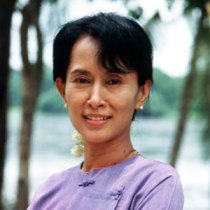
The release of Daw Aung San Suu Kyi continues to be the biggest story on the socially engaged Buddhist front this past week. To really get a sense of how important this is, you need only take a look at the front page of the Irrawaddy news magazine, Burma’s independent media voice. Articles this week include “Grandmothers Who Help Suu Kyi,” coverage of Daw Suu’s first visit with her son in more than ten years, and this disturbing story about the junta’s attempts to evict more than 80 HIV/AIDS patients after Suu Kyi visited their shelter in Rangoon last week.

But perhaps best of all was this interview between Daw Suu and Irrawaddy editor Aung Zaw (thanks to Lynette Monteiro of 108 ZenBooks for telling me about this). In response to a question about the possibility that she might meet with General Than Shwe (the leader of Burma’s military junta), Daw Suu said,

I am not sure if you have heard that Gandhi was very fond of a Christian hymn, even though he was a follower of Hinduism. The name of the song is “Lead, Kindly Light.” It says, “I do not ask to see the distant scene; one step enough for me.” Gandhi believed that, and so do I. I will do my best to walk, step by step. If I am on the right track, I will reach the right place. I don’t want to try to imagine something very distant. For me, hope is the desire to try. I believe I can only hope for something if I have tried to achieve it. I will continue to make an effort with this belief in mind.

Quote of the Week: Int’l Burmese Monks Organization

Posted on

photo: Associated Press

“The Saffron Revolution was and is essentially not a struggle for political power.
It is a revolution of the spirit that aims at changing Burma from the inside out.
With loving-kindness, we intend to change the hearts and minds of Burma’s generals,
returning them to their inborn buddha nature.”

The International Burmese Monks Organization (Sasana Moli)

Quote of the Week: Maylie Scott

Posted on

Kushin Seisho Maylie Scott was a beautiful bodhisattva who packed a lot into her 65 years of life. A Zen practitioner based for many years at Berkeley Zen Center, Maylie received dharma transmission from Sojun Mel Weitsman in 1998. She then founded Rin Shin-ji (Forest Heart Temple) in Arcata, California, in 2000, shortly before her death.

Throughout her life, Maylie was passionately committed to justice and devoted much of her time to work in prisons and homeless shelters throughout California. She was also very involved with the Buddhist Peace Fellowship, where she served on the board of directors and helped to envision both the Buddhist Alliance for Social Engagement (BASE) and BPF’s Prison Program.

Maylie died in May, 2000, not long after she was diagnosed with cancer. I only met Maylie a few times before her death, but she had a remarkable presence.

This week’s quote is Maylie’s rendition of the Metta Sutta, written in 1994. It feels wonderful to recite it out loud…give it a try.

This is what should be accomplished by the one who is wise,

May I be well, loving, and peaceful. May all beings be well, loving, and peaceful.

May I be at ease in my body, feeling the ground beneath my seat and feet, letting my back be long and straight, enjoying breath as it rises and falls and rises.

May I know and be intimate with body mind, whatever its feeling or mood,calm or agitated, tired or energetic, irritated or friendly.

Breathing in and out, in and out, aware, moment by moment, of the risings and passings.

May I be attentive and gentle towards my own discomfort and suffering.

May I be attentive and grateful for my own joy and well-being.

May I move towards others freely and with openness.

May I receive others with sympathy and understanding.

May I move towards the suffering of others with peaceful and attentive confidence.

May I recall the Bodhisattva of compassion; her 1,000 hands, her instant readiness for action. Each hand with an eye in it, the instinctive knowing what to do.

May I continually cultivate the ground of peace for myself and others and persist, mindful and dedicated to this work, independent of results.

May I know that my peace and the world’s peace are not separate;that our peace in the world is a result of our work for justice.

May all beings be well, happy, and peaceful.

___________________________________

If you enjoyed this post, I invite you to visit my other website: The Liberated Life Project — a personal transformation blog with a social conscience.

Quote of the Week: Alan Senauke

Posted on

A few days ago, I enjoyed a beautiful walk along the San Francisco Bay with Alan, Bhikkhu Bodhi, Katie Loncke, and Kim and Sylvie of Buddhist Global Relief. Together, we spanned three generations of engaged Buddhism, and the conversation on our walk ranged from dharma questions for Bhikkhu Bodhi (who has translated many classic Buddhist texts) to debating the utility and futility of electoral politics.

Alan gifted me with his new book, The Bodhisattva’s Embrace: Dispatches from Engaged Buddhism’s Front Lines. I’ve been reading the book and deeply appreciating how much Alan has contributed to all of us over his many years of practice and service. It’s a beautiful book and I highly recommend it.

This excerpt comes from the book’s introduction:

It is hard to define engaged Buddhism. But I think it has to do with a willingness to see how deeply people suffer; to understand how we have fashioned whole systems of suffering out of gender, race, caste, class, ability, and so on; and to know that interdependently and individually we co-create this suffering. Looking around we plainly see a world at war, a planet in peril.

Some days, I call this engaged Buddhism; on other days I think it is just plain Buddhism — walking the Bodhisattva path, embracing the suffering of beings by taking responsibility for them. In almost every religious tradition there [are] similar ways and practices integrating faith and activism. Across religions and nations we are each others’ sisters and brothers and allies. Our effort is to be more truly human.


Quote of the Week: Melody Ermachild Chavis

Posted on

Melody Ermachild Chavis is a private investigator, a longtime Zen practitioner at Berkeley Zen Center, and a writer. She is the author of two wonderful books that more people should know about: Altars in the Streets: A Courageous Memoir of Community and Spiritual Awakening and Meena: Heroine of Afghanistan.

In her role as a private investigator, she has worked on trials and appeals for inmates on Death Row in California, including Jarvis Jay Masters. In this excerpt from her essay, “Seeking Evil, Finding Only Good” (found in the anthology Not Turning Away), Melody reflects on the complexities of “guilt” and karma:

At first, my new client might seem guilty of something terrible. But that first impression gets complicated as the story of his life unfolds. I go out to interview witnesses, and in the listening, I become a witness. I find some more people who are “guilty” too — perhaps parents whose love failed.

As I work, the guilt in my client that seemed so solid begins to come apart in my hands. All I can find in the end are causes and conditions in an endlessly tangled web. Investigating any life, one sees how currents coming from very far away can meet within a person: echoes of a long-ago massacre, hurts barely spoken, then a dark street, a shout, a bullet — a lethal moment.

Does this mean that responsibility lies nowhere? No. We are each responsible for what we set into motion. Yet we can never isolate one current of karma from the ocean of creation.