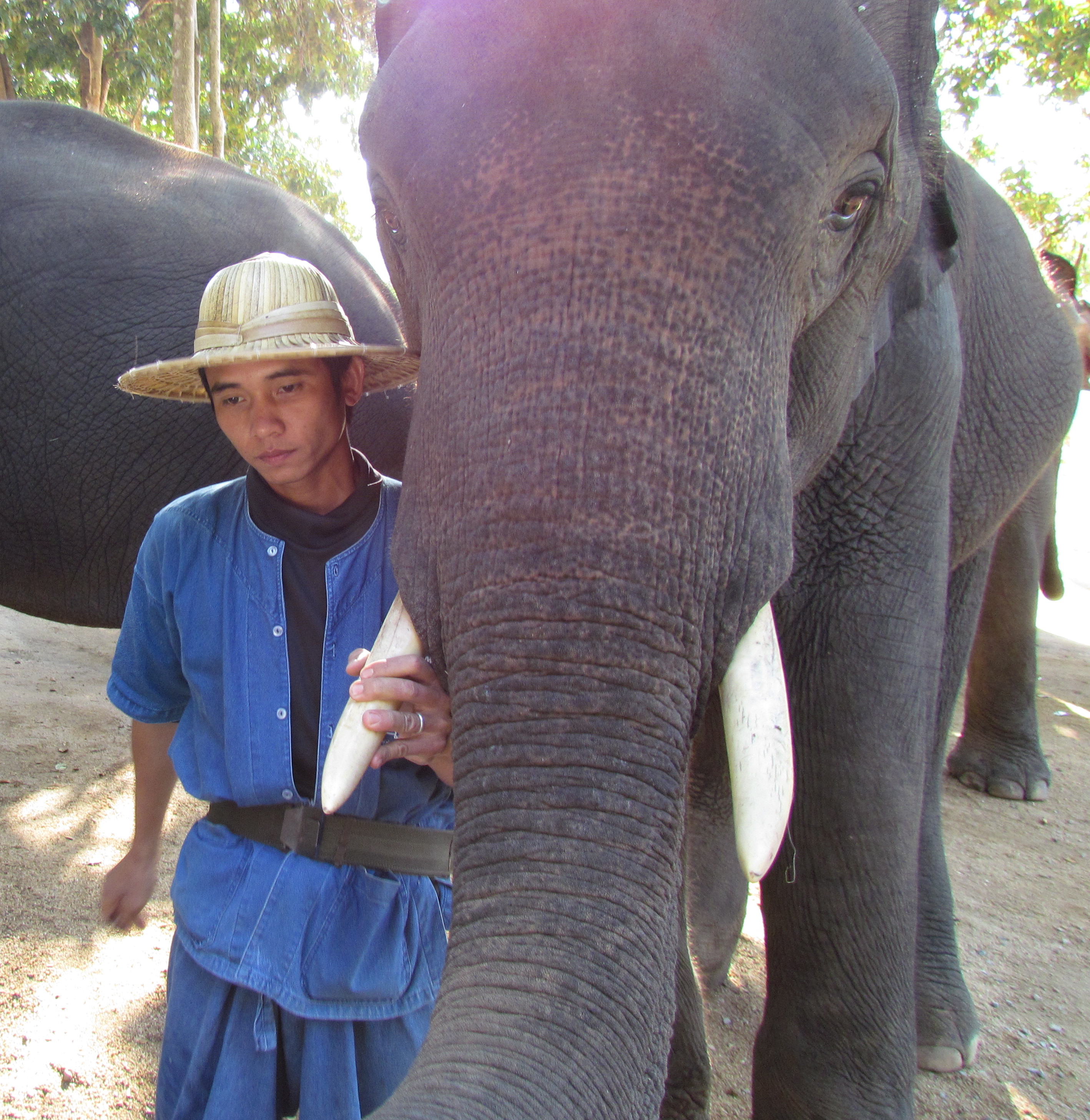
Photo: Mary Ann Bennett
As you may know, I’ve been traveling in northern Thailand for the past three weeks. I’ve written about this trip here and here on my other blog, The Liberated Life Project.
For my Jizo Chronicles readers, I thought you might enjoy a more in-depth look at Buddhism in Thailand as well as the main reason I took this trip, to commune with elephants. This first post focuses on the elephants. It’s a long one that I’ve adapted from a paper I wrote for Upaya Zen Center‘s Buddhist Chaplaincy Training Program. I hope you find it informative and interesting…
_________________________
While I have long been drawn to elephants, I don’t feel that I am all that connected to the natural world as I go through the course of my life, dharma practice, and chaplaincy training.
This may have something to do with my formative years – I was firmly rooted in a medium-sized city (Pasadena), embedded in a major metropolis (Los Angeles). I was surrounded by sidewalks and freeways growing up and felt most at home walking through the city. My family did a lot of traveling – back and forth to the Midwest to see grandparents – but we stayed in motels all the way, with no camping or other intimate experiences with nature.
In my adult years, I’ve had a strong orientation to justice issues concerning people, but have felt less of an imperative around the environment. I’ve always felt somewhat guilty about this… like I should feel passionate around environmental issues, but honestly, if pressed, I would choose people over nature.
Even writing this I realize how silly that is, as there is no way to separate people and the environment… people are part of nature, and vice versa. This dichotomy exists only in my mind (and is held largely by our culture). But clearly this is a dimension that I need to explore more deeply. And so this pilgrimage to spend time with Asian elephants, led by musician Jami Sieber, seemed like a perfect complement to my chaplaincy training.
My goals in taking this trip were to learn more about the plight of elephants in Thailand and, on a more personal level, to explore what a relationship with one elephant might reveal to me about my own nature.
About the Trip
Musician Jami Sieber was inspired to create these journeys for women to spend time with elephants after she had her own intimate experience with these animals in 2001, brought about through an invitation to play cello with the Thai Elephant Orchestra. Since then, she has led four groups of women to northern Thailand. The intention of these journeys, in her words, is “to educate and inspire.”
Our particular journey, comprised of eight women plus Jami, began on January 20, 2011, in Chiang Mai, the largest city in northern Thailand. Our itinerary included stops at three sites over ten days:
1) The Friends of the Asian Elephant Hospital (FAEH) near Lampang
2) Boon Lott’s Elephant Sanctuary (BLES) near Sukhothai
3) The Thai Elephant Conservation Center (TECC), near Lampang, where we went through four days of training to serve as mahouts (elephant caretakers)
We also visited a number of wats and Thai Buddhist historical sites such as Sukhothai. Spending time at these sites grounded the whole trip in a contemplative perspective which greatly deepened the experience.
Along the way, we met with a number of people who have been instrumental in protecting Asian elephants in Thailand, including Soraida Salwala (founder of FAEH), Katherine Connor (founder of BLES), and Richard Lair (longtime elephant advocate and author of Gone Astray: The Care and Management of the Asian Elephant in Domesticity).
The Plight of Elephants in Thailand
The first striking fact we learned: 100 years ago, it is estimated that there were 100,000 Asian elephants in Thailand alone. Today, there are approximately 2,500 captive elephants and 2,400 elephants in the wild.
Elephants in the wild have very little protection. While there is technically a law that protects them from capture or killing, in practice it is fairly common to capture these elephants (especially the babies which can be much more easily trained) and domesticate them. Once domesticated, they are considered draft animals and have the same legal status as cattle in the U.S. Domesticated elephants are subject to ownership and trade. Owners then make a living off of the animal through various means ranging from training them to entertain in tourist camps (legal) to street begging and logging (now illegal).
We learned a great deal about the symbiotic relationship between elephants and people throughout Thai history. Similar to the role the horse has played in North America, elephants in Thailand have been revered, feared, and turned into hardworking beasts of burden throughout the centuries.
The relationship between elephants and humans in Thailand is a complex one. Buddhist scripture and oral history is full of stories about elephants, starting with the role that the white elephant played in the conception and birth of the Buddha. Every wat that we visited had a statue of an elephant or a pair of ivory tusks placed prominently on the main altar. And yet the day-to-day reality is that elephants have served a very utilitarian function in Thai society.
Their intelligence and strength made them the perfect animal to use for logging the teak forests that cover much of northern Thailand. But when logging in Thailand was made illegal in 1989 due to deforestation, both the elephants and their mahouts were left unemployed and hungry. This resulted in large numbers of mahouts resorting to panhandling on the streets of Bangkok and other Thai cities, and searching for food in garbage dumps. City life is detrimental to elephants — standards of health are low, drugging with methamphetamine is common (to keep them working long hours), their diet is poor, and road accidents are frequent. Even though the practice of begging has been outlawed in Bangkok and other cities, in reality it still continues.
Complicating matters, a mafia-like group has gotten involved with elephant trade in Thailand. Often, the mahouts are no longer able to afford the upkeep of their elephants. This is when richer and more unscrupulous characters come on the scene, buy the elephants, and then rent them out to lower-income people seeking to make a living.
While logging is illegal in Thailand, it continues in Burma, Thailand’s neighbor to the north. The Thai-Burma border is among the most heavily land-mined places in the entire world, and people and elephants have been innocent victims of these mines. During our trip, I saw both humans and elephants who had been maimed by landmines. Every day on my walks through the city of Chiang Mai, I’d see at least two or three people with amputated legs or grossly deformed limbs.
Visits to Three Elephant Sites
On our visit to the Friends of the Asian Elephant Hospital (FAEH), we spent time with two elephants – Motala, an adult, and Mosha, a four-year old – who had lost portions of their legs to landmines. Each was fitted with a prosthesis. The hospital was founded by Soraida Salwala in 1993 to improve the living standards of domesticated elephants and oversee their successful release into the wild. It runs a mobile veterinary project to help injured or ailing elephants and works with vets and researchers to gather data on local elephants in captivity.
On our second stop of the journey, at Boon Lott’s Elephant Sanctuary (BLES), we were given a chance to simply be with elephants in their natural environment all day long. BLES was started by Katherine Connor, a young English woman. Katherine first came to Thailand in 2002 to volunteer at FAEH. While there, she developed a very close relationship with a baby elephant named Boon Lott.
Katherine travels throughout Thailand in response to reports of abused elephants. She does whatever is necessary to provide relief to these animals, and when possible arranges for their retirement to the Sanctuary. This requires raising a great deal of money – it is quite expensive to purchase the elephants from their owner, feed them, secure the land needed for their habitat, support the mahouts who take care of them 24 hours a day, and pay for medicines and other health treatment when necessary. In one case that Katherine related to us, the owner was not willing to sell the elephant – viewed as a huge asset for Thai people – but was willing to rent the elephant on a long-term basis to Katherine and Anon, her husband. Now the elephant as well as her owner’s family live on their land.
Katherine’s philosophy is that elephants should be allowed to live according to their natural rhythms as much as possible, and free from forced human contact. There are no performances or shows at BLES and visitors are kept to a bare minimum. Katherine’s friendship with Jami, who has sent financial support to BLES from sales of her album Hidden Sky, facilitated our being able to visit there.
Our third and final stop was the four-day period at the Thai Elephant Conservation Center. TECC is an educational center operated by the Thai government, which sets it apart from similar tourist-oriented parks that operate at a profit.
We did a “home stay” here, sleeping overnight in the village with the mahout families and following the mahout schedule completely each day (not unlike a Zen sesshin!). We were up by 6 am, headed to the forest at 6:30 to bring bananas and sugar cane for our elephants, rode the elephants back to the main area, gave them baths, and then had our own breakfast. The mid-morning routine, starting at 9 am, was a second bath, riding in an elephant ‘parade,’ and then doing the morning show for park visitors. The afternoon was similar to the morning – bath, parade, and matinee show – and then around 4 pm we walked our elephants back into the forest where they spent the night. Evenings were spent eating, drinking home-made rice wine, and dancing with our mahout friends and family.
We were paired with one elephant and a mahout throughout the four days. My elephant’s name was Prachuap – a 30-year-old female who the mahouts happily explained to me was “single, never married!” This meant that she had never allowed any of the male elephants at the park to mate with her. (I could relate.)
I don’t know the story of how Prachuap came to TECC, but I did learn that her best friend there was Prathida, another female elephant. Every morning when my mahout partner Nut and I went to pick up Prachuap in the forest, she literally ran several hundred meters to re-join Prathida (who had been chained at another location) to greet her, making some incredibly excited sounds along the way – squeaks, roars, trumpeting. It was beautiful to see the two of them re-united – they would spend long moments with their trunks entwined, communicating with each other through more sounds.
In all these locations, the animals are chained at night – a necessary precaution to keep them safe from wandering away to places where they could be poached. It was painful to watch this chaining process at the end of each day, but given the context, it started to make more sense over time.
Insights
These 10 days were filled with countless experiences and insights. Yet there were three aspects of the journey that stood out for me:
1) Embodiment
The whole journey was a deeply physical and sensual experience, particularly our four days at the TECC in mahout training. Riding bareback on an elephant is no easy task if you’ve never done it before. I put muscles into use that I hadn’t felt for years. But once I became more attuned with Prachuap and got over my initial anxiety about being 10 or so feet off the ground, I really settled down and enjoyed getting in synch with her slow, steady rhythm and feeling her great mass move so gently yet firmly underneath me. Riding an elephant felt similar to being on a ship at sea, rolling with the waves. I don’t know of a better way to describe it.
The early morning and late afternoon walks out of and back into the forest felt like an act of communion, myself with Prachuap, and Prachuap with the forest floor as she headed to her bed for the night.
It’s true – elephants really do walk on their tip toes, and the sensation of riding with them is the most wonderful combination of power and grace. They make almost no noise when the walk, and leave almost no imprint on the ground.
And then there is the trunk… with an estimated 100,000 muscles and tendons, it’s extremely flexible and strong. Elephants use their trunks for everything – eating, picking up food and other objects, sucking up water to wash themselves or pour into their mouths, smell, self-defense, and contact with others (people and elephants). To be kissed and hugged by an elephant and her trunk was one of the most magical experiences of my life.
Being fully in my body for those four days especially and being in close relationship with this majestic animal that embodies so much ancient wisdom was a true blessing.
2) Communication, connection, matriarchy, and relationships in the elephant world
Elephants are a deeply relational and cooperative animal. As Katherine said during our day-long accompaniment of the elephants at BLES, humans could learn a lot simply by watching how they interact with each other and deal with life situations. As we watched three elephants play in the mud pond – probably their favorite time of the day – we saw the two older female elephants put their trunks out to help the younger elephant up a steep embankment. This is usual behavior in the elephant world, and the elders will look out for and often adopt younger elephants. Female elephants especially are known for developing long-term friendships with each other, like the relationship that Prachuap and Prathida have.
In doing a little research on the topic, I found this on Wikipedia:
The elephant’s brain is similar to that of humans in terms of structure and complexity – such as the elephant’s cortex having as many neurons as a human brain, suggesting convergent evolution
The article goes on to note that elephants share
a wide variety of behaviors [with humans], including those associated with grief, learning, allomothering, mimicry, art, play, a sense of humor, altruism, use of tools, compassion, self-awareness, memory and possibly language.
3) The interdependent relationship between elephants and humans
As I’ve noted above, the relationship between elephants and humans in Thailand is long and complex. That probably makes a lot of sense, given the strong bio/neurological similarities between humans and elephants denoted above.
It seems like our most conflictual relationships are with species with whom we share the most traits. I am reminded of a trip I took in 1995 to an orangutan sanctuary in Borneo where a similar story has played out. Humans and animals form a tightly woven relationship where one depends on the other, but also where the natural order goes out of alignment, usually with the animal suffering the greatest consequences.
Many of the mahouts we got to know have lifelong relationships with their elephants. They are with them from birth and continue to be their caretakers all the way through to death – either the elephants or their own.
While the relationship between humans and elephants has become a partnership, of sorts, and the elephant is assured that its food and other needs will be taken care of (at least in the best of circumstances), it has also pulled the elephant out of its natural habitat and forced it to adhere to the needs and schedules of the human. As the relationship lengthens over time, the elephant loses her ability to survive on her own in the wild, thus increasing its dependence.
On the surface, humans seem to profit from this relationship, quite literally, through the money to be made via entertainment and labor. However, one has to ask what the cost is of living in a world where a great being such as the elephant is on the brink of extinction, and what part of our souls we have lost in that process as well.
In addition, what became very clear on this trip was that elephants suffer the consequences of human greed, ignorance, and hatred. At the FAEH, we saw two elephants who had recently been brought in after stepping on land mines. I clearly saw the look of pain, stress, and suffering in their eyes as their mangled feet were gently bathed by the technicians. There have been numerous reports of elephants experiencing post-traumatic stress disorder, and after seeing the FAEH elephants, I believe that to be true.
What Can Be Done to Help the Elephants?
Reflecting on this journey through the lens of systems theory, I see a complex situation in which both elephants and humans have become intertwined and there is no easy way out of the detrimental effects of this relationship.
As Richard Lair (who we met on this trip) has written,
One simple alternative to work often suggested would be to release all elephants back into the wild but the sad fact remains that while many domesticated elephants would probably survive quite well in nature, in Thailand (and throughout Asia) there is nowhere near enough safe, suitable habitat into which to release them…. With the loss of virtually all traditional forms of work, tourism and cultural activities have emerged as the only viable legal jobs.
The utilitarian role of the elephant is just as deeply rooted in Thai culture as is the sacred esteem in which they are held, creating a big paradox. How can an animal that is so revered also be so abused? While Thais love elephants — every Thai child learns the song, “Chang Chang Chang” – it’s also true that over hundreds of years, they have become conditioned to seeing them as work animals. Elephants begging on city streets has been a normal occurrence, causing little outrage except among a small part of population.
My assumption is that systems change is most effective when it takes places on several levels at once, and combines both high-level and grassroots efforts. From what I could tell, there are at least five approaches being taken to change this situation in Thailand for the better –
- Education: Organizations such as the TECC exist to educate people about these animals and their plight. One of the most moving moments on our trip came the evening that we spent having dinner with Katherine, Anon, and the mahouts at BLES, Wit, the young Thai man who was driving our van and who had been with Jami on previous years, shared how he had come to know much more about elephants and love and respect them through meeting people like Katherine and Anon. Now he wanted to help protect them as well. This demonstrated to me the power of educational efforts like this tour as well as places like TECC to change peoples’ attitudes and actions.
- Legislative: The National Elephant Institute has been founded by the Forest Industry Organization to serve as a center for ideas and actions, including drafting a new national law that will afford more protections for elephants.
- A holistic approach that includes people and animals: Realizing the importance of finding ways to support the livelihood of the mahouts as they also go through this transition with their elephants.
- NGO development and infrastructure: A growing number of Thai NGO’s dedicated to the welfare of elephants has helped to greatly improve veterinary care for them.
- Public-private partnerships: A leading NGO, the Royal Forest Department, and a commercial sponsor have joined forces to launch an innovative effort to employ privately-owned elephants in national parks, both in assisting patrolling and offering rides to visitors.
This multi-pronged approach seems to be making some impact, and there are reasons for optimism. Lair writes,
Perhaps the most hopeful sign is that the Thai public, once blissfully unaware of the elephant’s plight, is now highly motivated in helping to protect their beloved elephants. Most Thai elephant owners have always extended humane treatment, but now more than ever they are made aware that they are caretakers for a national treasure, not just their own private property. While constant vigilance is called for, the future of the Asian elephant in Thailand is looking brighter.
Finally, I notice that I’ve been having a very hard time putting this experience into words… the only one that comes anywhere near capturing it is “primal.” I resonate with these definitions: “having existed from the beginning,” “in an earliest or original stage or state.”
I love what Jami has written about her own musical partnership with elephant—it comes closest to describing what I felt on this journey:
The experience with the elephants was a mystical type of collaboration that I have never experienced before. They gave me the gift of love beyond barriers, beyond spoken language and beyond imagination. Interacting with the elephants was a remembering back to a time when we related deeply to the planet and to all beings on this earth.
If you want to help the elephants, check out these sites:
- Make a donation to Boon Lott’s to help rescue and care for abused elephants
- Help the Friends of the Asian Elephant Hospital to care for wounded and sick elephants






 The Jizo Chronicles