RSS Feed

Category Archives: SEB News

Western Buddhist Teachers for a Free Burma

Posted on

The Clear View Project has taken the initiative to write a letter to President Obama and Secretary of State Hilary Clinton, calling their attention to the “election” in Burma later this week. More than 100 Western dharma teachers signed this letter, which is re-printed below.

————————–

1 November 2010
The White House
1600 Pennsylvania Ave
Washington, DC  20500

Dear President Obama,

As you know, the upcoming elections in Burma, scheduled for November 7th cannot be legitimate without participation of the National League for Democracy (NLD). The NLD is boycotting this sham process because the Burmese military regime has designed electoral laws that insure that a rigged and non-representative election will transpire precluding the participation of Burma’s 2100 political prisoners and other democracy supporters.  As leaders in the western Buddhist community, we implore you to repudiate the results of this upcoming election.

We appreciate your Administration’s support for a Commission of Inquiry. We urge the U.S. government to exercise all diplomatic means to call the Burmese junta to account for allegations concerning Crimes against Humanity perpetrated against ethnic nationalities.

It is essential that the international community witness your clear and unwavering support for the freedom of the Burmese people at this pivotal time in their history.

We thank you in advance for your care and wisdom in responding to this urgent request and we look forward to your reply.

Respectfully submitted,

Jack Kornfield                                                 Sharon Salzberg

Tara Brach                                                       Tenzin Robert Thurman

Rev. Hozan Alan Senauke                               Lama Surya Das

Bhikkhu Bodhi                                                Jon Kabat-Zinn

Lama Palden

Robert Joshin Althouse
Rev. Susan Myoyu Anderson
Sally Armstrong
Carolyn Atkinson
Pascal Auclair
Martin Aylward
Rev. Zentatsu Richard Baker
Ezra Bayda
Mitra Bishop
Melissa Blacker
Bruce Seiryo Blackman
Joe Bobrow
Dae Bong Sunim
Tilmann Lhundrup Borghardt
Merle Boyd
Irene Bumbacher
Mitchell Cantor
Eugene Cash
Ven. David Chutiko
John Crook
Dhammarati
Gaylon Ferguson
James Ford
Gil Fronsdal
John M. Gage
Michael Grady
Elizabeth Hamilton
Rev. Zenkei Blanche Hartman
Kip Ryodo Hawley
Taigen Henderson
Joan Hoeberichts
Amy Hollowell
Paul Jeffrey Hopkins
Zen Master Soeng Hyang
Mushim Ikeda-Nash
Rev. Keido Les Kaye
Sumi Kim
Liana Kornfield
Rev. Taigen Dan Leighton
Stanley Lombardo
Berry Magid
John Makransky
Genjo Marinello
Rev. Nicolee Jikyo McMahon
Rev. Wendy Egyoku Nakau
Ariya Nani
Ethan Nichtern
Wesley Nisker
Rev. Tonen O’Connor
Rev. Enkyo O’Hara
Peter O’Hearn
Rev. Joen Snyder O’Neal
Michael O’Sullivan
Ji Hyang Padma
Rev. Tony Patchell
Rev. Josho Pat Phelan
Rev. Dosho Port
Rev. Susan Jion Postal
Rev. Taihaku Priest
Dr. Christopher Queen
Jason Quinn
Rev. Densho Quintero
Sylvan Genko Rainwater
Rev. Zuiko Redding
Caitriona Reed
Julie Regan
Alison Reitz
Nicholas Ribush
Joan Rieck
Sharda Rogell
Judith Roitman
Sandra Roscoe
Rev. Daigaku Rumme
Santikaro
Rev. Seisen Saunders
Katharina Schmidt
Gina Sharpe
Tulku Sherdor
Jason Siff
Elihu Genmyo Smith
Tempel Smith
Ralph Steele
Abbot Myogen Steve Stucky
Rev. Heng Sure
Thanissara
Karma Leshe Tsomo
Fred Von Allmen
Alan Wallace
Rev. Jisho Warner
Arinna Weisman
Dr. Jan Willis
Diana Winston
Elizabeth A. Wood
Larry Yang
Shinzen Young

Practicing Peace at Ground Zero

Posted on

There’s a great post by Patrick Groneman over at the Interdependence Project website about the Bearing Witness vigil that took place near Ground Zero in New York City on the ninth anniversary of September 11, 2001. The small group of meditators had to make their way through two very vocal opposing forces — those in support of the proposed mosque/Islamic community center and those against it.

An excerpt from Patrick’s post:

After the first two minutes of sitting and following my breathing I broke into tears –all I could feel and hear was pain, and it was so deep, and so pervasive. My own fear and sadness became indistinguishable from the pain and suffering of those around me. Like a nursery of babies crying for our lost mothers, it seemed like we were all there looking for a way to express our sadness and fear to each other, but instead it came out in anger:

“Faggot” “Racist” “Idiot” “Hippie” “Biggot” “Terrorist” “U-S-A!!”

Like bullets the protesters shot words at each other, considering it a victory if they got shot back at, finding solidarity not in peace, but in perpetuating the energy of argument. No real conversation about sadness, grief, fear or anger could take place in this environment, there was no space for healing.

The longer we sat, the more people became curious abut what we were doing – cameras were clicking, people were asking us what we were trying to accomplish. One passerby yelled:

“This is New York, don’t just sit there…stand up and say what you believe in”

You can read the whole post here. Thank you for your practice, Patrick.

Buddhist Chaplains in Louisiana

Posted on

This is a story I’ve been following for a while — a group of students from the Upaya Buddhist Chaplaincy Program returned last week from a trip to Grand Isle, Louisiana. The intention of their trip was to bear witness to the aftermath of the Gulf of Mexico oil spill and to respond in whatever way the could.

This post comes from Penny Alsop, one of the group:

The open space of not knowing is one of the three tenets of the Zen Peacemakers lineage. Those who seek to practice this tenet are encouraged to enter into situations, even very difficult and especially familiar ones, with an openness to what arises. We’re asked to let go of fixed ideas and preconceptions in order to pave the way to see things as they are instead of how we think they are; how we wish for them to be.

Much like the distinction between being silent and being mute, there is a difference between not knowing and not caring. Not knowing in this context demands deep involvement. It means holding out for all the limitless possibilities while not clinging to a particular outcome. We are asked to engage wholly with what is right in front of us; just as it’s presented, whether we prefer it or not. Time and time again we make the choice to look with our own eyes and feel with our hearts, letting the judgments, the evaluations, the ideas, the dreams and the dramas take a back seat to being with each unfolding moment.

A number of us, largely Buddhist chaplaincy students, went to the Gulf coast this past week. We chose Grand Isle, LA, as our destination because this little island with only fifteen hundred full time residents has been hard hit by the oil spill. We know that people and animals are struggling there, so we go. We go not knowing for certain that that is enough; if our presence is useful or desired. We go without deliverables or action items. We simply go and set a place at the table with an open invitation.

Not knowing doesn’t allow for the certainty of having helped. We give all that up in favor of being willing to give what is asked for in the moment, whether it is appreciation for perfectly made grits or for working twelve hour shifts, seven days a week to clean oil from boom and sand. We give up the certainty of helping in order to celebrate the opening of shrimping season or the first day that a raft has been sold all summer.

The result of over two million gallons of oil into the Gulf is far from clear and in many ways, this disaster is just beginning. For others, the threat is looming around an ill defined corner. This is a story without a predictable outcome. A story that asks us to go toward it willingly in spite of no assurances; to stand with the inhabitants of the Gulf coast when the reports are missing from the headlines and when we’d like to move on to the next thing.

We can’t be sure of much here except that lives have been turned upside down all along the Gulf coast. They are struggling in ways that we’ll never know if we fail to return over and over again.

Robert Aitken Roshi: Travel Safely and Swiftly

Posted on

Robert Aitken Roshi died yesterday evening in Honolulu, Hawai’i, at the age of 93 … he was truly one of the guiding lights of socially engaged Buddhism.

May we carry on his legacy in a way that would honor him.

We are born in a world in which all things nurture us. As we mature in our understanding of the Dharma, we take responsibility for pratitya-samutpada and continually divert our infantile expectations of being nurtured to an adult responsibility for nurturing others.

from “The Morning Star: New and Selected Zen Writings” by Robert Aitken Roshi


Bhikkhu Bodhi Goes to Washington

Posted on

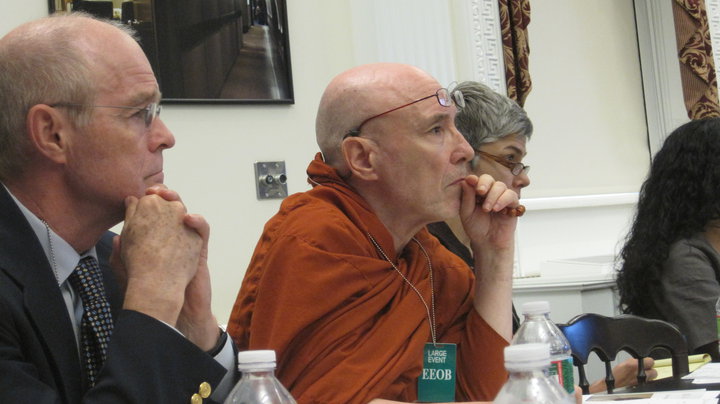
Bhikkhu Bodhi at the White House, July 26, 2010

I’m a fan of Bhikkhu Bodhi in real life, and also on his Facebook page. That’s how I heard about this story which he posted on Facebook this past Thursday, July 29. Buddhist Global Relief is the organization that Bhikkhu Bodhi founded in 2008, dedicated to the mission of providing relief to the poor and needy throughout the world regardless of nationality, ethnicity, gender, or religion.

Buddhist Global Relief at White House Meeting on Interfaith Action Against Poverty

This past month, Buddhist Global Relief (BGR) received a unique honor in being requested to join a task force on interfaith action to alleviate poverty and combat illness around the world. The first meeting of the task force took place at the White House on July 26th. The task force is intended to spearhead the Global Initiative for Faith, Health and Development, an international project guided and organized by the Center for Interfaith Action (CIFA), based in Washington. The Global Initiative was launched in response to President Obama’s call for the world’s religions to collaborate on issues of humanitarian concern. Its objective is to produce a strategic framework for advancing and multiplying inter-religious cooperation on action against global poverty and illness.

The task force brings together the world’s most prominent faith-based relief organizations for the purpose of designing the framework. In appointing the task force, CIFA wanted to broaden the range of the Global Initiative by including delegates from other religions besides the three Abrahamic faiths—Judaism, Christianity, and Islam. After a careful review, they chose BGR as the most suitable Buddhist organization to serve in this role. Though BGR has been in existence for only two years, the organizers were impressed by its significant achievements and the broad reach of its programs during such a short period of activity.

CIFA invited BGR chairperson Ven. Bhikkhu Bodhi and executive director Kim Behan to participate in the first meeting of the task force, held at the White House on the afternoon of July 26th. The meeting opened with words of welcome and encouragement from Rev. Josh Dubois, head of the Office of Faith-Based and Neighborhood Partnerships under President Obama. The conveners of the meeting then gave a broad presentation of CIFA’s plans to increase interfaith collaboration, illustrated by detailed charts and diagrams. This was followed by a lively exchange of views and comments from the members of the task force, with appreciated contributions from Ven. Bodhi and Kim Behan.

In the course of several future meetings, the task force will design a strategy to strengthen the contribution of the religious sector to poverty alleviation and global development. The next meeting will be held on October 4th at the United Nations in New York. This will be followed by a two-day session in November, to be held at the Washington National Cathedral and the White House. At this session, the participants will finalize the design of the strategic framework. The hope is that the framework will create a clear plan of action for different faith communities to work together in addressing the problems of poverty, hunger, and disease.

We at BGR feel privileged to be able to share in this worthy effort. We believe this appointment marks a significant recognition of BGR’s attempts to address the plight of the poor around the world. We hope that by participating actively with other faith-based organizations, we can make a significant difference in the lives of the marginalized sector of humanity.

July 29: Buddhist Love Delegation in New Mexico (and a lot of background story)

Posted on

This Thursday evening, July 29, I’ll be joining with my friend Russ Russell, a Zen priest with the Desert Mirror sangha, to offer a Buddhist presence at the Interfaith Vigil for Immigration Reform in Albuquerque. If any of you reading this are in or near Albuquerque, I hope you’ll join us. Send me an email at maia [at] gmail.com and we’ll figure out how to find each other.

If you’ve been reading The Jizo Chronicles for a while, you’ll know that I’ve been writing about the situation in Arizona ever since the passage of SB 1070, the anti-immigrant bill. This Thursday, the bill goes into effect, which is the reason for the interfaith vigil (as well as a much larger event in Phoenix).

Why does this matter to me so much? I’ve been wondering about that. You know how some issues just grab us and won’t let go, but they don’t have that same effect on other people? This seems to be one of them. I’ve been blogging, tweeting, and Facebook-ing about this, proposing the idea of a Buddhist “Love” Delegation to Phoenix, and a few people responded. But for the most part it doesn’t seem to touch the same nerve in other (mostly white) people that I know.

Then I remembered Mrs. Sanchez. I grew up in Southern California, just outside of Los Angeles. I went to a small Catholic school where I was in the minority – a good 75% of my class was Chicano/a, and I was one of the few white girls. My best friend was Pattie Sanchez and most weekends I would hang out at Pattie’s house. Mrs. Sanchez introduced me to tamales and enchiladas, and watched over me just like I was Pattie’s sister. The Sanchez’s celebrated every milestone along with me and my parents… from First Communions to graduations to family births and family deaths. Their house was really my second home, and they were my family. Mrs. Sanchez was like my second mom.

So I think at some sub-conscious level I’ve been holding Pattie and Mrs. Sanchez and so many of the other people I grew up with in my heart as I’ve been reading about SB 1070 and the likely consequences of it. As I wrote in an earlier post, I feel impassioned to speak out about SB 1070 because:

  • It’s mean-spirited… the opposite of lovingkindness.
  • It’s a massive display of white privilege. The bill mandates law enforcement officers to determine people’s immigration status based on “reasonable suspicion.” What exactly does that mean? If you have brown skin, you’re a suspect. Hey, how about me? I might be an illegal German/Slovenian immigrant. But would anyone ever think of that? Bingo. Racial profiling.
  • It will create a climate of distrust, and will almost certainly prevent people from reporting crimes to the police out of fear of being deported.
  • It’s redundant… the federal government is already responsible for enforcing immigration laws (for better or worse). The way I see it, even if you think that the immigration system in this country needs a major overhaul, this bill is still offensive and injust. (See this excellent interview with Rev. James Ishmael Ford, a Zen priest and a Unitarian Universalist minister, for his take on the bill.)

I’ve had to go through my own process to discern how to respond to this issue, and I want to share some of it with you because I think it’s a good illustration of socially engaged Buddhist practice, at least I understand it.

My first thought was to head to Phoenix on July 29 to join the Day of Non-Compliance there. But I struggled with this plan. There were a lot of factors to consider – it would be a big trip to take in terms of time and money, not to mention the carbon footprint. I thought perhaps I could take the train from Santa Fe to Flagstaff and then get a bus down to Phoenix. All of this felt like pushing against the river, especially in light of the fact that just a few days later, I need to be on full-duty for our core training time in the Upaya Buddhist Chaplaincy Program.

But I was willing to do this even if it felt like it was a big stretch. Then I looked at my ego… how much did I want to be in Phoenix, perhaps participating in civil disobedience, simply to satisfy my identity as “an engaged Buddhist”? I’m not immune to having a big ego and being righteous.

But then again, on the other hand, it truly did feel important to offer solidarity to people in Arizona who will be affected by this bill.

Every day of the past month I’ve gone back and forth with this, not being able to fully commit to going but also not being able to decide it was out of the question. Only in the last week did I finally become clear that I wouldn’t go to Phoenix but would instead make a donation to support Alto Arizona, the group that is doing much of the organizing around this day and immigrant rights.

The day after I made the donation, I saw the news about the Albuquerque vigil on July 29 via Twitter. Finally, the “appropriate response” took shape. Albuquerque is much closer to home – only an hour away. This was a way to take action that felt more sustainable in terms of time, money, my own energy level, and travel. I emailed Russ and she responded back almost immediately that she would join me.

Activist movements are often filled with people who are martyrs to a cause, and with the expectation that we should be martyrs to a cause or we’re not really doing anything worthwhile. I’m not sure this belief system really helps a situation. It’s not that I think we should never get out of our comfort zone… in fact I’m sure that if we don’t, no real change occurs and we never challenge our own ideas of power.

But I also believe that we need to find ways to take action that generate joy and connection, not further suffering. This, to me, is what is at the heart of socially engaged Buddhism.

I have no idea if I got it “right” on this one, but I am looking forward to being in Albuquerque this Thursday night with my dharma friend and “standing on the side of love,” as the Unitarian Universalists put it. Maybe we’ll see you there.

Updates on Gulf Coast and Arizona

Posted on

Two stories that I’ve been following with particular interest over the past couple of months have been the Gulf Coast Oil Spill and the passage of SB1070 in Arizona. Perhaps it’s because both strike me as situations in which our interconnectedness is front and center.

No matter how hard we try, we can’t escape from the fact that along with BP, all of us are in some way responsible for the oil spill that is decimating countless miles of ocean, habitat for water creatures, and livelihood for residents of that area.

And Arizona — immigration is a complex issue. But by labeling some humans as “illegal” and creating laws that cannot but help discriminate against certain groups of people, we are looking right in the face of what the Buddha points to as a prime source of suffering: the delusion that we are separate from one another.

So I’ve been covering responses from Buddhists to both of these events… “bodhisattvas in the trenches.” Here’s the latest update:

The Gulf Oil Spill

Penny Alsop, a student in the Upaya Buddhist Chaplaincy Program, is currently in Grand Isle, Louisiana, on a reconnaissance trip to see what is needed. She plans to return to that area August 19 – 27 and bring a group of volunteer Buddhist chaplains from the U.S. and Canada. She writes:

Coastal communities have been holding their breath for months now:  waiting for oil to land, fearful of both short- and long-term impacts, and waiting for help.  We know good will come from sending chaplains to land on the same shores in suffering communities.  Their gifts of presence and witness will be of service during their visits to the Gulf, and they will bring back real stories of the region to their home communities.

…More volunteers are welcome, as are business partners and individual sponsors.  Our collective outreach can be powerful. If you would like more information about how to join this project, contact Penny directly at penny@3smartgirlz.com.

You can read more about Penny’s efforts here.

Arizona

A couple of weeks ago, I wrote this post where I offered the idea of a Buddhist Love Delegation (riffing off the theme of “Standing on the Side of Love” that the Unitarian Universalists have created) to Arizona to take part in a July 29th “Day of Non-Compliance.” I also sent the idea out via email, Twitter, and Facebook. Only a few people wrote back to me, so it seems like the energy may not be there for this right now.

But if you are interested in going, take a look at this website and see what the UU’s are organizing. They are doing great work to speak out about this situation, as is the organization Alto Arizona.

And if a Buddhist Love Delegation does indeed form to head to Phoenix on July 29, you will be the first to know!

Symposium for Engaged Buddhism Coming Soon!

Posted on

In just a little more than a month, the good folks at the Zen Peacemaker Community will be hosting a fantastic Symposium for Western Socially Engaged Buddhism up in the pastoral beauty of Montague, MA.

The dates are August 9 – 14, and speakers include Roshi Joan Halifax, Roshi Bernie Glassman, Hozan Alan Senauke, Sarah Weintraub, Daniel Goleman, and Paula Green… there are many more great people on the schedule.

Here’s an invitation: I’m not able to be at the symposium, but if any readers of the Jizo Chronicles are going and would like to write some dispatches from the event, I’d be happy to publish them here. Please contact me at maia [at] gmail [dot] com to let me know if you’re interested in serving as our reporter.