RSS Feed

Author Archives: Maia

Peace in Our Hearts, Peace in the World

Posted on

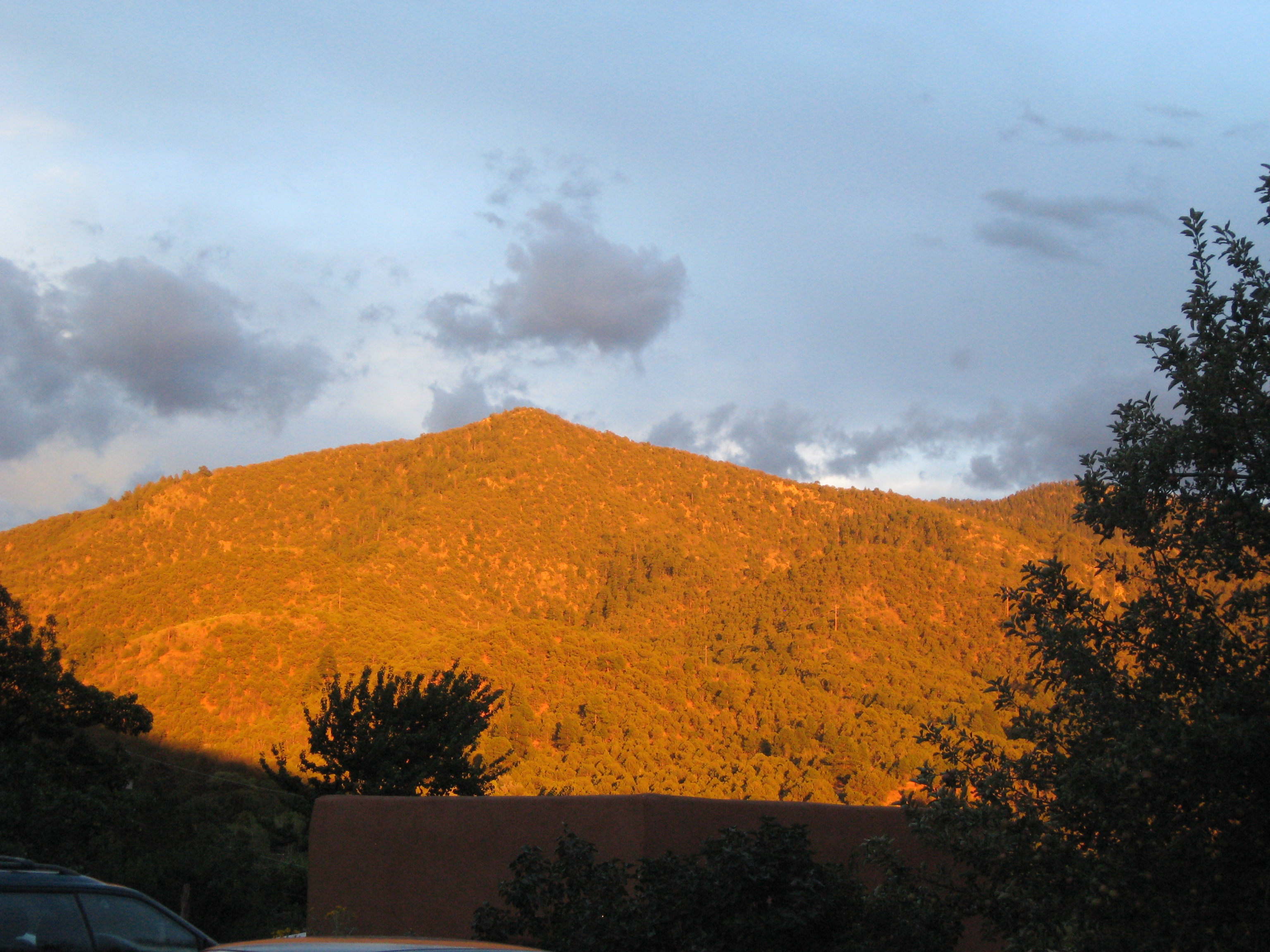
Lots and lots of words have been posted here… so in this moment, I’m going to pause,  take a breath, and share with you an image.

This photo was taken on a recent autumn evening, right outside the front door of my casita (little house) in Santa Fe, New Mexico. The light turns a wonderful golden shade here at twilight… and the mountain you’re looking at is called Picacho (which means “peak” in Spanish). I feel pretty blessed to live here.

Enjoy, and happy autumn!

Quote of the Week: Sayadaw U Kovida

Posted on

This fall marks the third anniversary of the Saffron Revolution in Burma. Although the revolution was not a success in the conventional sense, many monks, nuns, and Burmese people continue to hold hope for that country’s freedom and work toward that goal.

A few months after the Saffron Revolution, Alan Senauke and I had a chance to interview Sayadaw U Kovida, one of the most senior monks of Burma and one of the founders of Sasana Moli — the International Burmese Monks Organization. Sayadaw was 81 years old at the time we spoke with him; he died just a few months later. You can read the full interview here.

One of the questions I asked Sayadaw was, “Do you feel angry at the junta for all the harm they have caused the sasana and the Burmese people? How do you handle anger with your dharma practice?” His response:

At times I feel angry, just like other human beings. But being a son of Buddha, I follow what Buddha taught, and that means metta [loving kindness].

The reason something is happening is because of our bad karma in past lives. We should try to restrain our dosa [anger] by practicing metta instead. This doesn’t mean we are not angry, but every time there is anger, we try to relinquish it by practicing metta.

At first, I didn’t understand why I had to go to prison, because I thought that I had done good deeds all my life like teaching and building pagodas. Then I realized that because all human beings are born into samsara [rounds of rebirth], in some distant past we might have done something bad and this is just now showing up. So instead of forgetting that and getting angry, we can understand that this is what happened in our karma, and we go on with our lives. That was what helped me during those 22 months in prison. Otherwise I would have been angry and wouldn’t have survived for long. I taught for more than 50 years.

When I learn about my former students who are being murdered and sent to prison camps, I feel much anguish and pain, because they are related to me. If even people outside Burma, like the BPF members, feel a lot in their hearts, including anger, when they see what is happening in Burma, then you can imagine how the monks in Burma feel who have to directly face this. There is no way there will not be anger. The only thing is how to restrain anger and follow the teachings of Buddha.

Challenging Questions for Engaged Buddhism

Posted on

Okay, we’re going to mix it up a bit today. Lest you think that I am a birkenstock/patchouli-wearing socially engaged Buddhist, it’s important to know that one of my original intentions for the Jizo Chronicles was to give voice to many kinds of engaged dharma, and to demonstrate that it doesn’t all fall into the liberal/progressive camp. And that’s a good thing.

One of the hats I wear is directing the Upaya Zen Center‘s two-year Buddhist Chaplaincy Training Program. I’ve been doing this with Roshi Joan Halifax since the inception of the program in 2008, and it’s one of the most deeply satisfying experiences in my life. One of the students from our first cohort (which graduated this past March) was Dr. Christopher Ford. Chris is a dedicated Buddhist practitioner as well as a brilliant man. A graduate of Harvard, Oxford, and Yale, he served as the U.S. Special Representative for Nuclear Nonproliferation during the Bush Administration and he’s currently a senior fellow at the Hudson Institute. Chris is the author of The Mind of Empire: China’s History and Modern Foreign Relations, and he has a website, New Paradigms Forum.

Chris and I have a lot of affection and respect for each other, even while our perspectives on a number of political issues are often quite different. But I have to say, one paper that Chris wrote while in our program — called “Nukes and the Vow: Security Strategy as Peacework” — really caused me to question a number of my own assumptions, both about nuclear disarmament as well as engaged Buddhism.

Because I know Chris well, because we have practiced alongside of one another, and because I have tremendous regard for both his meditation practice as well as his extensive experience working in the world of government policy and diplomacy, I really sat with challenging questions he posed in this paper. One of Chris’ points is that even as peaceworkers, we should be very wary of being absolutists and “theologizing” the idea of total nuclear disarmament.  He goes on to explore why abolition of nuclear weapons may not be the “skillful means” that advocates of nonviolence think it is.

I’m posting two short excerpts from the piece below. It’s a long article, so I’m including a link to the full version as a Word document here: Nukes and the Vow. I hope you take time to read all of it because one piece builds upon another, and it’s important to have the whole context of what Chris is saying.  I’m curious to hear what you think about all this, and I send a big bow to Chris for his great heart/mind.

It is relatively easy to vow to save all sentient beings; it is much harder to figure out how best to do it. Engaged Buddhism – that rich field of action in the world that devotes itself to the alleviation of suffering by trying to address unhealthy patterns and structures in human social life – aims beyond merely the transformation of individual hearts. It aspires also to systemic transformation. This inescapably entangles it, however, with quite conventional issues of public policy….

In Buddhist peacework, our lodestar should be fundamental human security, rather than the talismanic presence or absence of nuclear devices per se. If we cannot be reasonably confident of real security in a nuclear-weapon free world, it might be better to have a world with nuclear weapons but in which we can have more such confidence. Depending upon our assessment of the anticipated conditions, in other words, it might be possible to make a Buddhist argument for the retention of nuclear weapons as one constituent element of the global security system. Make no mistake: I do not make such an argument here. Nevertheless, it may be incumbent upon all Engaged Buddhists to be at least alive to this possibility. As the saying goes, the devil is in the details; we should not let either pro- or anti-nuclear knowing get in the way of our employment of skillful means for the alleviation of suffering in this complicated and messy world of international political samsara.

Quote of the Week: Hozan Alan Senauke

Posted on

Alan Senauke is one of the people most responsible for bringing forth socially engaged Buddhism in the United States over the past 20 years.

Alan is a Soto Zen priest who received dharma transmission from Sojun Mel Weitsman in 1998, and currently serves as vice-abbot of Berkeley Zen Center. He came to Buddhist practice after being deeply involved in the civil rights and peace movements, including being part of the 1968 Columbia University student strike.

I was lucky enough to work with Alan directly at the Buddhist Peace Fellowship during his years as executive director there (1991 – 2001), and then afterwards when he served as a special advisor to many of BPF’s projects, particularly international efforts in Burma and other parts of Asia. He went on to found The Clear View Project, a nonprofit organization dedicated to creating Buddhist-based resources for relief and social change.

Alan is smart, compassionate, down-to-earth, and utterly grounded in the Buddhadharma. To me, he is the embodiment of someone who has fully integrated what it means to take loving, compassionate action in the world. Alan’s new book, The Bodhisattva’s Embrace: Dispatches from Engaged Buddhism’s Front Lines, has just been published, and I highly recommend it. And he also happens to be a damn fine bluegrass musician.

Here’s this week’s short quote from Alan:

…Recognizing unity, even in the midst of difference and turmoil, is the essence of peacemaking.

And when you have time to read and digest it, here is that same quote within a longer selection — this is the beginning of Alan’s beautiful essay titled “Vowing Peace in an Age of War,” which he wrote in 1999 for the Dogen Symposium at Stanford University.

San Quentin Prison sits on a bare spit of land on San Francisco Bay. This is where the state of California puts prisoners to death. The gas chamber is still there, but for the last five years executions are done by lethal injection in a mock-clinical setting that cruelly imitates a hospital room. Five hundred seventeen men and ten women wait on California’s death row, often for fifteen or twenty years. The voting public supports this state-sanctioned violence. In fact, no politician can get elected to higher office in California without appearing to support the death penalty.

On a stormy evening in March, several hundred people came forward for a vigil and rally to protest the execution of Jay Siripongs, a Thai national and a Buddhist, convicted of a 1983 murder in Los Angeles. Sheets of rain and cold wind beat on everyone gathered at the prison gates: Death penalty opponents, a handful of death penalty supporters, press, prison guards, and right up against the gate, gazing at San Quentin’s stone walls, seventy-five or more Zen students and meditators bearing witness to the execution, sitting in the middle of anger, grief, painful words, and more painful deeds.

My robes were soaked through and my zafu sat in a deepening puddle. Across a chain link fence, ten feet away, fifteen helmeted guards stood in a wet line, rain falling as hard on them as on ourselves. I felt a moment of deep connection: Black-robed Zen students sitting upright in attention in the rain, protecting beings as best we know how; black jacketed police officers standing at attention in the rain, protecting beings as they know how. Is there a difference between the activities and mind of Zen students and prison guards?

Yes, of course. But recognizing unity, even in the midst of difference and turmoil, is the essence of peacemaking. And I imagine there were guards who had the same awareness.

Our witness at San Quentin is part of a great vow that Zen persons take. Bearing witness is the Bodhisattva’s radical act of complete acceptance and non-duality. My own understanding of Dogen Zen leads me to active resistance and social transformation. I vow to bear witness where violence unfolds. I vow to recognize the human capacity for violence within my own mind, acknowledging conditions of greed, hatred, and delusion that arise within me.

I take true refuge in Buddhadharma, and seek to resolve conflicts. I vow never again to raise a weapon in anger or complicity with the state or any so-called authority, but to intervene actively and nonviolently for peace, even where this may put my own body and life at risk.

Who will take this vow with me? Am I really ready? Are you? We offer heartfelt vows over and over again in the zendo. Dogen Zenji and all buddha ancestors are with us in that sacred space. I know it is stretching a point to characterize Dogen or Shakyamuni Buddha as engaged Buddhists. But all buddha ancestors teach us that the dharma is our own experience.

Let us wake up to what is wholesome in the world. Remake Buddhism for this time, this place, this circumstance. In that spirit we can raise our voices in a vow that fits our season. May we realize our vow in action, and step forward from the top of a hundred foot pole…

Buy "The Bodhisattva's Embrace" at Powells.com

October Engaged Buddhist Events: Sit, Walk, and Celebrate!

Posted on

I just added three new events to the Engaged Buddhist calendar for October… one involves sitting, one involves walking, and one is pure celebration.

Full details are on the calendar page on this site; here’s the short version:

  • Oct 2: The Peace Pagoda’s 25th Anniversary in Leverett, MA
  • Oct 16: 10,000 Steps to Help Feed the Hungry organized by Buddhist Global Relief and Bhikkhu Bodhi, in South Orange, NJ
  • Oct 17: Sidewalk Sit: Contemplative Communities Against Prop L in San Francisco

Practicing Peace at Ground Zero

Posted on

There’s a great post by Patrick Groneman over at the Interdependence Project website about the Bearing Witness vigil that took place near Ground Zero in New York City on the ninth anniversary of September 11, 2001. The small group of meditators had to make their way through two very vocal opposing forces — those in support of the proposed mosque/Islamic community center and those against it.

An excerpt from Patrick’s post:

After the first two minutes of sitting and following my breathing I broke into tears –all I could feel and hear was pain, and it was so deep, and so pervasive. My own fear and sadness became indistinguishable from the pain and suffering of those around me. Like a nursery of babies crying for our lost mothers, it seemed like we were all there looking for a way to express our sadness and fear to each other, but instead it came out in anger:

“Faggot” “Racist” “Idiot” “Hippie” “Biggot” “Terrorist” “U-S-A!!”

Like bullets the protesters shot words at each other, considering it a victory if they got shot back at, finding solidarity not in peace, but in perpetuating the energy of argument. No real conversation about sadness, grief, fear or anger could take place in this environment, there was no space for healing.

The longer we sat, the more people became curious abut what we were doing – cameras were clicking, people were asking us what we were trying to accomplish. One passerby yelled:

“This is New York, don’t just sit there…stand up and say what you believe in”

You can read the whole post here. Thank you for your practice, Patrick.

Ten Guiding Principles for Socially Engaged Buddhism

Posted on

I think it’s time to bring out this piece, developed by my friends Diana Winston and Donald Rothberg. It seems like there are a number of people in the blogosphere who are questioning the whole notion and point of socially engaged Buddhism (see for example this post from The Reformed Buddhist and this one from Point of Contact)  — is it really any different than someone with liberal politics who slaps a Buddhist sticker on to their beliefs and then heads out to a protest?

I think the answer is yes. There’s a qualitative difference. Diana and Donald have done a good job of distilling the qualities that characterize socially engaged Buddhism.

And by the way, in the near future I’m going to post an article that I believe will demonstrate that socially engaged Buddhism is not always synonymous with a liberal/progressive political stance. That should be interesting.

*********

Ten Guiding Principles for Socially Engaged Buddhism

by Diana Winston and Donald Rothberg

1. Setting Intention, Clarifying Motivation:
Our actions can be dedicated to the benefit and awakening of all beings. Keeping this intention in mind helps our actions to go beyond mere “do-gooding,” fighting so-called oppression, or just “getting things done,” into the realm of dharma practice.

2. Interbeing and Co-Responsibility:
We look at our tendencies to separate “us” and “them,” and “inner” and “outer.” We see in ourselves the same structures of greed, hatred, and delusion that we seek to change. We realize that there is ultimately no “other” to fight against, yet we also recognize that some are indeed in positions of greater responsibility for suffering and oppression.

3. Not Knowing, But Keep Going:
Our work is to remain open to what is unknown, mysterious, and confusing, and to avoid easy answers and habitual views. Maybe we’re wrong or incomplete. We cultivate the ability to listen openly, to hold the multiple questions and perspectives that arise, and to be present with whatever is coming up.

4. Opening to Suffering:
In our meditation practice, we learn to be present in the face of suffering, working through out reactivity, denial, avoidance, and fears, and exploring and transforming the roots of suffering. We bring this skill outward, not turning away from the suffering and injustice that we find in our families, communities, work, society, and world. Our action comes increasingly out of our compassion.

5. Acting from Equanimity:
Can we bring equanimity–the state of even-mindedness and balance–to all our actions, balancing acceptance and understanding of the present moment and its causes and conditions with compassion and the intention to respond to suffering?

6. Being Peace:
Thich Nhat Hanh says that “peace is every step.” We are careful in balancing task- and process-orientation, ends and means. Beyond ideological differences, we share a commitment to be in ourselves that which we are trying to bring about in the world–peace and freedom.

7. Mindfulness and Presence in Action:
Open, mindful awareness is the fundamental nature of our being. How can we cultivate this presence in our actions in any domain, and cut through tendencies to be distracted, to be caught in fixed views and habitual patterns of thought, body, and emotion?

8. Embracing Paradox:
How can we hold in creative tension what often seem to be contradictory perspectives–that all is “as it needs to be” and that we feel deeply moved to respond to suffering, that we are both personal and universal, that nothing needs to happen and that everything needs to happen?

9. Devotedly Do… Without Attachment:
In our practice, we learn of the roots of suffering in compulsive attachment to objects, experiences, ways of doing things, views, and outcomes. Yet non-attachment does not mean complacency, passivity, separation from life, lack of commitment, or non-doing. We have to act. Action that comes from clear seeing and an open heart can be deeply committed, yet without attachment.

10. Loving Kindness: Taking Care of Ourselves, We Take Care of the World:
Like the parent who uses the mask in an airplane emergency first, before helping the child, we need to attend to our long-range well-being. We need to attend to the signs of burnout of resentment. Cultivating our own awakening and joy, we may truly be of use, and naturally seek the well-being of others.

___________________________________

If you enjoyed this post, I invite you to visit my other website: The Liberated Life Project — a personal transformation blog with a social conscience.
San Bruno Explosion: How You Can Help

Posted on

Image via marlasinger333 on Flickr.com

This post is primarily for readers from the San Francisco Bay Area. If you want to help people who were affected by the terrible explosions in San Bruno, CA, here’s a list put together by Laura Mason of the website 7×7. At least four people were killed in the blast, caused by a gas line leak, and dozens have been left homeless.

Save San Bruno, Get A Haircut! On Wednesday, September 22nd, band together and help our neighbors by attending Save San Bruno: A Cut for Charity, an all-day hair-cutting extravaganza hosted by Johnny Bueno and his stylists Jeremy Jenks and Guf Gufler. Starting at 9am until 7pm, Johnny Bueno Color Studio will donate $75 or 100% of any haircut to the Silicon Valley Community Foundation’s efforts to help the San Bruno explosion’s victims. Clients can expect to be fully pampered with a new ‘do, along with helpings of Blue Bottle coffee and mini cupcakes from Miette. @ 166 Geary St., Suite 1005. (415)362-2668.

The SF Giants have big hearts. They’re dedicating tomorrow’s home game against the LA Dodgers to the victims of the San Bruno fire, and are donating $3 of every ticket to relief efforts. They will also be accepting donations from fans at that came to donate to the cause. Click here for details.

The Salvation Army got a head start on their relief efforts by sending out mobile kitchens to offer cold drinks and food for those fighting the San Bruno fires while providing counseling for displaced families. To keep their relief going strong, donate money so they can buy supplies most necessary for those in crisis. Needless to say, 100% of these Salvation Army San Bruno Disaster Relief Fund proceeds go to help those affected. Click here for ways to pledge money.

Wells Fargo and Safeway, both of whom have already contributed thousands of their own money, are accepting donations to give to the American Red Cross’ efforts to help affected families. Through the end of September, you can donate money to San Bruno’s families at all Wells Fargo ATMs in San Mateo County. To help out while grocery shopping, you can donate money at any Safeway checkout stand in one of their 80 participating stores around the Bay Area.

The Jewish Community Federation is also on the front lines of relief efforts with financial and volunteer assistance. They are accepting donations, all of which will go to the most effective service providers in the area. Click here to make a donation. If you live in the area and would like to donate supplies, bring diapers, blankets, shoes, towels, kid’s clothing to the San Bruno Recreation Center at 251 City Park Way in San Bruno.

If you want to donate blood, Blood Centers of the Pacific are accepting donations this weekend and in the following weeks for victims. They’ve extended their hours to accomodate the outpouring of recent donations. Two of their donation centers in the city are at Irwin Center at 270 Masonic Ave., and at Downtown Center at 250 Bush St. For additional donation centers and their hours around the peninsula and in the East Bay, click here.