
RSS Feed

Author Archives: Maia

A New Year

Posted on

Happy new year to everyone! I hope that your holidays were both energizing and relaxing for you.

I am just getting back into the blog rhythm again, hence the absence of entries over the past week.

January 8 is the big “Buddhist Blog Swap (part 2)” initiated by Nate DeMontigny, author of Precious Metal. So, tomorrow will be all topsy-turvy in terms of where things are… I’ll have a post up on Home Brew Dharma, and the author of Zenfant’s home for dirty dharma will have an article here, among other happenings. Should be an interesting day!

See you then…

Bearing Witness in Gaza

Posted on

Emerging from my holiday blogging break, because this seems like an important story to share.

If you haven’t yet heard about it, over the past few days a long-planned Gaza Peace March has been gathering in Cairo, Egypt, to walk in solidarity with Palestinian people and to call for an end to the siege of that territory. However, out of the 1,400 people who have come to march (many of them faith leaders), only 100 were being allowed across the border by the Egyptian government.

One of those people is angel Kyodo williams, who is currently on sabbatical from her role as director of the New Dharma Community and the Center for Transformative Change. angel is a Zen Buddhist priest and the author of Being Black: Zen and the Art of Living with Fearlessness and Grace.

In the post below, angel writes about the on-the-ground challenges of being a peacemaker.  I bow to her courage and willingness to look deeply at her own intentions in a very heated situation, and for exploring what it means to be peace. These are her words:

********************

northern Sinai, Egypt. 7:50pm [posted Dec. 30, 2009]

here we are on the road to Gaza.

i am one of what ended up being 65. i was included in the original 100. i got the news that I was selected last night at 9pm. “pack your bags” my friend and coordinator of the media team said. “you’re on the list. you’re going.”

when they held a meeting to tell everyone, obviously it did not go down easily for many people for many different reasons. over 1300 people impossiblly pared down to 100. and with only two hours to decide and make the selections. it could never be satisfactory. finally and still, we the 100 were to meet two buses at 7am.

we packed. wrote last email. some of us slept and woke again. but when we left our rooms at 6:15am, we were met with the news that the organizing team decided they’d made the wrong call in accepting the 100-person proposal without being able to consult everyone, etc. they were very sorry for the pain and challenge it had caused. so we would go to the bus, this perspective of the organizers would be shared and whoever still wanted to go would go.

long story short, the left thing happened. the people that felt we should all go or none of us should go began tactic after tactic to convince people they should not go. that they should get off the bus. that the foreign minister issued a statement saying the 100 chosen were selected because they were not dangerous but the remaining were. that the people would not want us to come. that the entire movement–all of the years of work–would be destroyed if we went.

it was not a conversation. it was not thoughtful. it was not nonviolent.

over the next 3 hours, much shuffling occurred. people getting off the bus. people getting on. people screaming that everyone should get on, screaming that everyone should get off. people just screaming. a few people took turns holding up a hastily scrawled sign that said “Get off the buses. Do you think 100 people represent 1400 Palestinians dead?”

very few of the people that had made it through the passport check already were firm all the way through. neither firmly on nor firmly off. there were a handful, though, that for whatever their reasons–and they were varied–knew without a doubt that they intended to go.

Zainab Salbi, the Iraqi author and leader for women offered, in a dignified and repectful way, “if you are here for humanitarian reasons, you should stay on. if you are here for political reasons, you should get off. they are both right.”

from the time I knew there was unsureness about whether fewer than all should go, I knew that if the bus went, I would go. if not, I would not.

looking into the ony heart that knows, I realize, with all the complexity, that I am not here for reasons humanitarian or political in the conventional sense. I am here by the call of Spirit. I am here as a priest. I am here in my role as a fellow human being Bearing Witness to what too much of the world has ignored for far too long.

so given the choice, if it were at all possible, I would bear this witness with my own eyes, being and heart.

having been a witness, perhaps my Jewish colleagues will no longer send me email telling of how well Palestinians are faring. perhaps when the debates are riddled with charecatuers and hyperbole about either Palestinians or Israelis, I will have the trust of my own, undoubtedly limited experience. perhaps i can be a credible voice that contributes to the voices raised for truth, even if that truth is just my own. and…perhaps the people will not want us there as was suggested by the off-Busers. be that so, I will Bear Witness to that, too.

what I bore witness to today was the hypocrisy that lives in our hearts when we speak of nonviolence, when we speak of choice, when we speak of basic respect. but I rest assured that my crossing the border to say “you are not forgotten” will not destroy a movement towards what we all–humanitarian, political, spiritual–wish for, to see the Gazan people, and through them all people, Thrive.

so I am ON the bus, and on a now-Splintered Road to Gaza. but my heart and my spirit are whole.

salaam.

ps, we just became 75. ten of some 30-odd folks that had come to Al-Arish hoping to get across the border but ending up on house arrest in a hotel were just transferred to our 2nd bus.
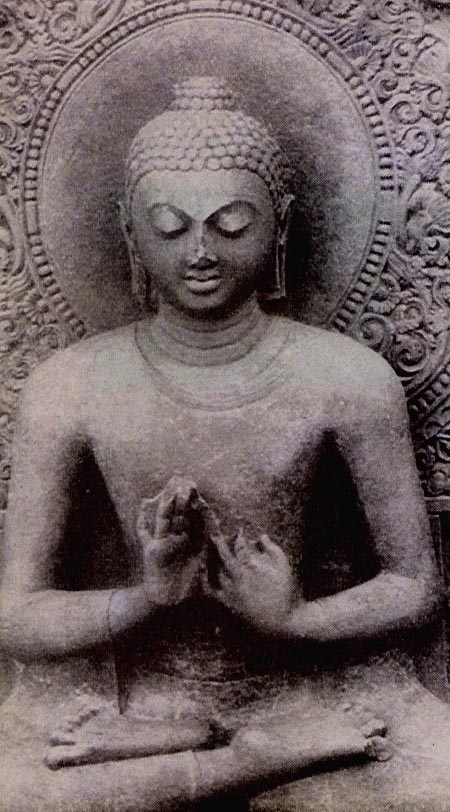
Quote of the Week: Shakyamuni Buddha

Posted on

Yes, this week’s quote is from the original engaged Buddhist, Siddhartha himself. This time we’ll leave out the bio, as I think you know who he is. Here’s the quote, as it appears in the Dhammapada:

“Hatred does not cease by hatred, but only by love; this is the eternal rule.”

To go off on a little side road — a few weeks ago one of the big news stories was President Obama’s acceptance of the Nobel Peace Prize. In his otherwise gracious acceptance speech, the president said, “A non-violent movement could not have halted Hitler’s armies.” This is an argument that many people make when they talk about the possibility of nonviolence as a force for change in the world.

Michael Nagler, a scholar at UC Berkeley and founder of the Metta Center for Nonviolence, does a great job in explaining the holes in this argument and telling the story of a nonviolent resistance action in Germany during World War II that actually did work in this post on Yes! Magazine’s website.

So it seems that Siddhartha was on to something. Nonviolence is not easy, it’s not magic, but it can and has worked in the course of history.

****************

Blog news: I’m taking a little time off from writing the rest of this week to re-charge my batteries. When I return, I’ll be getting ready to participate in a “Buddhist Blog Swap.” I’ll be doing a guest post on Adam Johnson’s blog “Home Brew Dharma” and my blog will be honored to post an entry by Shane Hennesy, the author of the blog “Zenfant.” Should be fun!

Have a wonderful. peaceful new year!

___________________________________

If you enjoyed this post, I invite you to visit my other website: The Liberated Life Project — a personal transformation blog with a social conscience.


Inquiring Minds Want to Know…

Posted on

If you’re a news junkie, you can do no better than bookmarking Rev. Danny Fisher’s Buddhism Beat column on the Shambhala Sun website. Danny filters through all the Buddhist-related news worldwide so that you (and I) don’t have to.

A gander at this week’s issue will get you updated on the news from:

  • Bhutan (the government recently convened a workshop on Gross National Happiness)
  • Burma (Aung San Suu Kyi will meet with three leaders from the National League for Democracy party this week)
  • The Netherlands (the launch of the Dutch Buddhist Broadcast Foundation, “the first independent Buddhist broadcasting foundation in the West to produce and broadcast Buddhist programs within a country’s Public Broadcasting Foundation System.”)

and that’s just a few of the things you’ll learn… Thanks for keeping us updated, Danny!

Quote of the Week: Samdech Preah Maha Ghosananda

Posted on

Maha Ghosananda (1929 -2007) was known as the “Gandhi of Cambodia,” and sometimes as the “Buddha of the Battlefields.” He was born into a poor peasant family in the Takeo Province, located in the southern part of Cambodia.

There was great suffering in Cambodia even then. In the wake of the Depression and World War II, Khmer nationalism began to stir bringing with it social upheaval, riots, and terrorism.

Maha Ghosanada became a novice monk at a young age and went on to study in monastic universities in Phnom Pen and Battambang. Later he studied with Nichidatsu Fujii, the Cambodian Patriarch Samdech Preah Sangharaja Chuon Nath, and Ajahn Dhammadaro of the Thai Forest Monk tradition.

In 1969, the U.S. began bombing Cambodia as part of their attempt to shut down the Ho Chi Minh Trail and end the Vietnam War. Cambodia became engulfed in civil war and social disintegration. Once the Khmer Rouge took power, Pol Pot denounced Buddhist monks as part of the feudalistic power structures of the past. Maha Ghosananda, who was in a Thai forest hermitage during this time, was one of the few Cambodian monks to survive the brutal torture and murders that came after that. His entire family and many friends were killed by the Khmer Rouge. In 1978, he left his forest hermitage in Thailand, and began to minister to Cambodian refugees who came across the Thai-Cambodia border.

In his later years, Maha Ghosanda continued his ministry for peace on an even larger scale. He led a 125-mile Dhammayeitra (pilgrimage of truth) across Cambodia in 1992 to begin restoring the hope and spirit of the Cambodian people. The Dhammayeitra continues to this day.

I was lucky enough to meet Maha Ghosananda once, in 2004 at a Buddhist Peace Fellowship conference in Amherst, MA, not far from one of his communities in Leverett, MA. The moment he entered the room, the more than 150 people in attendance suddenly fell silent. Though he never said a word, he was an incredibly powerful presence and as he bowed to all of us, a palpable wave of joy spread throughout the room.

I’ve had this quote hanging over my desk for many years now and never fail to be moved by it:

The suffering of Cambodia has been deep.
From this suffering comes Great Compassion.
Great Compassion makes a Peaceful Heart.
A Peaceful Heart makes a Peaceful Person.
A Peaceful Person makes a Peaceful Family.
A Peaceful Family makes a Peaceful Community.
A Peaceful Community makes a Peaceful Nation.
A Peaceful Nation makes a Peaceful World.
May all beings live in Happiness and Peace.

~ From the book Step by Step by Maha Ghosananda (Parallax Press, 1991)

Dark Times

Posted on

Moon over Santa Fe, NM

In just a couple of days, it will be the Winter Solstice – the longest night of the year. The other day, I was wondering what it must have been like to be one of the early humans, before there was a body of cultural and scientific knowledge built up to assure us that the light would, indeed, return as we turned the corner on this day and headed once again toward Spring. It must have been terrifying to see the sun drop lower and lower in the sky each day and the night grow longer and longer without really knowing if that trajectory would reverse.

So this is a dark time. And it feels like it, not only astronomically but also the world right now. Health care reform, at least in what I would consider any meaningful form, is for all purposes dead. It seems as though the insurance companies stand to gain the most if the current version of the Senate bill is to pass. The climate summit talks at Copenhagen have stumbled along, revealing just how much the richer nations of the world are determined to not step up to the plate and take needed actions to effectively address global warming. The economy is still in the toilet, and at least 15 million people are without jobs this holiday season (source: US Dept of Labor )

Fortunately, if you try to work with principles of socially engaged Buddhism, all this does not, necessarily, have to feel devastating. Even though it kind of is.

A number of years ago, I was the scribe at a meeting of representatives from Buddhist Peace Fellowship chapters from around the U.S. I took notes as they each described what kinds of actions and events they were organizing in their local chapters, and even more importantly, how they were doing these things.

A whole Mandala came out of this exercise that I’ll share in another post. For the moment, I just want to pull out the six qualities, informed by Buddhist practice, which emerged as ways that these folks perceived and practiced their activism in a unique way.

  1. Looking at an issue through the lens of dharma, questioning the notion of “self” in relation to activism
  2. Recognizing the truth of interconnection
  3. Offering a calming presence
  4. Having patience, being willing to slow down, recognizing the long arc of change
  5. “Being with not knowing,” non-attachment to views and goals
  6. Infusing our activism with bodhicitta, joy

Right now, those last three qualities might be especially helpful for us to remember. I don’t intend to be Pollyanna here, and breathing and smiling will not make the bad situations go away. But to truly be of use and to be effective as we try to nourish a more just and sustainable world, it can be helpful to ground ourselves in these principles. And remember that light and dark are always part of each other.

In the light there is darkness,
but don’t take it as darkness;
In the dark there is light,
but don’t see it as light.
Light and dark oppose one another
like the front and back foot in walking.

~From the Sandokai (Harmony of Difference and Sameness)

What Does Socially Engaged Buddhism Look Like?

Posted on

Here’s one possibility. This one comes from nearly three years ago, January 2007, when about 300 people came together to form a “Buddhist Peace Delegation” as part of a much larger march in Washington D.C. to call for an end to the war in Iraq. Approximately 500,000 people walked for peace that day, though it received little media coverage. I helped to organize the Buddhist delegation, along with my friend and writer Louise Dunlap and others, and it was one of the most inspiring few days of my life.

Our delegation was comprised of Buddhist of all stripes — Pure Land, SGI, Zen, Theravadin, Tibetan — as well as people in the march who gravitated toward us because of the noticeably different energy that emanated from our participants. We had a group of kids leading the delegation, and one of us rang a bell of mindfulness every so often to remind us all to stop a take a breath.

On another day of the weekend long action, a small group of us visited the offices of several Senators and Representatives to have a dialogue about the war. I always remember one of Sen. Harry Reid’s aides telling us that even though the Senator didn’t agree with our request to de-fund the war, it was important that we were out there marching and holding that position because it gave him more leverage to negotiate a more moderate position (gradual withdrawl of troops).

This video was put together by Paul Davis, a photographer, Vietnam vet, and member of the Cincinnati Buddhist Peace Fellowship chapter.

Quote of the Week: Daw Aung San Suu Kyi

Posted on

Aung San Suu Kyi, born in 1945 in Rangoon, Burma, is a Theravadin Buddhist woman and Nobel Peace Prize winner (1991). She has been in detention and under house arrest by the military junta that rules Burma (Myanmar) since 1989.

In 1988, after Suu Kyi had returned to Burma to take care of her mother after years of living and studying abroad, she gave a speech to the Burmese people calling for a democratic government. That same year, the National League for Democracy (NLD) was formed, with Suu Kyi as general secretary.

Throughout all her years in detention, she has been a beacon of hope and  dharma practice under the most dire circumstances for the people of Burma and the whole world. Suu Kyi’s courage rings through in her books and speeches, including this excerpt from Freedom From Fear (Penguin, 1996):

It is not easy for a people conditioned by fear under the iron rule of the principle that might is right to free themselves from the enervating miasma of fear. Yet even under the most crushing state machinery, courages rises up again and again, for fear is not the natural state of civilized man.