RSS Feed

Author Archives: Maia

Stuff to Read

Posted on

I’m slowly adding some of my past articles to the “Writing” section of this blog. Just uploaded one from 2004 called “Impossible Choices: Thinking about mental health from a Buddhist perspective.”

And I’m honored that this blog was named in a list of women Buddhist bloggers on Marguerite Manteau-Rao’s  “Mind Deep.” Thank you!

Jan 7-11, 2010: Mindfulness Retreat with Ouyporn Khuankaew

Posted on

This retreat, to be held in Chiang Mai, is organized by the International Women’s Partnership for Peace and Justice, of which Ouyporn Khuankaew is a co-founder. Khuankaew is a remarkable Thai woman who addresses gender-based violence through her Buddhist practice. In 2006, she was named one of the “Outstanding Women in Buddhism.”

According to the  IWPPJ website,

This 5 day retreat, in a peaceful and quiet village setting, will cultivate wellness and awareness of the body, mind and spirit through:

  • Meditation,  incorporating various meditation techniques and mindfulness practices throughout the day
  • An introduction to socially engaged Buddhist teachings
  • Experiential sharing and personal reflection
  • Daily meditative yoga practice
  • Ample time for rest and relaxation
  • Simple living close to nature

You can find out more information about this retreat here.

David Loy on Obama and Politics

Posted on

David Loy, Buddhist scholar and author of The Great Awakening: A Buddhist Social Theory and other books, has some interesting things to say about President Obama, the military escalation in Afghanistan, and politics in general in a post over on the Shambhala Sun website. An excerpt:

The lesson to be learned from the Obama campaign is that it’s a big mistake to expect the political/economic system to reform itself. People must demand the changes that are needed, a demand that assumes greater awareness of what is actually happening, and greater awareness is where Buddhism comes in. Buddhism is about dispelling delusions and seeing things as they really are, which means that Buddhism may have an important role to play in the great transformations that are needed if humanity and the biosphere are to survive and thrive in the future — a future that looks pretty grim right now.

A few themes in David’s post and the comments that follow it include:

  • The role of a leader, of lobbyists, and of citizens themselves in effecting “radical reformation” in militarism, economics, and other areas;
  • What role did delusion play in our expectations about Obama as a candidate for president?
  • What does it mean for Buddhism and Buddhists to be ‘politically engaged,’ not merely ‘engaged’?

The comment I contributed: “As to politically engaged Buddhism, my sense is that many people (particularly Buddhists) get all weird and phobic about the notion of ‘politics’ when really all it means, in its simplest form, is the use of power. Power itself, just like emotions, is neutral. It is how we work with it that makes it positive or negative, that creates beneficial actions or harmful ones. Power is everywhere, including in Buddhist centers. So to take part mindfully and skillfully in politics can be a practice, just like anything else.”

There’s certainly more to be said about all that, but I’ll leave that for another time.

Warm Hand to Warm Hand

Posted on

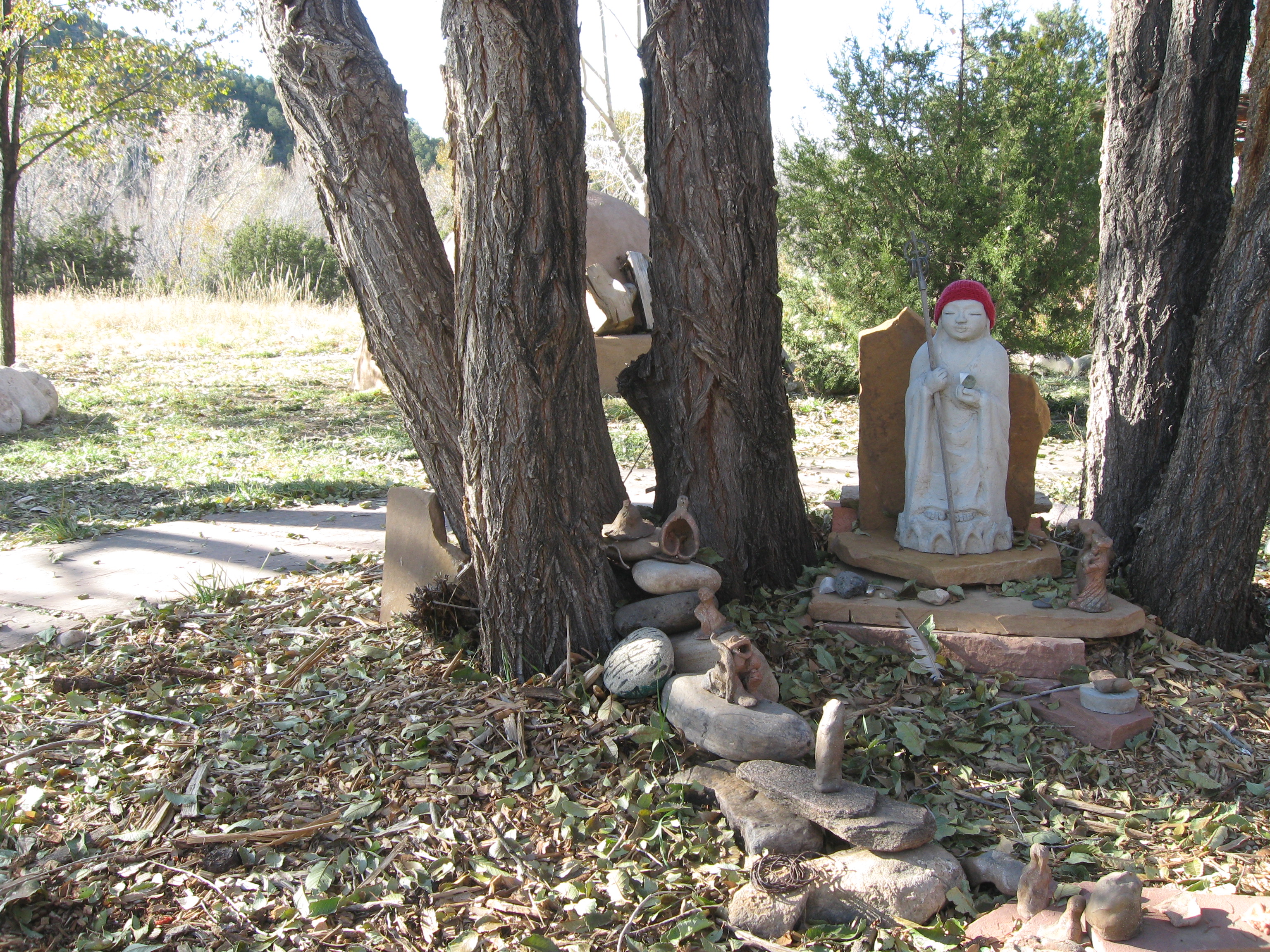
Santa Fe Winter

Happy Bodhi Day to everyone!

Back online again after 7 days of keeping the computer off during Rohatsu. Okay, full disclosure: this was not Rohatsu sesshin the way you Zen folks know it. I did a modified home-based version of sesshin, in order to be more available to my doggie who had an operation the week before.

But I didn’t turn on the computer, didn’t drive the car, practiced zazen at home and sometimes next door at Upaya Zen Center, and helped make several meals in the Upaya kitchen for everyone who was sitting Rohatsu there. Last night, a snowstorm blanketed Santa Fe; it’s wonderful to wake up on the last morning of Rohatsu and see fresh snow everywhere.

Even doing Rohatsu this way, I could feel my practice settle into some deeper places, and was reminded of how spacious life can feel when ‘unplugged.’ I definitely have an addiction to information and knowledge (not the same thing as wisdom!), and this past week was a reminder that I can get seduced into thinking that I’m connecting and engaging with people through all my online activities. But there is a very different quality to connection and engagement when they happen warm hand to warm hand.

I’m no Luddite, and I appreciate the many ways that the Internet has expanded my web of connections and made me aware of what’s going on in many corners of the world and given opportunities to respond. Take, for example, the Saffron Revolution in Burma two years ago — something we only knew about because of the courageous people inside Burma who were able to get out photos and communications via the Internet.

But at the moment, I’m aware of how easy it is for me to get lulled into thinking of the Internet as my sole channel for activism, and how much more balanced and enriching it would be to get engaged more with local issues, with real live people, on a daily basis.

I’m curious how those of you who are online a lot find ways to balance this out in your lives…

Dissing Thich Nhat Hanh?

Posted on

On Sunday, I posted a quote by Ven. Thich Nhat Hanh, who I think I can safely say is one of the world’s most beloved dharma teachers. To get more coverage for this blog, I also ‘tweet’ updates on new postings through the Twitter accounts that I maintain, @fivedirections (for my consulting business) and @UpayaChaplains (an account I run for Upaya Zen Center’s Chaplaincy Program).

Soon that post was  ‘re-tweeted’ from @BarkingUnicorn, preceded with the acronym AYFKM. Once I figured out that AYFKM meant “Are you fucking kidding me?” I was a little surprised… who was this Barking Unicorn and what did he have against my post and/or Thich Nhat Hanh? I decided to ask him, and here’s what he messaged back to me:

What the quote recommends does absolutely nothing to solve the problem, only makes one feel good for no reason. Which is OK.

Remember — all this is going on in Twitter where every correspondence has to be less than 140 characters. It’s great for getting right to the point.

Once I got over my initial ego bruise that someone was dissing my blog, I started to think about this comment some more. After all, it takes chutzpah to critique Thich Nhat Hanh. And I realized, the comment actually gets to the heart of some of my own questions about how to ‘be’ a socially engaged Buddhist.

On the one hand, Barking Unicorn is right — Thich Nhat Hanh’s quote encourages us to take care of ourselves and our minds, and by doing so we will better know how take care of the problem. But that doesn’t directly address the problem. And there are plenty of Buddhists (and others) who take that approach as a cop-out to grappling with some pretty tough issues… it’s kind of like the New Age philosphy: by linking hands and meditating during the Harmonic Convergence, we will make a more peaceful world.

I think there is a missing step. Meditation and mindfulness are wonderful, indispensable practices. If we are socially engaged Buddhists, they must come before anything else…. the energy of our intention is crucial. And yet, I don’t think that can be the end point. We still need to roll up our sleeves, sit down with people from various sides of an issue, and do the difficult work of dialoging, organizing, calling our Congressional representatives, voting, protesting, whatever else is called for to shift society toward more justice and peace.  And then, back to meditation, we need to practice with whatever the outcome might be.

My tendency has often been to skip through the meditation piece and move right to the action, often resulting in not-so-great results and burnout. I’m continually trying to find this balance of action and reflection. Which is why this blog will go dark for the next week, as I return to deep practice once again, to nourish my soul and prepare myself for whatever work is to come. I’ll be sitting Rohatsu sesshin at Upaya Zen Center and at home this week and turning off my computer and phone until December 8.

A bow to Barking Unicorn, whoever you are, for bringing all this up. And maybe the whole point is his last sentence, “Which is OK.” Maybe everything is OK. That will be my koan for the next seven days. In the meantime, let me know what you think about Thay’s quote, which you can find here.

Have a good week!

March 2010: Buddhism Without Borders at IBS

Posted on

The Institute of Buddhist Studies in Berkeley, CA, is planning what looks to be a great conference next March. “Buddhism Without Borders: Contemporary Buddhism in the West” will explore questions such as:

  • How has Buddhism outside Asia been shaped by diaspora and immigration?
  • How has the increase in global tourism, communication, and capitalism affected the way Buddhism is understood, taught, and practiced?

Speakers include Charles Prebish, Richard Hughes Seager, Eve Mullen, Duncan Ryūken Williams, Jeff Wilson, Wakoh Shannon Hickey and many others. The keynote address will be given by Prof. Thomas Tweed, author of The American Encounter with Buddhism and Crossing and Dwelling.
You can find out more about the conference and register here.

Rev. Danny Fisher on “No Buddhists in Washington?”

Posted on

Rev. Danny Fisher posted a thought-provoking article, “No Buddhists in Washington,” on yesterday’s Religion Dispatches website. The premise of the article:

Buddhism, which has a larger US population than either Islam or Hinduism, has had a sizable and growing impact on American culture. So why no representative on the Obama administration’s Advisory Council on Faith-Based and Neighborhood Partnerships?

There actually are, to my knowledge, at least two Buddhists serving in the U.S. Congress — Hank Johnson (Democrat from Georgia’s 4th Congressional District) and Mazie Hirono (Democrat from Hawaii).

But aside from those two names, there really aren’t many self-identified Buddhists in positions of political influence and, as Danny points out, there is no Buddhist representative on President Obama’s Advisory Council on Faith-Based and Neighborhood Partnerships. He makes a good case on what Buddhists might contribute to that effort and suggests names of some excellent potential candidates, including Jack Kornfield, Zenju Earthlyn Manuel, Jan Willis, and Roshi Joan Halifax.

Quote of the Week: Thich Nhat Hanh

Posted on

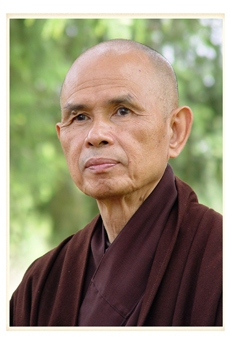
Ven. Thich Nhat Hanh, now 83 years old, is a Vietnamese Zen Buddhist teacher, author, poet, and peace activist. During the Vietnam War, he started the School of Youth for Social Service (SYSS), a neutral corps of Buddhist peaceworkers who went into rural areas to establish schools, build healthcare clinics, and help re-build villages. Because he refused to take sides during the war, he was subsequently exiled by the Vietnamese government. Later, in 1967, he was nominated for the Nobel Peace Prize by Dr. Martin Luther King, Jr.

My introduction to Thây, as he is often called, was in 1996, when I transcribed some of his talks for Parallax Press. At first I could hardly understand a word he said, but after a while I began to attune to his accent and found the act of transcribing his words became a meditation in itself.

This quote comes from one of his first books, Peace Is Every Step (Bantam Books, 1991).

We must be aware of the real problems of the world. Then, with mindfulness, we will know what to do and what not to do to be of help. If we maintain awareness of our breathing and continue to practice smiling, even in difficult situations, many people, animals, and plants will benefit from our way of doing things. Are you massaging our Mother Earth every time your foot touches her? Are you planting seeds of joy and peace? I try to do exactly that with every step, and I know that our Mother Earth is most appreciative. Peace is every step. Shall we continue our journey?