RSS Feed

Author Archives: Maia

Occupy Wall Street: Buddhist Voices

Posted on

10:00 pm update: Please make sure to read the comments underneath this post — I’ve added a few more article and videos. Also please see the Calendar of Events.

The movement to Occupy Wall Street (OWS) has been building for the past month. Until just recently, there were very few Buddhists writing on the subject.

Over the past week, I’ve come across a number of essays and statements on OWS coming from Buddhist voices. I’m sharing and summarizing the ones I’ve found below – if you have more to add to this list, please write in the comment section.

Some of these will be featured in next week’s Upaya Zen Center e-newsletter, which always includes fascinating and provocative articles from the dharma world (and beyond).

• Chris Wilson, president of the Buddhist Peace Fellowship board of directors, compares OWS to the Arab Spring and states that BPF endorses OWS  “based on our agreement that the influence of money in politics is blocking many of the social justice and environmental goals that BPF promotes. It is also based on the fact that Occupy Wall Street has made nonviolence one of its primary commitments and thus far has kept that commitment.”

Read more here: http://bpf.org/what-buddhists-are-saying/occupy-and-arab-spring

________________________

• In “We Are the 100%,” Ari Pliskin of the Zen Peacemakers offers a “mindful response” to OWS. Drawing on the precepts and particularly this one: “When peacemakers vow to be oneness, there is no Other,” Ari’s piece makes the case for a non-dualistic view of the current situation.

Read more here: http://www.elephantjournal.com/2011/10/we-are-the-100/

________________________

• Madrone Phoenix, a dharma practitioner based in Providence, RI, shares her experience visiting OWS in New York last week, and she reflects on her earlier experiences as an “angry activist” and how her Buddhist practice over the past few years has impacted her way of being involved in this movement. She writes, “i woke up to the notion that to occupy a place – to infuse it with kindness, consideration and deep love for all – is the place where liberation truly occurs whether in our minds, or in our streets.”

Read more here: http://cultivatefearlessness.blogspot.com/2011/10/waking-up-from-american-dream.html

________________________

• Michael Stone, a yoga and meditation teacher based in Toronto, also visited NYC last week. He offers his perspective in an article titled, “Remaining Human: A Buddhist Perspective on Occupy Wall Street.” In it, he focuses on the ways in which this nascent movement is striving to be the change it wishes to see, through a commitment to nonviolence and a collective decision making process. Michael writes, “We need a language now that allows us to reimagine what a flourishing society looks like. Any meditator knows that there are times when the thoughts that stream endlessly through awareness can eventually grow quiet. But it’s only temporary. The stories come back. But they return differently. They have more space and they are –more fluid, less rigid. We need stories to think and make sense of a world – now an ailing world that needs us.”

Read more here: http://torontobodymind.ca/articles/remaining-human-buddhist-perspective-occupy-wall-street

________________________

• Rev. Zenju Earthlyn Marselean Manuel, past executive director of the Buddhist Peace Fellowship and Zen priest based in the San Francisco Bay Area, notes the troublesome connotations of the word, “occupy.” She writes, “The word brought up visions of invasion, people marching in to take over.  I also saw a consciousness of us holding down specific territories (turfing) that seems to persist as the way to conquer.”

Read more here: http://zenjuearthlynmanuel.com/2011/10/09/un-occupy-the-land/#more-1451

________________________

• The Rev. James Ford, who has the distinction of being both a Unitarian Universalist minister and a Zen priest, begins his piece by echoing the words of Harvey Milk: “I’m here to recruit you.” Rev. Ford’s lengthy meditation, which he originally delivered as a sermon, weaves together themes from the Jewish holiday of Yom Kippur (a day of atonement) with political and economic analysis, but his main point is clear: get involved. He writes, “Sometimes you have to be outside. Sometimes you have to stand up. And sometimes you have to shout. You have to make demands that may be uncomfortable to the status quo. The Vietnam war ended for many reasons, but one principal among them were the people willing to mass together, take some tear gas, and bear witness to another way.”

Read more here: http://monkeymindonline.blogspot.com/2011/10/american-autumn-yom-kippur-meditation.html

Interview: Arun of “Angry Asian Buddhist”

Posted on

This is the second in a series of monthly interviews that I’m sharing with inspiring and interesting socially engaged Buddhists of our time. For the first interview with Ven. Bhikkhu Bodhi, please click here.

Today our guest is Arun, the author of the blog Angry Asian Buddhist. While Arun and I have never met in person, for the past year I’ve admired his writing from afar and appreciate the intelligence and honesty he brings to conversations about Buddhism, race, politics, and more. I’m grateful that he took the time to correspond with me and engage with these questions.

JC: Where do you call home?

Arun: Los Angeles is where I currently live, although as a fourth generation San Franciscan, I must say that my home will always be by the Bay.

JC: What are you reading right now?

Arun: Understanding Comics: The Invisible Art by Scott McCloud. I spend very little time reading books about Buddhism, although I am hoping that this book will help me launch a creative expression program at a local temple. This book has done a great job at challenging my notions of both “creative” and “expression.”

JC: Who inspires you – Buddhist teachers, activists, writers, artists…

Arun: There are so many individuals who inspire me, from family to friends to strangers long before my time. These days, one of my greatest inspirations is my friend, co-blogger and fellow temple committee member who blogs under the pseudonym “John” at Dharma Folk.

I have known John for six years. In that time I have had the pleasure of watching him grow into being an enormously influential Buddhist community leader. John inspires me with his kind and effective leadership, commitment to practice and mastery of writing, such that I am always learning from him when I am around him. I could write pages of praises about John, but suffice it to say that he is one of the most inspirational people in my life.

JC: What social issue is close to your heart right now?

Arun: There are several social issues close to my heart, but in the Buddhist blogosphere, I am perhaps most well known for my discussion and exploration of the marginalization of Asian Americans in American Buddhism and, more broadly, Western Buddhism. This sort of marginalization takes many forms. We are repeatedly excluded from the Western Buddhist narrative and often reduced to immigrant caricatures when included. Our communities and practices are denigrated wholesale as retrograde, foreign or inferior. Even our grievances on this very issue are invalidated, such that our arguments and observations are portrayed as achieving nothing more than division and discord.

The heart of the problem is that these actions dissuade Asian Americans from embracing Buddhism. Our exclusion tells us that the we are irrelevant. The denigration of our communities tells us that we will not be accepted for who we are. The silencing of our protests tells us more clearly than anything else that there are yet people in Western Buddhism who believe not that marginalization is the problem, but that we are the problem. The vast majority of Western Buddhists, hundreds of thousands of whom are Asian, abhor racism and firmly support the principles of fairness and equality—and yet this marginalization so regularly recurs.

JC: How does your dharma practice inform your involvement on that issue?

Arun: On this specific issue, my involvement is rooted in the practice of community. I have spent weeks struggling over this question, but it all boils down to the importance of cultivating community. Even when I blog as the Angry Asian Buddhist, I do so as part of the community of Buddhist bloggers and more broadly as a Western Buddhist and a Global Buddhist. Community involvement challenges me to acknowledge a vast array of deeply ingrained habits that are easy to ignore on the cushion. Not only that, this involvement broadens my understanding of the wonderfully diverse Buddhist community in the West and the many different ways that I can help strengthen the practice of the Dharma within these communities.

JC: If you could invite people to join you in taking one action on that issue, what would it be?

Arun: I would encourage readers to engage more with Asian American Buddhists. You can even interact with us online. Just recently I began following the group blogs of the Young Wisdom Project and dharmas, both of which include a number of young Asian American Buddhist bloggers.

JC: What else would you like people to know about you?

Arun: I would love for people to know that the “angry” in Angry Asian Buddhist is an homage to the Angry Asian phenomenon, of which the Angry Asian Man and the Angry Little Asian Girl are the most famous examples. Our names speak to the stereotype of Asian Americans as passive and submissive, and my blog title speaks to the same stereotype held for Asian American Buddhists. Even while I do get angry, the point of my blog is not to glorify anger. Even from a young age, my father taught me that anger is something over which we each have ultimately responsibility, and this sort of teaching is at the heart of my Buddhist practice. “All living beings are owners of their actions, are heirs to their actions, born of their actions, related through their actions, and live dependent on their actions.”

________

Thanks to Arun for taking time to be part of this interview series!

The Greatest Wealth is contentment: A Buddhist Perspective on Poverty (David Loy)

Posted on

Via Scoop.itSocially Engaged Buddhism

A reflection by David Loy…
Show original

Meditating on Wall Street [video]

Posted on

I’ve been waiting for this to happen…

Here’s a video from Day 12 of the occupation of Wall Street. The gentleman giving the contemplative pep talk is businessman and Hip Hop artist Russell Simmons, who is also an avid yoga practitioner.

I’m still wondering if there is any kind of organized Buddhist presence at these protests… if you know of anything, please leave a comment below.

Good Stuff You Should Know About…

Posted on

A collection of things that have been piling up to share with you…

♦ New Book by Zenju Earthlyn Manuel
Zenju Earthlyn Manuel,
past executive director of the Buddhist Peace Fellowship, has just published a new book: Tell Me Something About Buddhism. Larry Yang writes about the book: “Zenju Earthlyn Manuel’s book is a lyrically written description of how the Teachings of the Buddha are relevant to all communities in our contemporary world. Her words are simple and yet penetrating, covering philosophy, technique, and the ineffable qualities of experiencing a spiritual life.” You can find it here at the Powells online bookstore.

Thich Nhat Hanh to Offer Mindfulness Retreat for Members of Congress
My friend Louise Dunlap writes, “Those of us longing for a more mindful congress might want to join this effort to urge our senators and congresspeople to attend a short retreat in October with Thich Nhat Hanh. Even though this is not a directly political tactic, I think it can make a difference. Especially if you are already in touch with legislators or their staff (who are also invited), perhaps you can pass on this invitation and urge others to do so too.”

You can find more information about this event here on the Plum Village website.

Urban Retreat in Providence, RI
Acharya Fleet Maull
will be offering a year-end 7-day retreat through the Shambhala Center in Providence, December 26 to January 1, 2012. From the description: “Acharya Maull’s teachings will focus on the integration of meditation practice and spiritual evolution with the realities and needs of daily life and our shared aspiration to create a healthy, sane, and sustainable society for ourselves, our families, and future generations.”

I know Fleet from his involvement in the Upaya Buddhist Chaplaincy Program; he’s a wonderful teacher and I hope some of you will be able to participate in this. For more info, see: http://www.shambhalasun.com/news/?p=23426

Scoop It!
I’ve been experimenting with a new online tool for curating articles on socially engaged Buddhism that I find around the Internet. It’s called “ScoopIt” and you can see the page I created here. I’ll be curious to know if you find this interesting, useful, inspiring, or none of the above : )

Bodhisattvas in the Trenches: A Zen Priest at the Tar Sands Action

Posted on

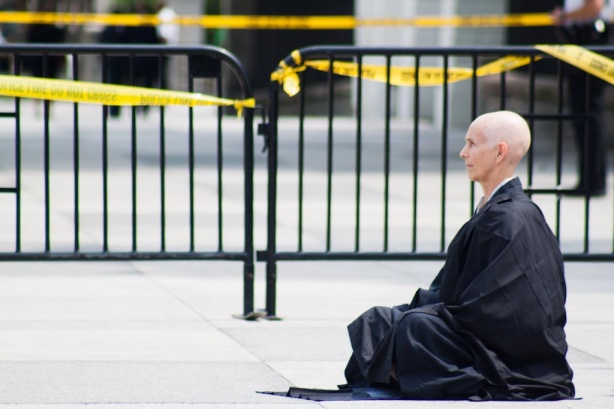
Shodo Spring sits outside the White House / photo courtesy of tarsandsaction

This is a guest post from Shodo Spring, a Zen priest who has dedicated her life to socially engaged Buddhism. Shodo is a trained therapist, mother of two, and grandmother of four, who received priest ordination from Shohaku Okumura. She recently sent me this account of her time in Washington, DC, where she took part in the Tar Sands action, and I wanted to share it with all of you.

___________________

Leaving Washington after ten days in front of the White House, I ride the train through hills and mountains – Maryland, West Virginia? I look out on trees, rocks, river as: wide river, shallow with rocks, winding, here and there a small island;  now an old stone building, a wide field, a farm; now trees again, roads, farms. “Beautiful,” I think. There’s a bit of mist, now turned to rain streaming down the windows. Across the aisle a baby is entertained by his mother.

This is what it is about: that life should continue.

Read the rest of this entry

The Window

Posted on

There is this moment, often just a split second, between the time something happens and our reaction to it.

Anything can happen in this moment. Whatever does happen turns the wheel of karma.

In the moments and days after September 11, 2001, there was an open window for those of us here in the U.S., a time when we were stunned by what happened and we hadn’t yet reacted, as a nation. And then the window closed, in the form of a formal declaration of war on Afghanistan (and subsequently Iraq).

But before that, can you remember?

Read the rest of this entry

The Robe Chant (slightly edited)

Posted on

Vast is the robe of liberation

A formless field of benefaction

Wearing the Tathagatha’s teaching

Loving all sentient beings

_________________

photo: Sunrise in Sukhothai, Thailand