RSS Feed

Category Archives: Ruminations…

Holiday Shopping: Donkeys, Dharma, and more

Posted on

[Originally posted on The Jizo Chronicles last year, but this seems timely to share again.]

There are all kinds of ways to deal with the upcoming holiday shopping season. One is to buy nothing on the day known as “Black Friday,” an action pioneered by Adbusters. Gary Gach gives a  dharma perspective on “What Would Buddha Buy?” (the answer: not too much, not too little).

Another approach is to take part in the cycle of giving and receiving, but to do it in a way that may be of benefit to others. Generosity is, after all, one of the basic Buddhist virtues.

If living beings knew the fruit and final reward of generosity and the distribution of gifts, as I know them, then they would not eat their food without giving to others and sharing with others, even if it were their last morsel and mouthful.
~ Avadana Jataka

I am a big donkey lover. I’m not sure I can even tell you why, but I am. So, last holiday season, I was tickled pink when a friend of mine sent me a donkey as a gift. The only catch was that my donkey was actually given to a farmer in Darfur, on my behalf, through Oxfam America. It turns out that donkeys are a key piece of helping farmers there to become more self-sufficient. The donkeys can transport materials, help with cultivating the fields, and they can also be hired out to others. It was one of the best gifts I’ve ever received.

If you’re looking for a way to give a gift that does more than gather dust and may make a difference in someone’s life, here’s a list of suggestions starting with two that have an impact in Buddhist countries:

• Adopt a Monk or Nun from Burma’s Saffron Revolution
The Clear View Project invites you to “Adopt a Monk” to help bring attention to the false imprisonment of the monks and nuns in Burma. The Assistance Association for Political Prisoners of Burma (AAPPB), reports that when the international community shines a light of attention on particular prisoners, their lot improves.  When one prisoner’s life improves, hope is restored.

• Sponsor a Tibetan Nun
Through this sponsorship program, the Tibetan Nuns Project supports over 700 nuns living in northern India. For less than $1 per day, sponsors can provide a nun’s basic necessities. One hundred percent of sponsorship money goes directly to India to meet the nuns’ living expenses. The TNP also makes a great calendar you can purchase on their website as well.

• Seva Foundation’s Gifts of Service
Through Seva, your gift can help restore sight to a blind person in Tibet, Nepal, India, Cambodia or Guatemala, or support other projects that alleviate suffering caused by poverty and disease. Seva works with local people to create sustainable solutions.

• Oxfam America
Oxfam America – the givers of the aforementioned donkey – is an international relief and development organization that creates lasting solutions to poverty, hunger, and injustice. Besides the donkey, other gifts include mosquito nets for a family in Africa, a dozen chicks that will provide eggs and income for an HIV/AIDS-infected household, and support for indigenous craftswomen

• Changing the Present
Changing the Present is a clearinghouse of gifts that “change the world.” Shop here to give everything from an afternoon of tutoring for inner city kids to funding a loan for a widow in India to start her own business. Nonprofits can also register on this site so that more people can learn about their cause.

• Equal Exchange
Equal Exchange is the largest Free Trade company in the US. You can buy organic coffee, tea, sugar, cocoa, and chocolate bars produced by democratically run farmer co-ops in Latin America, Africa, and Asia.

• The Womens’ Peace Collection
The Womens’ Peace Collection an enterprise that fully supports women in regions of conflict and post-conflict as mothers, peace builders and skilled artisans. Their website features handmade jewelry, textiles, and other gifts from around the world, including “dolls of compassion” crafted by Karenni women living in a refugee camp on the Thai-Burma border.

Lulan Artisans: Contemporary designs fused with ancient weaving techniques to create extraordinary hand-woven textiles, apparel, and products for the home. Your purchase helps to support more than 650 weavers, spinners, dyers and finishers in weaving cooperatives in Cambodia, Laos, Thailand, Vietnam and India.

No Sweat: Union-made footwear and casual clothing. “Our gear is produced by independent trade union members in the US, Canada, and the developing world. We believe that the only viable response to globalization is a global labor movement.”

The Global Center for Cultural Entrepreneurship’s blog has a good list of “Ten Places to Buy Gifts That Support Women Artisans”

And here’s a new addition — a great column, “The Gifts of Hope,” by Nicholas Kristof published in the Dec. 18, 2010 New York Times.

 

Jizo Celebrates His/Her First Birthday

Posted on

Photo: Theresa Thompson (Creative Commons): http://www.flickr.com/photos/theresasthompson/

This month, The Jizo Chronicles celebrates its first birthday. (I can’t decide Jizo’s gender, and historically Jizo is gender-fluid anyway. Thank goodness.) A year is not much in the human realm, perhaps, but a pretty good feat for the blogosphere. And now I understand why… it takes a certain level of commitment and creative imagination to continue posting new material week after week.

The biggest thing I’ve learned this year is what an amazing virtual sangha of Buddhist bloggers is out there. When I started TJC back in November of 2009, I was only aware of Danny Fisher’s great blog. It’s been wonderful to meet so many new sister and brother bloggers who inspire me and challenge me. Many of them are listed in the right sidebar… I encourage you to check them out. Four bloggers who I have come to particularly appreciate for the depth and quality of their thinking and writing and willingness to grapple with tough issues are Katie Loncke, Nathan of Dangerous Harvests, Rev. James Ford of MonkeyMind, and Arun of Angry Asian Buddhist.

My intention this year with TJC has been to explore how my own dharma practice informs how I look at and act upon suffering in the world, and to share stories and information with all of you that are relevant to that topic.

I’ve been looking over the posts from this past year and have created my own award categories, kind of a narcissistic version of the Blogisattva awards just for The Jizo Chronicles. So here we go…

Most viewed post

2nd most viewed post

This one is fascinating to me… for some reason, this quote from Thomas Merton came out in spot number two, with 547 viewers. I didn’t do anything to promote it, but it seems to have taken on a life of its own and pops up every week in my statistics as one of the most viewed posts.


Posts that generated the most comments

Post with the most provocative title:


Some of my favorite first-person accounts

The tagline for this blog is “bodhisattvas in the trenches,” and I’m always looking for moving stories from people on the frontlines of social change and social justice. We’ve featured a diverse group  of voices on The Jizo Chronicles over this past year, ranging from a nuclear disarmament policy analyst to a peace volunteer in Bangkok during the uprising in Thailand. Here are a few of my favorites:

Three favorite posts that almost nobody read


Some of the topics Jizo covered this year

______

If you have any favorite Jizo Chronicle moments from this past year, or if you want to let me know the kinds of posts you’d like to see more of, I’d love to hear from you. Just drop a comment below. Even just to say hi. Bloggers love our readers…we’d be nothing without you.

I’ll have one more birthday celebration post next week with a special giveaway coming up.

Most of all, thanks for reading along with me and Jizo this year!

Buddhism and Politics

Posted on

It’s election season again… mid-terms this time. Should engaged Buddhists get involved, as Buddhists that is, or not? Or should we just keep quiet and go to the voting booth as though our spiritual practice has nothing to do with our vote?

Maybe… maybe not.

A while ago, I wrote:

My sense is that many people (particularly Buddhists) get all weird and phobic about the notion of ‘politics’ when really all it means, in its simplest form, is the use of power. Power itself, just like emotions, is neutral. It is how we work with it that makes it positive or negative, that creates beneficial actions or harmful ones. Power is everywhere, including in Buddhist centers. So to take part mindfully and skillfully in politics can be a practice, just like anything else.

So, here are some thoughts on Buddhism and politics, as non-dualistically as I can manage them.

I just read an interesting article by Van Jones and Billy Wimsatt. The bottom line, according to them: “Voter guides are cheap and easy and they help win elections. The right-wing uses them better than we do.” Jones and Wimsatt write,

According to these voter guides (which exist in all 50 states), the vast majority of Democrats in Congress are “Anti-Jesus” and have a “faith friendly” rating of zero. No matter that the majority are Christians and people of faith. Meanwhile, the vast majority of Republicans are similar to John Ensign: They get a perfect score.

The goal of this campaign, created by http://www.PrayInJesusName.org is to fax these voter guides to 120,000 churches, to be distributed among congregations during Sunday services.

Clearly, people of other religious persuasions are linking up their religious and political beliefs. Not that this makes it the right thing to do, but it’s happening.

So what would happen if we were to play around a bit with a Buddhist perspective on elections? (Please note I did not say “the” Buddhist perspective. I would never presume that there is one Buddhist opinion on anything, much less politics. Buddhists are, by nature, a pretty un-definable group of folks. Have you ever tried to organize a bunch of Buddhists to do anything? It’s worse than herding cats.)

A number of years ago, we tried that at the Buddhist Peace Fellowship. We created a guide to the 2004 elections. In the guide, we sketched out some of the major issues of that year and explored how Buddhist teachings might be relevant to those issues. As a nonprofit organization, we could not endorse candidates or parties, but we listed the positions that each candidate had taken in relationship to that issue and encouraged people to decide for themselves how their dharma practice might inform their vote.

It’s no surprise, of course, that BPF was and still is a progressive, left-leaning organization, so we were not without our own biases on the candidates and the issues and you’ll no doubt pick up on those in the text below. But our attempt with this guide was to offer information and encourage people to get involved in the electoral process in whatever way they determined was appropriate for them.

So, here’s a walk down memory lane… an excerpt from that original Election Guide. (The original document is quite long, which is why I’m only including one issue here. The other issues it covered were the economy, globalization, human rights/civil rights, the environment, and health care. If there’s interest, I can post the text from the rest of the guide.) Amazing to think back on a time when Howard Dean, John Edwards, and Al Sharpton were all in the running…

I’m interested to hear what you think. How relevant is your Buddhist background when you consider how you are voting, or to take a step further back, how you relate to the whole electoral/political process in general?


Election 2004 Guide to Issues and Candidates’ Positions

From the Buddhist Peace Fellowship

The Buddhist Peace Fellowship offers the following information for the purpose of voter education about the major campaign issues of 2004. As a nonprofit organization, we do not endorse specific candidates, nor do we take specific stands on legislative issues. As an organization whose mission is to help beings liberate themselves from the suffering that manifests in individuals, relationships, institutions, and social systems, we do encourage all those who value teachings of wisdom and compassion to actively and thoughtfully engage in these issues within your sanghas and communities.

This document provides a basic outline of some of this year’s major issues, their potential impact on the lives of sentient beings, and each candidate’s position on them. For some of these issues, we have included thoughts from a dharmic perspective. But in the spirit of inquiry, we echo Gautama Buddha’s injunction: “Do not accept anything by mere tradition. Do not accept anything just because it accords with your scriptures. Do not accept anything because it agrees with your opinions or because it is socially acceptable. Do not accept anything because it comes from the mouth of a respected person. Rather, observe closely and if it is to the benefit of all, accept and abide by it” (the Kalama Sutta).

Information on candidates’ positions comes from The New York Times and is current as of February 14, 2004. Please keep in mind that these positions may change; we suggest you follow news sources regularly to keep yourself informed. And most of all, we encourage you to exercise your civic responsibility and vote in your state’s primary and on November 2, 2004.

Terrorism and National Security

This election year, the specter of terrorism looms large for Americans. In a December 2003 Gallup Poll, a majority of Americans ranked it as the most important issue that will determine how they vote. The attacks of September 11, 2001, continue to reverberate in our national psyche and nearly all of our current lawmakers and politicians have placed terrorism on the top of their agendas. The responses and strategies they present almost always revolve around increased levels of military spending and intervention, and curtailing of civil rights and privacy. Other practical alternatives that would work to keep us safe have been offered, though these are usually given less coverage in the mainstream press – for example, Sen. Schumer’s bill (passed in January 2003) to provide $150 million to plug the gap in US port security. A number of political and spiritual leaders urge us to address the root causes of terrorism around the world. But the main discourse has been dominated by militaristic responses.

In 1999, the U.S. spent $281 billion on defense, far outranking the second biggest spender, China ($89 billion). In the 2000 federal budget, $291 billion was allocated for defense compared to $35 billion for education. The next president and administration will choose whether to continue this same course. And they will decide on major policy issues related to use of our defense. In 2003, the Bush Administration made the decision to bypass the United Nations and stage a pre-emptive attack on Iraq, under the premise that the U.S. was in imminent danger from the Iraqi government. This premise has yet to be proven true, and the future ramifications of such a decision are critical.

From a Buddhist perspective, the question of intention and motivation is helpful to consider. What is the intention behind these actions and proposals? How much is driven by panic, fear, and the profit motive? What would a life-affirming approach to these issues look like? One of the best known quotes from the Dhammapada is “Hatred does not cease by hatred at any time: hatred ceases by love, this is an old rule.” How does this teaching apply to this issue?


Candidates Positions

George W. Bush

• Following Sept. 11 attacks on U.S., instituted policy of pre-emptive strikes against suspected threats to the nation’s security, where U.S. would act alone or with others to protect the nation. • Prosecuted successful war against Taliban forces in Afghanistan and is currently working to create a stable, democratic government there.

• Invaded Iraq, calling it a threat to nation’s security. • Swift military victory in Iraq was followed by violent aftermath, halting efforts at stabilizing new government. • Won congressional approval of $87 billion for continued military operations and aid in Iraq and Afghanistan. • Calls for a Palestinian state as part of yet-to-be-adopted “road map for peace” plan. • Administration has had a deep rift with some traditional allies in Europe over war in Iraq.


Howard Dean

• Opposes the war in Iraq. • Would transfer sovereignty to “credible and legitimate” Iraqi leaders and “encourage the United Nations to take responsibility for this political transition.” • Supported war in Afghanistan. • “One priority should be strengthening our bonds with other countries, especially our historical allies in a world growing ever more interdependent.” • “Our long range foreign policy ought to embrace nation building, not run from it.” • Would open talks with North Korea. • Would triple American financing to $30 billion over 10 years to combat unconventional weapons around the world. • Has said he would approve the use of force to halt genocide. • Would increase finances to secure the former Soviet Union’s nuclear stockpile. Would appoint a nonproliferation czar and convene a summit within six months to draw up a “global nuclear compact”


John Edwards

• Mr. Edwards voted for the war last year in a Congressional resolution but against the $87 billion appropriation in the fall to finance rebuilding and some military operations. • Would put the Iraqi Civilian Authority under the control of the United Nations. • Voted to enlarge NATO to include Eastern Europe.

• On North Korea: “We should negotiate with the North Koreans. We should be tough. We should require that they stop their nuclear development program. We should have the absolute ability to verify that that has occurred.” • On the Middle East: Has said that he believes “a two-state solution is ultimately the answer” but would not negotiate with Yasir Arafat. Would send an envoy to the region. • Would devote more resources to worldwide disarmament programs and to cooperative threat-reduction programs.


John Kerry

• Supported decision to go to war but now says he did so based on faulty U.S. intelligence. • Opposed $87 billion package for Iraq and Afghanistan. • Believes greater international involvement is necessary in Iraq. • Supported legislation providing American expertise and funding to the nations of the former Soviet Union to help secure nuclear stockpiles, a program that he now supports extending to other countries.

• Fought against withdrawal from the Comprehensive Nuclear Test Ban Treaty. • Voted to enlarge NATO to include Eastern Europe • Brought issue of investigations of U.S. involvement in Latin America, especially with the Nicaraguan Contras, to the forefront. • On Middle East: Sees the Bush Administration’s road map as an acceptable approach for reinvigorating the peace process, but says there must be verifiable security benchmarks that the Palestinian Authority can reasonably achieve.


Dennis Kucinich

• Opposed U.S. going to war, and wants United Nations to take over in Iraq. “It is time to bring our troops home.” • Says the U.S. must immediately work to ratify a number of international measures including: the Kyoto Treaty on Global Climate Change, the Nuclear Non Proliferation Treaty and the Landmine Ban Treaty

• Says, “Foreign aid should be used to protect our interests in terms of diplomacy, human rights, isolation of disease, environmental destruction and prevention of increased refugees to the U.S.” • Has proposed the creation of a cabinet-level Department of Peace dedicated to peacemaking and the study of conditions that are conducive to both domestic and international peace.


Al Sharpton

• Opposed war in Iraq. • Meet with Anan immediately, admit that we were wrong in our unilateral actions and negotiate the U.N.’s introduction into the process. • Open the rebuilding process up to the U.N. to all of our allies who have supported us over the last 50 years


The Vow

Posted on

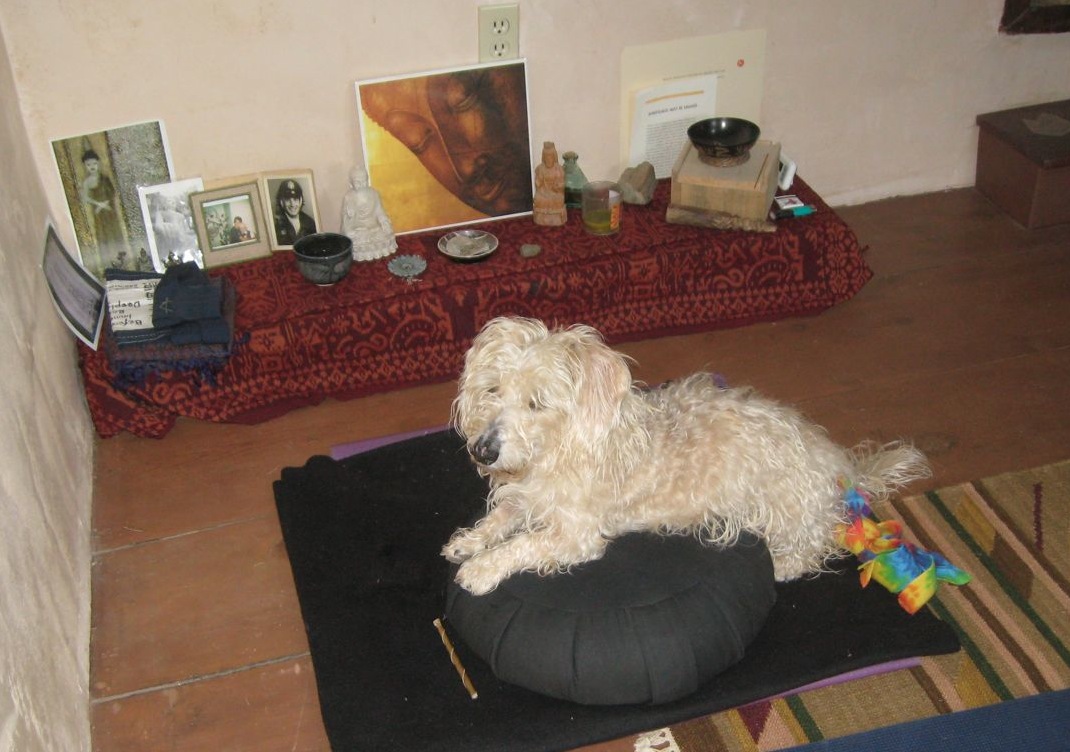
Beings are numberless…. I vow to love ’em.

That’s my personal version of the Bodhisattva vow. And that’s my dog, Lucy, in the photo, who has taken over my home altar and is making the same vow.

And that’s all I’ve got to say today.

How about you? What’s on your mind? In your heart? What are you practicing with today?

Challenging Questions for Engaged Buddhism

Posted on

Okay, we’re going to mix it up a bit today. Lest you think that I am a birkenstock/patchouli-wearing socially engaged Buddhist, it’s important to know that one of my original intentions for the Jizo Chronicles was to give voice to many kinds of engaged dharma, and to demonstrate that it doesn’t all fall into the liberal/progressive camp. And that’s a good thing.

One of the hats I wear is directing the Upaya Zen Center‘s two-year Buddhist Chaplaincy Training Program. I’ve been doing this with Roshi Joan Halifax since the inception of the program in 2008, and it’s one of the most deeply satisfying experiences in my life. One of the students from our first cohort (which graduated this past March) was Dr. Christopher Ford. Chris is a dedicated Buddhist practitioner as well as a brilliant man. A graduate of Harvard, Oxford, and Yale, he served as the U.S. Special Representative for Nuclear Nonproliferation during the Bush Administration and he’s currently a senior fellow at the Hudson Institute. Chris is the author of The Mind of Empire: China’s History and Modern Foreign Relations, and he has a website, New Paradigms Forum.

Chris and I have a lot of affection and respect for each other, even while our perspectives on a number of political issues are often quite different. But I have to say, one paper that Chris wrote while in our program — called “Nukes and the Vow: Security Strategy as Peacework” — really caused me to question a number of my own assumptions, both about nuclear disarmament as well as engaged Buddhism.

Because I know Chris well, because we have practiced alongside of one another, and because I have tremendous regard for both his meditation practice as well as his extensive experience working in the world of government policy and diplomacy, I really sat with challenging questions he posed in this paper. One of Chris’ points is that even as peaceworkers, we should be very wary of being absolutists and “theologizing” the idea of total nuclear disarmament.  He goes on to explore why abolition of nuclear weapons may not be the “skillful means” that advocates of nonviolence think it is.

I’m posting two short excerpts from the piece below. It’s a long article, so I’m including a link to the full version as a Word document here: Nukes and the Vow. I hope you take time to read all of it because one piece builds upon another, and it’s important to have the whole context of what Chris is saying.  I’m curious to hear what you think about all this, and I send a big bow to Chris for his great heart/mind.

It is relatively easy to vow to save all sentient beings; it is much harder to figure out how best to do it. Engaged Buddhism – that rich field of action in the world that devotes itself to the alleviation of suffering by trying to address unhealthy patterns and structures in human social life – aims beyond merely the transformation of individual hearts. It aspires also to systemic transformation. This inescapably entangles it, however, with quite conventional issues of public policy….

In Buddhist peacework, our lodestar should be fundamental human security, rather than the talismanic presence or absence of nuclear devices per se. If we cannot be reasonably confident of real security in a nuclear-weapon free world, it might be better to have a world with nuclear weapons but in which we can have more such confidence. Depending upon our assessment of the anticipated conditions, in other words, it might be possible to make a Buddhist argument for the retention of nuclear weapons as one constituent element of the global security system. Make no mistake: I do not make such an argument here. Nevertheless, it may be incumbent upon all Engaged Buddhists to be at least alive to this possibility. As the saying goes, the devil is in the details; we should not let either pro- or anti-nuclear knowing get in the way of our employment of skillful means for the alleviation of suffering in this complicated and messy world of international political samsara.

Ten Guiding Principles for Socially Engaged Buddhism

Posted on

I think it’s time to bring out this piece, developed by my friends Diana Winston and Donald Rothberg. It seems like there are a number of people in the blogosphere who are questioning the whole notion and point of socially engaged Buddhism (see for example this post from The Reformed Buddhist and this one from Point of Contact)  — is it really any different than someone with liberal politics who slaps a Buddhist sticker on to their beliefs and then heads out to a protest?

I think the answer is yes. There’s a qualitative difference. Diana and Donald have done a good job of distilling the qualities that characterize socially engaged Buddhism.

And by the way, in the near future I’m going to post an article that I believe will demonstrate that socially engaged Buddhism is not always synonymous with a liberal/progressive political stance. That should be interesting.

*********

Ten Guiding Principles for Socially Engaged Buddhism

by Diana Winston and Donald Rothberg

1. Setting Intention, Clarifying Motivation:
Our actions can be dedicated to the benefit and awakening of all beings. Keeping this intention in mind helps our actions to go beyond mere “do-gooding,” fighting so-called oppression, or just “getting things done,” into the realm of dharma practice.

2. Interbeing and Co-Responsibility:
We look at our tendencies to separate “us” and “them,” and “inner” and “outer.” We see in ourselves the same structures of greed, hatred, and delusion that we seek to change. We realize that there is ultimately no “other” to fight against, yet we also recognize that some are indeed in positions of greater responsibility for suffering and oppression.

3. Not Knowing, But Keep Going:
Our work is to remain open to what is unknown, mysterious, and confusing, and to avoid easy answers and habitual views. Maybe we’re wrong or incomplete. We cultivate the ability to listen openly, to hold the multiple questions and perspectives that arise, and to be present with whatever is coming up.

4. Opening to Suffering:
In our meditation practice, we learn to be present in the face of suffering, working through out reactivity, denial, avoidance, and fears, and exploring and transforming the roots of suffering. We bring this skill outward, not turning away from the suffering and injustice that we find in our families, communities, work, society, and world. Our action comes increasingly out of our compassion.

5. Acting from Equanimity:
Can we bring equanimity–the state of even-mindedness and balance–to all our actions, balancing acceptance and understanding of the present moment and its causes and conditions with compassion and the intention to respond to suffering?

6. Being Peace:
Thich Nhat Hanh says that “peace is every step.” We are careful in balancing task- and process-orientation, ends and means. Beyond ideological differences, we share a commitment to be in ourselves that which we are trying to bring about in the world–peace and freedom.

7. Mindfulness and Presence in Action:
Open, mindful awareness is the fundamental nature of our being. How can we cultivate this presence in our actions in any domain, and cut through tendencies to be distracted, to be caught in fixed views and habitual patterns of thought, body, and emotion?

8. Embracing Paradox:
How can we hold in creative tension what often seem to be contradictory perspectives–that all is “as it needs to be” and that we feel deeply moved to respond to suffering, that we are both personal and universal, that nothing needs to happen and that everything needs to happen?

9. Devotedly Do… Without Attachment:
In our practice, we learn of the roots of suffering in compulsive attachment to objects, experiences, ways of doing things, views, and outcomes. Yet non-attachment does not mean complacency, passivity, separation from life, lack of commitment, or non-doing. We have to act. Action that comes from clear seeing and an open heart can be deeply committed, yet without attachment.

10. Loving Kindness: Taking Care of Ourselves, We Take Care of the World:
Like the parent who uses the mask in an airplane emergency first, before helping the child, we need to attend to our long-range well-being. We need to attend to the signs of burnout of resentment. Cultivating our own awakening and joy, we may truly be of use, and naturally seek the well-being of others.

___________________________________

If you enjoyed this post, I invite you to visit my other website: The Liberated Life Project — a personal transformation blog with a social conscience.

Remembering 2005: Hurricane Katrina and New Orleans

Posted on
New Orleans after Hurricane Katrina: Flood dev...

Image via Wikipedia

Five years ago, Hurricane Katrina hit New Orleans. It’s ironic that at this very moment, the people affected by the floods in Pakistan are being forgotten in a way very similar to what transpired five years ago in Louisiana.

I remember that week well. I was doing some work from home for the Buddhist Peace Fellowship when the news of the Hurricane came to the forefront.  I felt outraged at the stories of people being stranded on their rooftops, waiting for rescues that never came. I felt so helpless sitting there in my apartment in Oakland, CA, wishing there was something I could do. The only thing I could think of was to call the Greyhound Bus company to see what it would take for them to send their buses there to help get people out… I couldn’t fathom how the U.S. government couldn’t get its act together to help those affected. And so I dialed Greyhound. (They couldn’t help.)

I sat down and wrote what eventually ended up as “Waking Up to the Tragedy of New Orleans,” which you can read in the Writing section of this blog. Rarely have I had words flow out of my pen so quickly and so passionately. Here’s an excerpt:

To witness the travesty that has been New Orleans over these past five days is heartbreaking beyond belief. And outrageous.

Phrases comes to my mind, and at first I thought them too inflammatory to write here. But I will anyway, because I want to wake us up. I want to wake myself up. Genocide. Ethnic Cleansing. Economic Cleansing. What else to call it when thousands of poor, Black people are allowed to die in front of our eyes? And not just any death – excruciating deaths, brought about by lack of food, water… drowning deaths because people have waited for rooftop rescues which never came, and while they watched other corpses float by… children dying, old people dying, disabled people dying.

The really sad thing is, I’m not sure much has changed since August 2005.

May all beings be safe.

Radical Dhamma: Engaged Buddhism Starts on the Cushion But it Can’t End There

Posted on

Buddhist Peace Delegation, Washington DC, 2007

This past Monday, we had a memorial service for Robert Aitken Roshi at the Upaya Zen Center temple. We were on the last morning of our seven-day Buddhist Chaplaincy Training intensive, and I’d just been blessed to spend the week with 38 chaplaincy students, Roshi Joan Halifax, Sensei Fleet Maull, and Jimmy Santiago Baca, all of us exploring “Dharma at the Edge.”

Roshi Joan asked me to say a few words about Aitken Roshi during the service. As I prepared to do that, I remembered just how radical Aitken Roshi was in his life and in his Buddhist practice. As I recounted before on this blog, I got a chance to spend three days with him back in 2005. I’ve never forgotten his encouragement to me to ensure that the Buddhist Peace Fellowship would not forget its radical, anarchist roots, and to keep placing ourselves in harm’s way if need be for the protection of all beings and of the Earth.

Some time after my trip to Hawai’i to meet Roshi, he sent me a gift in the mail – a copy of the book Death in the Haymarket: A Story of Chicago, the First Labor Movement, and the Bombing that Divided Gilded Age America. This was characteristic of his great generosity as well as his desire to educate fellow Buddhists about the mechanics of radical social change and anarchism. I still can hear his strong voice in my head: “It’s not enough to sit on the cushion.” Roshi’s heroes were people like Dorothy Day, Emma Goldman, Philip Berrigan, Daniel Ellsberg, and Kathy Kelley (of Voices in the Wilderness).

Yesterday, I came across a wonderful piece of writing from sister blogger Katie Loncke. She writes:

As Buddhists and dhamma practitioners, I would love to see us having more conversations about what compassion and social change actually look like: locally, on the ground, in practice.  Because it’s too easy for us to invoke these words — compassion, inner work, social change — and assume that everyone is on the same page.

The truth is, we’re not all on the same page.  And it’s not until after the event is over, on the subway ride home, when a gaggle of us start discussing in detail the relationship between inner and outer work, that these fundamental differences emerge, sharp and cold, like mountain peaks, from the soothing golden fog of Buddhist unity.

Katie then goes on to outline five points where she digresses from “spiritual liberalism”:

1.  Mystified Mechanism. When we start doing the inner work of developing compassion and insight, our outer social justice work will automatically get good.

How?  Sometimes folks talk about spirituality helping to reduce burnout, or converting the motivation of anger into the motivation of compassion.  But while both are wonderful benefits, neither speaks to the testable effectiveness of the particular outer work itself.

2. Healing As (Total) Resistance. Smiling at strangers on the subway is resisting militarism.

Well, I disagree.  Our healing work, spiritual work, and structural resistance work ought to inform each other, but they are not interchangeable substitutes.  Mandela didn’t inspire a movement and challenge the status quo just by praying compassionately for the liberation of the oppressor. (Though he did that, too.)

3. Social Change Relativism. Together, a growing movement is working for peace and justice in the world.  From green business to prison meditation to high-school conflict resolution programs on MTV, signs of hope and change abound.

Are all forms of progressive activism equally useful?  No.  But the shorthand of social change frequently obscures this fact.  Coupled with a feel-good engagement paradigm, the ‘every little bit helps’ idea makes it very difficult to hold each other accountable for our political work and its actual outcomes.

4. Root vs. Radical. Radical political agendas fail to grasp the root cause of oppression: dualism.  And ultimately, the best ways of overcoming dualism are through meditation and small-scale, intimate, interpersonal, compassion-building exercises.

Even if dualism is the “root cause” of oppression, that doesn’t make it the best or most actionable point for resistance, always.  Besides: why is this idea of dualism so pervasive and tenacious, anyway?  In large part because of the political and material structures (i.e. schools, economies, hierarchical religious institutions) that train human beings.  Without changing the power relations governing those material structures, there’s little hope of giving non-dualistic living, and appreciation for inter-being, a real shot on a global scale.      

5. Bhudd-opian Visions. Gandhi said it best: “Be the change you wish to see in the world.”

Often, this gets construed to mean: build the best alternative society you can, and slowly it will change the entire society.  Especially in Buddhist communities that prize extended retreat time, a decade of study with a realized Asian master, and this sort of removal from everyday householder society, there’s a danger of trying to build our sanghas into utopias, and assuming that they will automatically radiate peace and well-being into the world.  Might be true on an individual or small-group level, but why should we believe that we can scale up well-being from personal transformation to world peace, without specific strategies for tackling enormous material systems?

I think these are really important questions, and I bow in gratitude to Katie for bringing them forward. On the same morning I came across Katie’s article, I also happened upon this piece on Transformative Organizing (TO) from this year’s US Social Forum. I’ll write more on this in another post, but in a nutshell, “TO is about creating deep change in how we are as people, how we relate to each other, and how we structure society. It brings together approaches to transformative change, ideological development, and impactful grassroots organizing to create a new paradigm for organizing.”

The interesting thing to me is how TO starts from the basis of effective organizing, and enfolds both inner and outer transformation from there. Too often, I think that many of us as engaged Buddhists give short shrift to the dimension of outer transformation, as well as the challenges in our relationships with each other, especially when there are power inequities based on race, class, and gender. It’s kind of like a spiritual/political bypass.

Meanwhile, in Montague, MA, this week, hundreds of people are attending the Engaged Buddhist Symposium at the Zen Peacemaker Institute. I wonder if these conversations are happening there as well, if people are exploring where the radical edge of dharma lies, and how we as practitioners in this day and age, living in this profoundly broken yet beautiful world, can really get down in the dirt with all beings.

If you’re at the Symposium, or if you have thoughts about all this, I’d love to hear your voice in the comments below.