RSS Feed

Category Archives: Ruminations…

July 29: Buddhist Love Delegation in New Mexico (and a lot of background story)

Posted on

This Thursday evening, July 29, I’ll be joining with my friend Russ Russell, a Zen priest with the Desert Mirror sangha, to offer a Buddhist presence at the Interfaith Vigil for Immigration Reform in Albuquerque. If any of you reading this are in or near Albuquerque, I hope you’ll join us. Send me an email at maia [at] gmail.com and we’ll figure out how to find each other.

If you’ve been reading The Jizo Chronicles for a while, you’ll know that I’ve been writing about the situation in Arizona ever since the passage of SB 1070, the anti-immigrant bill. This Thursday, the bill goes into effect, which is the reason for the interfaith vigil (as well as a much larger event in Phoenix).

Why does this matter to me so much? I’ve been wondering about that. You know how some issues just grab us and won’t let go, but they don’t have that same effect on other people? This seems to be one of them. I’ve been blogging, tweeting, and Facebook-ing about this, proposing the idea of a Buddhist “Love” Delegation to Phoenix, and a few people responded. But for the most part it doesn’t seem to touch the same nerve in other (mostly white) people that I know.

Then I remembered Mrs. Sanchez. I grew up in Southern California, just outside of Los Angeles. I went to a small Catholic school where I was in the minority – a good 75% of my class was Chicano/a, and I was one of the few white girls. My best friend was Pattie Sanchez and most weekends I would hang out at Pattie’s house. Mrs. Sanchez introduced me to tamales and enchiladas, and watched over me just like I was Pattie’s sister. The Sanchez’s celebrated every milestone along with me and my parents… from First Communions to graduations to family births and family deaths. Their house was really my second home, and they were my family. Mrs. Sanchez was like my second mom.

So I think at some sub-conscious level I’ve been holding Pattie and Mrs. Sanchez and so many of the other people I grew up with in my heart as I’ve been reading about SB 1070 and the likely consequences of it. As I wrote in an earlier post, I feel impassioned to speak out about SB 1070 because:

  • It’s mean-spirited… the opposite of lovingkindness.
  • It’s a massive display of white privilege. The bill mandates law enforcement officers to determine people’s immigration status based on “reasonable suspicion.” What exactly does that mean? If you have brown skin, you’re a suspect. Hey, how about me? I might be an illegal German/Slovenian immigrant. But would anyone ever think of that? Bingo. Racial profiling.
  • It will create a climate of distrust, and will almost certainly prevent people from reporting crimes to the police out of fear of being deported.
  • It’s redundant… the federal government is already responsible for enforcing immigration laws (for better or worse). The way I see it, even if you think that the immigration system in this country needs a major overhaul, this bill is still offensive and injust. (See this excellent interview with Rev. James Ishmael Ford, a Zen priest and a Unitarian Universalist minister, for his take on the bill.)

I’ve had to go through my own process to discern how to respond to this issue, and I want to share some of it with you because I think it’s a good illustration of socially engaged Buddhist practice, at least I understand it.

My first thought was to head to Phoenix on July 29 to join the Day of Non-Compliance there. But I struggled with this plan. There were a lot of factors to consider – it would be a big trip to take in terms of time and money, not to mention the carbon footprint. I thought perhaps I could take the train from Santa Fe to Flagstaff and then get a bus down to Phoenix. All of this felt like pushing against the river, especially in light of the fact that just a few days later, I need to be on full-duty for our core training time in the Upaya Buddhist Chaplaincy Program.

But I was willing to do this even if it felt like it was a big stretch. Then I looked at my ego… how much did I want to be in Phoenix, perhaps participating in civil disobedience, simply to satisfy my identity as “an engaged Buddhist”? I’m not immune to having a big ego and being righteous.

But then again, on the other hand, it truly did feel important to offer solidarity to people in Arizona who will be affected by this bill.

Every day of the past month I’ve gone back and forth with this, not being able to fully commit to going but also not being able to decide it was out of the question. Only in the last week did I finally become clear that I wouldn’t go to Phoenix but would instead make a donation to support Alto Arizona, the group that is doing much of the organizing around this day and immigrant rights.

The day after I made the donation, I saw the news about the Albuquerque vigil on July 29 via Twitter. Finally, the “appropriate response” took shape. Albuquerque is much closer to home – only an hour away. This was a way to take action that felt more sustainable in terms of time, money, my own energy level, and travel. I emailed Russ and she responded back almost immediately that she would join me.

Activist movements are often filled with people who are martyrs to a cause, and with the expectation that we should be martyrs to a cause or we’re not really doing anything worthwhile. I’m not sure this belief system really helps a situation. It’s not that I think we should never get out of our comfort zone… in fact I’m sure that if we don’t, no real change occurs and we never challenge our own ideas of power.

But I also believe that we need to find ways to take action that generate joy and connection, not further suffering. This, to me, is what is at the heart of socially engaged Buddhism.

I have no idea if I got it “right” on this one, but I am looking forward to being in Albuquerque this Thursday night with my dharma friend and “standing on the side of love,” as the Unitarian Universalists put it. Maybe we’ll see you there.

A Declaration of Interdependence

Posted on

Photo: Paul Davis

As the Fourth of July approaches, I’d like to offer an alternative way to think about and celebrate the day. How about a day of remembering how interdependent we all are?

The essay below was originally written in 2004 by Alan Senauke of the Buddhist Peace Fellowship, and presented to delegates of the Republican and Democractic conventions that year. A number of people contributed to subsequent drafts, including: Robert Aitken Roshi, Hilda Ryumon Gutiérrez Baldoquín, Diane Gregorio, Ken Kraft, Santikaro Larsen, Diana Lion, David Loy, Bob Lyons, Susan Moon, Cliff Reiss, Craig Richards, Donald Rothberg, Cedar Spring, Diana Winston, and myself.

The essay was updated in 2006 and the questions at the bottom were added at that time.

________________________

A Declaration of Interdependence:
A Call to Transform the Three Poisons for the Sake of All Sentient Beings

January 2006

As concerned global citizens and as members of a diverse Buddhist community, we want to contemplate and question the role of government in creating a civil and compassionate society. From the standpoint of interconnectedness, those of us living in the United States have a special responsibility to the whole world to explore this question. We know our government is in a position to effect great social change all across this world—change that can be both positive and negative.

Like most people, we are concerned about the war in Iraq, terrorism, deteriorating public schools, low-paying jobs, racism, and vanishing civil liberties. We are concerned that politics as usual— whether Democratic or Republican—offers little or no meaningful change of direction. Yet we refuse to succumb to apathy, cynicism, or anger. We seek a politics rooted in compassion and generosity born in each of us. Compassion means, literally, to suffer with, to recognize our human connection across all lines of race, culture, nationality, and identity. Generosity means to give freely of what we have, because giving to others is the natural expression of seeing others as ourselves.

Buddhist practice and ethical precepts call forth a range of beneficial views that apply as much to society as to individuals. Twenty-five hundred years ago, when Shakyamuni Buddha was enlightened under the Bodhi Tree, he said, “Now I am awakened together with all sentient beings.” Every person on the planet has the full capacity to wake up from the mistaken notion that we are separate from each other. Each of us is connected interdependently with all others, including those who disagree with us. This understanding leads to a reverence for the preciousness of all sentient life.

There are barriers, however, that make people and nations believe that they are separate. From a Buddhist perspective, the “three poisons” of greed, hatred, and delusion cloud our minds and skew our actions:

• Greed is the driving force in a consumer society that supports undemocratic corporations that sell us things we don’t need. Greed is also at the root of a system in which people, including government officials, are corrupted by the seemingly insatiable appetite for money and power. Looking deeply, we see that nothing can be hoarded, accumulated, or held on to. We understand, too, that those things we take from others that are not freely given—resources, labor, wealth, votes, and more—are the birthright of all people. All people have the right to decide how these resources are used.

• Hatred gives birth to war, prejudice, and repression. Those forces tend to perpetuate themselves in a ceaseless cycle of violence and militarism. As Buddhism and other faith traditions affirm, “Hatred does not cease by hatred, but only by love.” Hatred is rooted in separateness; compassion is rooted in connection. Which way would we wish to turn?

• Delusion, or ignorance, stems from our tendency not to see reality just as it is. We are schooled in delusion by systems of indoctrination and mass media that condition us from early childhood to buy into the false promises of consumerism and American exceptionalism. Delusion is the driving force evident in our ever-more centralized media.

And finally, we do not have government of the people, by the people, and for the people. Rather, government has become a holding company for corporate control. When we fail to point out the unraveling of our democratic system, and—as the aftermath of Hurricane Katrina made clear— the way in which so many citizens lack even the necessities for a life of self-respect, we have fallen prey to the delusion of separateness, and we disempower ourselves and others.

The current political and economic system is tainted by these poisons, which necessarily reinforce each other. When we spend many billions of dollars on a foreign war premised on lies and distortions, we have no money to buy food, medicine, and first-class education for the poor at home…or for displaced peoples in need around the world. So a spiral of anger, resentment, need and confusion spins on and on.

And yet we are called to participate in this very system, even with all its injustices and inequalities. The task before us requires presence of mind, awareness, patience, and perseverance. We wish to be part of a polity that is genuinely representative and fully participatory.

All of us—whatever our faith, political affiliation, cultural background, or economic status—have the same wish for safety and well-being. We may agree or disagree with each other. We may approve or disapprove of a given candidate or representative’s positions. But in these decisive times, when so much is at stake, we must act with courage.

Traditional Buddhist teachings invite us to consider the well-being of the generations to come, seeing the future of parents, children, and loved ones. How will our loved ones be impacted if we fail to take care of the present? This kind of care calls for transformation: personal, political, economic, social, and cultural. Transformation is difficult work. We are often afraid to exchange a familiar situation—even one that causes us suffering—for a future that is unknown. Our challenge is to step into the unknown and not fear change or discomfort. Our challenge is to understand that principled conflict is often the midwife of transformation.

With these principles in mind, we offer three areas of transformation to apply when designing policies that will shape lives around the world. As students of the Buddha’s way of wisdom and compassion, we vow to practice these principles in our own lives, and to bring this understanding into our work in the social and political realms:

• Transform greed into generosity.

• Transform hatred into love and compassion.

• Transform ignorance into clarity and attention.

The Declaration of Independence of the United States says, “All men [and women] are created equal.” In Buddhism, the corollary teaching is that within each of us there is innate goodness and wholeness. Actualization of these ideals is only possible in a life-affirming society. Therefore, it is our responsibility to create the social conditions and political structures that enable people to live with dignity, honor, safety, and sufficient resources.

Only by working together can we renew our world. Only by working together can we insure that the U.S. will fulfill its promise of liberty and justice for all. In our hearts we long to see this vision born anew. As engaged Buddhists and spiritual activists, we commit ourselves to this path.

Questions for Reflection and Discussion

1. How do the three poisons of greed, hatred, and delusion manifest in my own life as a global citizen? For example, what are my consumption patterns around food, oil, and other limited resources?

2. What is one way in which I can work to transform my personal relationship to greed, hatred, or delusion? How can my dharma practice support this process of transformation?

3. How do the three poisons manifest in the social and political structures in my local region? For example, how does ignorance take form in our school/educational system?

4. What is one local issue that I would like to engage with, and what are some ways that I can support the cultivation of generosity, compassion, and clarity in this area?

Where is the Love? (aka: Meet Me in Arizona)

Posted on

To my knowledge (which is limited), the word “love” doesn’t show up very often in Buddhist suttas and teachings, at least not in the way you see it over and over again in the teachings of Jesus. Which may be why people get the impression that Buddhism is primarily a cerebral exercise. The prevalent use of the word “mindfulness” just reinforces that notion. I was recently at a meeting where someone suggested that a better word might be “heartful-ness” – because what’s really happening if we practice deeply is that our heart awakens and we respond to the world from that place.

(A semantic note: Part of the problem here is a cultural/linguistic one. Western modes of thought and language tend to reify dualism. As you may know, the Chinese word shin [xin] means “heart-mind.” There’s a wonderful article by Shohaku Okumura on this word and its Japanese parallel kokoro here on the Buddhadharma website.)

Which brings me to Arizona.

Arizona needs a lot of love right now. Over the past few months, the state has passed a couple of bills that make it pretty difficult to be a Latino/a living in that state and not feel that you are despised and unwanted. First came SB 1070. Less than a month later, the governor signed another bill that limited the teaching of ethnic studies classes in public schools. And on top of that, the state’s education department started to mandate re-assignments of teachers who it was deemed didn’t speak English well enough or who had an accent. (See how some Stanford University professors responded to this.)

A number of people are responding by organizing a Summer of Human Rights in Arizona. One of my favorites is the “Standing on the Side of Love” campaign from the Unitarian Universalists. One of those UUs is also a Zen priest – James Ishmael Ford. Danny Fisher did a great interview with Ford which you can read here.

So how about it, dharma sisters and brothers – who would like to join me in a Summer of Love in Arizona? Let’s practice the dharma in a big-hearted way. Since I’m in New Mexico and Arizona is my neighbor, I’m thinking of going to Phoenix on July 29 for a Day of Non-Compliance (the day SB 1070 goes into effect). Perhaps we can get a Buddhist Love Delegation organized, similar to what a number of us did in Washington D.C. in 2005 and 2007 (see photos here and this past Jizo Chronicles post).

We’ve got one month. Anybody else interested? Let me know and let’s see what we can cook up.

And by the way – I’m also following up to find out more about the potential Buddhist group that’s going to the Gulf states to respond to the oil spill. I’ll be writing again soon with details on that.

love,
Maia

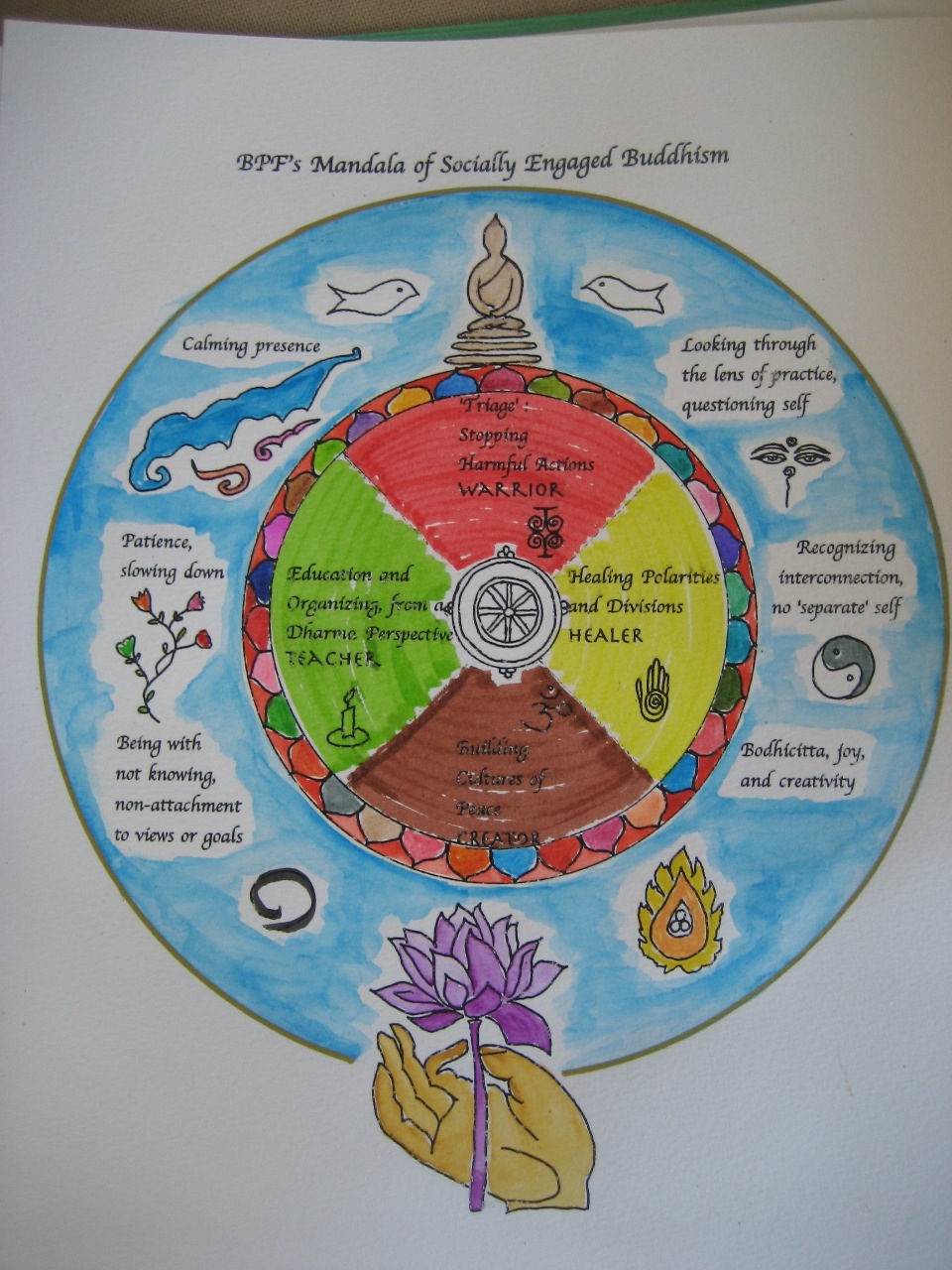
Mandala of Engaged Buddhism, in Color!

Posted on

But wait, it gets better…

Yesterday, you saw the not-so-exciting, almost-black-and-white version of the mandala. A year or two ago, my friend Anchalee Kurutach created this illustrated, hand-painted, colorful version of the mandala. It’s beautiful. Enjoy!

Mandala of Socially Engaged Buddhism

Posted on

I’ve referred to the “Mandala of Socially Engaged Buddhism” a couple of time in previous posts on this blog, and I’ve finally dug it up to share it with all of you. If you click on the graphic above, it should open up in a separate window with slightly higher resolution.

Some background on this mandala: It was inspired by a gathering of a number of Buddhist Peace Fellowship chapter leaders in 2003. Everyone shared the kinds of activities that their chapters had organized, and (just as importantly) how they organized these events, what qualities were important for them in the process of organizing.

I was the designated note-taker at this meeting. After digesting all I had heard that day, this mandala is what came to me as a way to summarize what everyone had shared. I realized that the types of activities or events seemed to cluster into four categories (the four quadrants of the circle above), and then I included the six qualities that people consistently named as important parts of the process around the outside of the circle. Later on, I added an archetype into each of the quadrants (e.g. “the healer”) as that was an interesting dimension to play with.

Here are some examples of the kinds of activities you might find in each of the four quadrants:

“Triage”: Stopping Harmful Actions

• Participating in vigils, rallies, and marches against the war on Iraq

• Sitting in meditation vigil at state-sanctioned executions (death penalty)

• Writing letters or calling legislators to call a stop to harmful environmental practice

• Nonviolent civil disobedience and non-cooperation with life-destructive policies

Healing Polarities and Divisions

• Reconciliation or listening circles with groups that have “opposing” points of view

• Practicing Nonviolent Communication

• Addressing issues of racism, classism, sexism, etc. within our sanghas and in society

Building Cultures of Peace

• Working to establish a Department of Peace in the U.S. government

• Work with children and young people

• Building creative arts communities

• Monastic communities that are based on principles of sustainability and non-harming

• Practice simple, sustainable living, individually and in community

Education and Organizing, from a Dharma Perspective

• Empowering ourselves and others with information about a specific issue, such as the minimum wage (economic injustice)

• Inquiry/Analysis. Ask questions: “Why is this situation like this? Who is suffering from this injustice? How can we change it? Who has the power to change it? How can we leverage that power?”

• Designing actions intended to shift power and encouraging others to participate in the change process –provide contact information for legislators, suggested letters to write, invitations to vigils, etc.

The mandala was also influenced by Joanna Macy’s writings about the “Great Turning.” In fact, you’ll see some parallels in this mandala. Macy says that in order for us to navigate the transition from an industrial society to a life-sustaining society, three actions are needed: 1) Holding Actions (similar to the “Triage” in this mandala), 2) Alternative Structures and Analyses (similar to the “Building Cultures of Peace”) and a 3) Shift in Consciousness and Spiritual Awakening (not really a separate part of this mandala, but woven in throughout).

One of the most important points about this mandala is that it is completely interconnected. All four quadrants of action are equally necessary, equally valuable. No one’s work is more important than someone else.

Over the years, this mandala has been a very helpful tool to work with, both with individuals and groups, as we think through how we’ve engaged with social, political, and environmental issues. I’m wondering what thoughts you have about this mandala. Do you notice that your activism has tended to be in one of these quadrants more than others? Do you feel out of balance in any way as you engage with the world? Are the six qualities present in your life and activism? What else might be missing from the mandala?

I consider this mandala a work in progress, so I’d love to hear your feedback on it and any ways that you find it useful.

The Original Engaged Buddhist

Posted on

There’s a debate of sorts going on over at the Bearing Witness blog. The question: “Was the Buddha socially engaged?” So far, there are 18 comments on the topic including one from me.

In the one “corner,” there is the unnamed author of the blog Digital Tibetan Buddhist Altar, who writes:

If you are rushing from one disaster to another, saving whales, trees, dogs, birds, starving orphans, victims of this, and victims of that, sooner or later you will become exhausted. Sooner or later, you will come to realize that, despite all of your effort, the whales, trees, dogs, birds, orphans, and victims are no fewer in number than when you began your crusades.

Later, rather than sooner, you might even come to realize that all your rushing around is just another excuse for not realizing emptiness: for not realizing impermanence…

When Buddha achieved or relaxed into whatever it is we believe he achieved or relaxed into while sitting beneath the Bodhi Tree, a large red cross did not suddenly begin glowing on his chest. He did not jump up and rush out to save the poor. He did not latch on to a cause and use it as the locus of a fundraising mechanism. He did not begin building institutions.

Twist it and wring it and pound it any way you like. Buddha did not engage in engaged Buddhism.

In the other corner, Ramesh Bjonnes writes in Elephant Journal:

Buddha was an animal and human rights activist long before PETA and Amnesty International.

During the time of Buddha, circa 500 BC, the Vedic religion of the Brahmin priesthood  in India had become degenerate and suppressive and engaged in frequent animal sacrifices.

The Buddha is reputed to have denounced the Vedic religion at the time. He especially denounced the religious animal sacrifices so common during those days.

As I wrote in my comment on the Bearing Witness blogs, I find these kinds of ‘debates’ rather tiresome. They set up a false duality, forcing us into a position of either/or.

I think reality is much more complex and beautiful than that. And as the author of Digital Tibetan Buddhist Altar writes later on in the post:

Have I said anywhere that Buddhists should abandon social activism? No I have not. In the foregoing, it is not my suggestion that you should abandon social conscience altogether and start tossing garbage out the window of your speeding life. It is merely my suggestion that you earnestly consider hitching the horse to the front of the cart. It is better for the horse, and gets the job done.

I like that. And it gives me an opportunity to share one of my favorite verses from contemporary Buddhist poetry:

I never see you

In Jetavana’s garden

Sitting with closed eyes

In meditation, in the lotus position

Or

In the caves of Ajanta and Ellora

With stony lips sewn shut

Taking the last sleep of your life.

I see you

Walking, talking,

Breathing softly, healingly,

On the sorrow of the poor, the weak,

Going from hut to hut

In the life-destroying darkness

Torch in hand,

Giving the sorrow that drains the blood

Like a contagious disease

A new meaning.

— Daya Pawar (Pawar, who died in 1996, was a prize-winning poet and writer from India’s Marathi Dalit community)

Untangling the Tangle: Sea Turtle #15

Posted on

The inner tangle and the outer tangle,
this whole world is entangled in a tangle,
and so I ask the Buddha this question,
How does one untangle this tangle?

~ Vissudhimagga

This morning, I drove downtown to pick up croissants and strawberries for some dear friends who are coming for tea later on. Along Alameda Street, I stopped and parked the car to walk out and get a closer look and smell of some beautiful lilac bushes growing in the meridian between the sidewalk and the drop off to the Santa Fe River. The fragrance of the lilacs was nearly lost among the exhaust fumes of the cars and trucks passing by.

Sitting outside on this beautiful day, reading the story about Kemp’s Ridley sea turtle number 15, near Padre Island, TX, in danger from the massive Gulf oil spill. Contemplating my own addiction to oil… this morning’s errand, driven by greed, driven by love…. Who will untangle this tangle?

Watching a spider at work

I vow with all beings

to cherish the web of the universe:

touch one point and everything moves.

~Robert Aitken Roshi

Wisdom 2.0: Mindfulness and Technology

Posted on

I just posted a long entry over on my other blog on culture and communications, Five Directions, about the Wisdom 2.0 conference that ended today. Maybe you’ll like it… maybe not. Check it out.

And to all a good night!