RSS Feed

Stand With Aung San Suu Kyi on Her 65th Birthday

Posted on

Thanks to Danny Fisher for reminding us that tomorrow, June 18, is Daw Aung San Suu Kyi’s birthday.

From the Amnesty International website:

As Myanmar prepares for its upcoming elections, a sense of concern and tension is in the air. Many fear that there will once again be political unrest, resulting in widespread arrests from election-related crackdowns. Moreover, contributing to the anxiety is the anticipated release of democracy leader and co-founder of the National League for Democracy (NLD) Daw Aung San Suu Kyi, who has endured unofficial detention and has been held under house arrest for about 15 years in Yangon.

Will you be among those calling for justice in Myanmar on Friday? On June 18th, Amnesty International and other NGOs will be holding a demonstration and panel discussion in New York to commemorate Daw Aung San Suu Kyi’s birthday. Activists will also participate in a procession to the Permanent Mission of the Union of Myanmar to deliver 65 yellow roses in honor of Suu Kyi’s 65th birthday. Amnesty International members, the Burmese community, and other activists will be calling for her release, as well as for the over 2,100 political prisoners of Myanmar.

Can’t make it to the demonstration in New York? You can still support Amnesty’s efforts by joining our “Stand with Suu Kyi” photo action.

Stand with us as we stand with Suu Kyi and the more than 2,100 political prisoners in Myanmar!

Another World is Possible: Spiritual Activism at the Detroit USSF

Posted on

Another world is possible
Another US is necessary

Something amazing is about to happen in Detroit. From June 22 – 26, thousands of people will gather in that city to connect, to share ideas, and to inspire each other toward a better world. This is the purpose of the US Social Forum — one of the nation’s largest grassroots gatherings of activists and organizers.

This is the way organizers describe the forum:

The US Social Forum (USSF) is a movement building process. It is not a
 conference but it is a space to come up with the peoples’ solutions to the 
economic and ecological crisis. The USSF is the next most important step in our
 struggle to build a powerful multi-racial, multi-sectoral, inter-generational,
 diverse, inclusive, internationalist movement that transforms this country and
 changes history.

This is the second time that the forum has happened in the U.S.; the first was in Atlanta in 2007. (The World Social Forum is the older, bigger sister to the US forums.) That year, a small group of spiritual activists offered workshops and contemplative spaces. This year, the number has grown dramatically — perhaps a sign that compassion-based activism is taking root in social change movements, thanks to organizations like stone circles and others. The Buddhist Peace Fellowship is also getting involved this time around as well.

Here’s a guide to events that fall under the category of spiritual/transformative practices at this year’s forum, compiled by stone circles:

Faith and Spirituality led by a local committee on the ground in Detroit with support from organizers around the country, including stone circles and Word and World.

~Sacred Space Canopy with programming every day from 10 am – 5 pm including reflection, ritual, prayer and dialogue as well as space for individual practice.
~Interfaith Service on Friday morning, as a prelude to a march and rally at Chase Bank
~People’s Movement Assembly, “The Faith Community from Internal Reflection to External Action”
~Many workshops on topics such as nonviolence, self-care, Sabbath economics, street retreats, the spiritual left and much more.

Transformative Practice and Organizing led by a group of organizations from around the country including Center for Transformative Change, Movement Strategy Center, Rockwood Leadership Program, Social Justice Leadership and stone circles!

~Transformative Practice Canopy with continuous practice offerings, workshops and more
~People’s Movement Assembly on Defining Transformation for Social Change
~Daily morning practice in Cobo Hall, beginning with 20 minutes of quiet meditation and followed by a complementary practice for 30-40 minutes.
~Many workshops on topics such as art and creative practice; somatics, trauma and transformation; transformative organizing, fearless meditation and more.

Health and Healing Justice, led by a collective of individuals and organizations in Detroit and from across the country including Generation5, Kindred and others.

~Healing Justice Practice Space with individual and collective healing sessions
~People’s Movement Assembly on Healing Justice and Liberation
For more info, see Kindred’s website!

In addition, Sarah Weintraub, executive director of the Buddhist Peace Fellowship, will offer a workshop on “Caring for Ourselves and the World: Practices for Self-Compassion and Self-Care.”

If you’re able to get to the USSF, by all means do — and please tell us about your experience. If you can’t make it there, I hope you can take heart in knowing about this amazing event and the inspiring people who are presenting and participating there.

Wanted: Your Nomination for the Next Engaged Buddhist Quote

Posted on

I’m currently at the Fetzer Institute in Kalamazoo, Michigan, attending a meeting on the “current state of contemplative practices in the U.S.” Tomorrow is a travel day… a long one! I’m headed back to Santa Fe by train, a journey which will take about 30 hours. Unfortunately, there is no internet access on the Southwest Chief.

I may not get to post the “quote of the week” this time around, but I’d love to hear which socially engaged Buddhist you’d nominate for the next time we have a quote (which I usually post on Sunday or Monday). And if you have a favorite quote from that person, please share that too.

If you’d like to see the archive of past quotes, take a look here: https://jizochronicles.wordpress.com/category/quotes/

Dispatch from the Train to Auschwitz

Posted on

Photo by Peter Cunningham

I received this email (below) on Sunday from Michael Melancon, a friend who is in his second year of the Upaya Buddhist Chaplaincy Program. He is on his way to take part in the Bearing Witness Retreat at Auschwitz with Roshi Bernie Glassman and others from the Zen Peacemaker Community. Thank you, Michael, for your deep intention to practice with suffering.

It is Saturday morning June 5 as I write this. I’m on a train from Warsaw to Krakow, Poland… Starting this Monday we will sit a Retreat of Remembrance at Auschwitz… In total we will be about 150 people from all over the world on retreat together.

I’m not Jewish myself, but I was “adopted” by a dear Jewish family about 20 years ago. My adopted Jewish mom Hedy stood in for my own mother when Glenn and I were married. She offered a Hebrew prayer of blessing over our rings; everyone was dry-eyed until that moment in the ceremony. Hedy’s daughter Eve stood up for me as my Best Person. These people are my family.

Hedy’s family of origin — her mother, father, sister and grandparents — were all killed at Auscwhitz.

In my Rakusu case here at my side are photos of Hedy’s family members the way they were when she last saw them. Her parents hid Hedy away in a convent in Belgium, just before the Gestapo took most of the rest of the family to the death camps. Later this week in a ceremony of remembrance we will honor those family members I’ve met only through Hedy’s cherished memories.

My choice to travel by train in Poland is intentional. It is part of my pilgrimage here. I am mindfully aware that this rail track from Warsaw to Krakow, on which i now ride in comfort and in a bright and sun-filled rail car, is like the very route so many traveled to their deaths a mere generation ago. I hold them all in my heart: the victims as well as those who risked their lives to defy and stop the madness. I also hold the perpetrators, and the innocent and not-so-innocent bystanders. I know I am not so separate from either the willing or the unwilling participants. A single cloud hovers in this clear blue sky, as I consciously untangle their entwined karma, while weaving it more deliberately together with my own . . . and with yours.

Here, you are not far from me.

The many beings are numberless, I vow to free them.

Greed, hatred and ignorance rise endlessly, I vow to abandon them.

Dharma gates are countless, I vow to perceive them.

The awakened way is unsurpassable, I vow to embody it . . . fully.

Love in cubits . . .

Michael ‘Daiun’

Quote of the Week: Thich Nhat Hanh and bell hooks

Posted on

I’ve been thinking about what to offer for this week’s quote, and came across something a little bit different: a conversation between Ven. Thich Nhat Hanh and writer and cultural thinker bell hooks in Shambhala Sun.

I love the way they traverse through some difficult subjects, including racism and injustice,  keeping love and the Dharma as their touchstones throughout. This passage comes near the end of their conversation:

bell hooks: And lastly, what about fear? Because I think that many white people approach black people or Asian people not with hatred or anger but with fear. What can love do for that fear?

Thich Nhat Hanh: Fear is born from ignorance. We think that the other person is trying to take away something from us. But if we look deeply, we see that the desire of the other person is exactly our own desire—to have peace, to be able to have a chance to live. So if you realize that the other person is a human being too, and you have exactly the same kind of spiritual path, and then the two can become good practitioners. This appears to be practical for both.

The only answer to fear is more understanding. And there is no understanding if there is no effort to look more deeply to see what is there in our heart and in the heart of the other person. The Buddha always reminds us that our afflictions, including our fear and our desiring, are born from our ignorance. That is why in order to dissipate fear, we have to remove wrong perception.

bell hooks: And what if people perceive rightly and still act unjustly?

Thich Nhat Hanh: They are not able yet to apply their insight in their daily life. They need community to remind them. Sometimes you have a flash of insight, but it’s not strong enough to survive. Therefore in the practice of Buddhism, samadhi is the power to maintain insight alive in every moment, so that every speech, every word, every act will bear the nature of that insight. It is a question of cleaning. And you clean better if you are surrounded by sangha—those who are practicing exactly the same.

bell hooks: I think that we best realize love in community. This is something I have had to work with myself, because the intellectual tradition of the West is very individualistic. It’s not community-based. The intellectual is often thought of as a person who is alone and cut off from the world. So I have had to practice being willing to leave the space of my study to be in community, to work in community, and to be changed by community.

Thich Nhat Hanh: Right, and then we learn to operate as a community and not as individuals. In Plum Village, that is exactly what we try to do. We are brothers and sisters living together. We try to operate like cells in one body.

bell hooks: I think this is the love that we seek in the new millennium, which is the love experienced in community, beyond self.

Thich Nhat Hanh: So please, live that truth and disseminate that truth with your writing, with your speaking. It will be helpful to maintain that kind of view and action.

Mandala of Engaged Buddhism, in Color!

Posted on

But wait, it gets better…

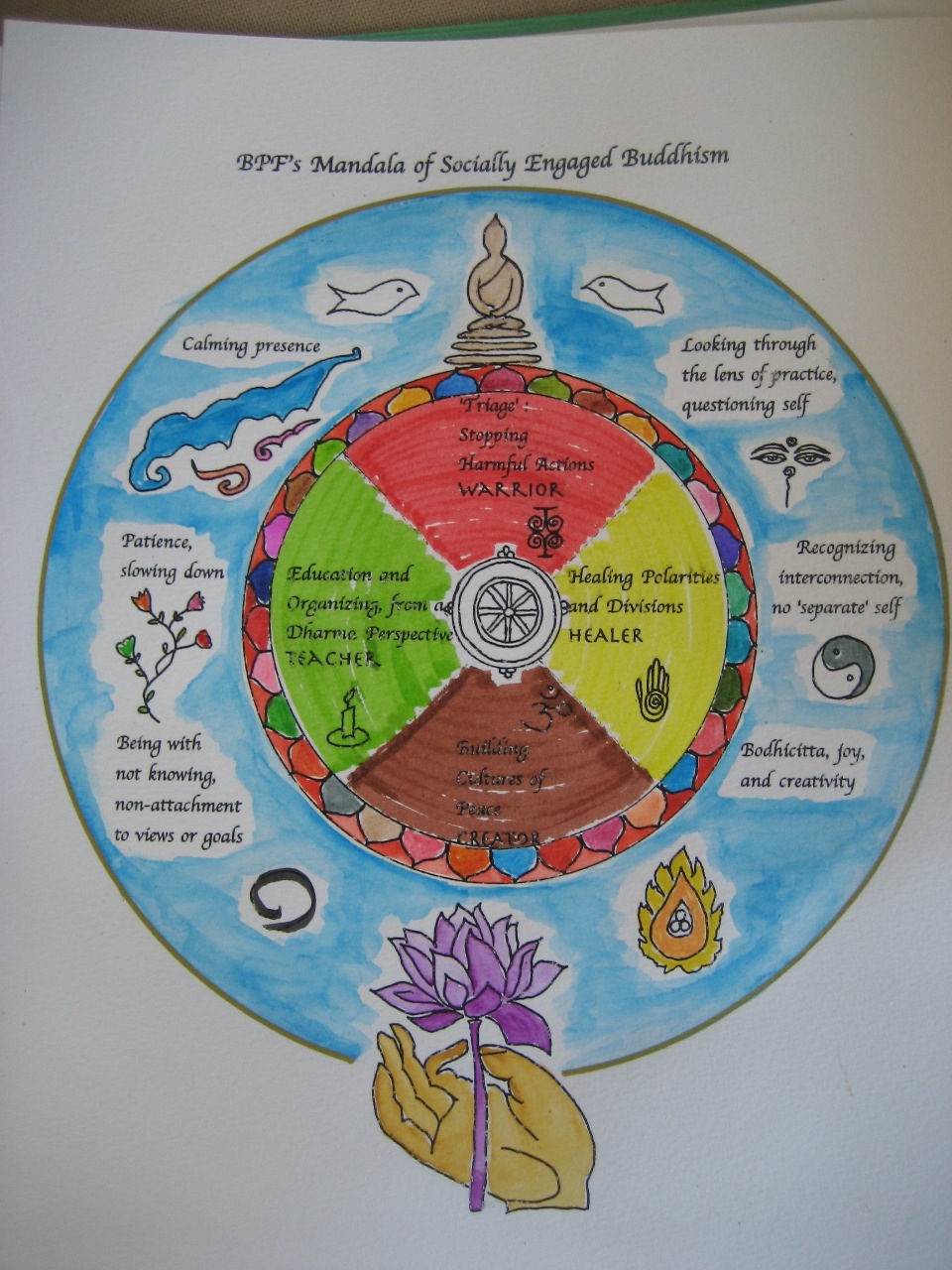
Yesterday, you saw the not-so-exciting, almost-black-and-white version of the mandala. A year or two ago, my friend Anchalee Kurutach created this illustrated, hand-painted, colorful version of the mandala. It’s beautiful. Enjoy!

Mandala of Socially Engaged Buddhism

Posted on

I’ve referred to the “Mandala of Socially Engaged Buddhism” a couple of time in previous posts on this blog, and I’ve finally dug it up to share it with all of you. If you click on the graphic above, it should open up in a separate window with slightly higher resolution.

Some background on this mandala: It was inspired by a gathering of a number of Buddhist Peace Fellowship chapter leaders in 2003. Everyone shared the kinds of activities that their chapters had organized, and (just as importantly) how they organized these events, what qualities were important for them in the process of organizing.

I was the designated note-taker at this meeting. After digesting all I had heard that day, this mandala is what came to me as a way to summarize what everyone had shared. I realized that the types of activities or events seemed to cluster into four categories (the four quadrants of the circle above), and then I included the six qualities that people consistently named as important parts of the process around the outside of the circle. Later on, I added an archetype into each of the quadrants (e.g. “the healer”) as that was an interesting dimension to play with.

Here are some examples of the kinds of activities you might find in each of the four quadrants:

“Triage”: Stopping Harmful Actions

• Participating in vigils, rallies, and marches against the war on Iraq

• Sitting in meditation vigil at state-sanctioned executions (death penalty)

• Writing letters or calling legislators to call a stop to harmful environmental practice

• Nonviolent civil disobedience and non-cooperation with life-destructive policies

Healing Polarities and Divisions

• Reconciliation or listening circles with groups that have “opposing” points of view

• Practicing Nonviolent Communication

• Addressing issues of racism, classism, sexism, etc. within our sanghas and in society

Building Cultures of Peace

• Working to establish a Department of Peace in the U.S. government

• Work with children and young people

• Building creative arts communities

• Monastic communities that are based on principles of sustainability and non-harming

• Practice simple, sustainable living, individually and in community

Education and Organizing, from a Dharma Perspective

• Empowering ourselves and others with information about a specific issue, such as the minimum wage (economic injustice)

• Inquiry/Analysis. Ask questions: “Why is this situation like this? Who is suffering from this injustice? How can we change it? Who has the power to change it? How can we leverage that power?”

• Designing actions intended to shift power and encouraging others to participate in the change process –provide contact information for legislators, suggested letters to write, invitations to vigils, etc.

The mandala was also influenced by Joanna Macy’s writings about the “Great Turning.” In fact, you’ll see some parallels in this mandala. Macy says that in order for us to navigate the transition from an industrial society to a life-sustaining society, three actions are needed: 1) Holding Actions (similar to the “Triage” in this mandala), 2) Alternative Structures and Analyses (similar to the “Building Cultures of Peace”) and a 3) Shift in Consciousness and Spiritual Awakening (not really a separate part of this mandala, but woven in throughout).

One of the most important points about this mandala is that it is completely interconnected. All four quadrants of action are equally necessary, equally valuable. No one’s work is more important than someone else.

Over the years, this mandala has been a very helpful tool to work with, both with individuals and groups, as we think through how we’ve engaged with social, political, and environmental issues. I’m wondering what thoughts you have about this mandala. Do you notice that your activism has tended to be in one of these quadrants more than others? Do you feel out of balance in any way as you engage with the world? Are the six qualities present in your life and activism? What else might be missing from the mandala?

I consider this mandala a work in progress, so I’d love to hear your feedback on it and any ways that you find it useful.

Quote of the Week: John Francis

Posted on

Like two other people I’ve featured in this “Quote of the Week” feature (Dr. Martin Luther King, Jr., and Thomas Merton), John Francis is not a capital B Buddhist. But he is definitely a buddha. And his story is very relevant in the wake of the current Gulf oil spill.

After the 1971 oil spill in San Francisco Bay, Francis was so appalled by the destruction from this event that he vowed to not take any form of motorized transportation. And he kept that vow for the next 17 years. He walked everywhere. Between 1971 and 1990, Francis walked  through all 48 mainland American states and South America, in Europe, Asia and Antarctica, and gained three university degrees. And during that time, he also took a vow of silence.

For this week’s quote, I’m going to send you to this wonderful WGBH interview with Maria Hinojosa so you can hear John’s words straight from him (along with his trusty banjo):

http://www.wgbh.org/watch/index.cfm?programid=12&featureid=14041&rssid=1

I especially appreciate the way Francis realized how argumentative he became with people who couldn’t understand what he was doing, and then he realized that to truly be a change-maker, he needed to transform at an even deeper level.

To learn more about John Francis, visit his website Planetwalk.