RSS Feed

Author Archives: Maia

Micro Peacework

Posted on

This post originally appeared on Danny Fisher’s blog as part of the Buddhist Blog Swap a couple of weeks ago… including it here now for the archives.

We often think about activism and peacework in grand terms, even grandiose terms. We think it means we have to stop an entire war, save the planet from global warming, eliminate racism. Free Tibet, Save the Redwoods, End Poverty. That’s a big agenda. No wonder we’re exhausted.

Lately I’ve been thinking that two of the most common sources of violence are actually much closer to home, rooted in our own psyches. These are: 1) the tendency to hold tightly to fixed ideas, and 2) the compulsion to rush or speed in our lives.

I realize I’m not saying anything dramatically new here… teachers from the Buddha himself to Thich Nhat Hanh and His Holiness the Dalai Lama say this much better than I could. But it’s such a good teaching that it bears remembering, and we will never run out of chances to practice with these obstructions.

The first, holding tightly to fixed ideas, probably comes our way almost every waking moment. The second, the compulsion to rush or speed, causes harm in more ways than we are probably aware of. The movie “Changing Lanes” (2002, with Ben Affleck and Samuel Jackson) was a great parable on the karma generated by unwholesome actions that are so often fueled by speed. And recently, I posted a wonderful quote by Thomas Merton on that very topic on my blog.

What would it be like to consider that every moment, every interaction, is an opportunity for reversing the karma of those tendencies, and for potent peacemaking? And to consider that these apparently small actions can add up to make a significant difference in the world?

In that spirit, I offer this small, handcrafted batch of peacemaking for you to try, specially blended to work with these two obstructions:

  • Observe Shabbat, the Jewish practice of stopping on the seventh day, of being in stillness and rest. You don’t necessarily have to do it on Saturday, but try it for one day each week and see what happens.
  • Walk (or take the bus or the train) rather than drive your car. Notice how the pace of your life changes. What else happens?
  • Consider a long-held grievance you have against someone and, just for today, let it go. Grant emotional amnesty to that person.
  • Allow someone to cut in front of you in line without going into a hissy fit.
  • Watch yourself closely as you note ideas of scarcity of resources arising. Take a deep breath and practice trusting that there is enough for everyone, that all will be well.
  • Meditate. Meditation is the ultimate act of nonviolence. When you are sitting still, you are living in low impact on the world, and you are regulating your own mind and body to operate in a more sustainable way.

What would you add to this list?
Tibet Girls School Destroyed in Earthquake; Relief Fund Information

Posted on

This is very sad news, from a press release just sent out by the 2010 Buddhist Women’s Conference Committee. The Tibet Girls School, the recipient of this year’s Women and Engaged Buddhism Award, has been destroyed in the earthquake that struck the Himalayan region of Eastern Tibet earlier today.

From the release (and please note the information for the relief fund that has been set up):

Evanston, IL – An earthquake reported at a magnitude of 6.9 hit Yushu county high in the Himalayas of Eastern Tibet on the morning of April 14 th. The powerful quake killed at least 400 people, injured 10,000 and left many others buried under debris. Tibet Girls School founder and executive director, Asang, has learned not only that he has lost family members in the disaster, but that the school was destroyed and several students are dead or missing.

The urgent priority now is to raise money to help care for survivors and rebuild their homes and schools. Donations can be made on the web site for Tsogyaling Meditation Center of Evanston and Tibet Girls School at www.evanstonmeditation.org. All donations are tax deductible as allowed by law and 100% of funds collected will go to rebuilding in Tibet. Checks can also be made out to “Tsogyaling Meditation Center” and mailed to Tibet Girls School, c/o Heartwood Center, 1599 Maple Avenue, Evanston, IL 60201.

Home to Nomad yak herding and farming families, this remote mountainous region is where Asang calls home. Asang escaped from Tibet shortly after his sister and her baby died during delivery. Along with his wife, Nancy Floy, the school was meant to honor his sister and all the women at risk by offering the key to health and opportunity: education. As survival has now become the more critical need, the school’s board of directors and the community will be putting all of their efforts toward rebuilding homes and lives in Eastern Tibet.

Tibetan women in this area—also called the Nangchen region—typically have as many as six to 10 children, yet the region has one of the highest mortality rates for infants and mothers during pregnancy and childbirth. Education is the key to health and opportunity. While rebuilding homes and lives is critical right now, the goal will be to reopen the school and provide girls with these opportunities which will be needed more than ever. In just two short years, students at Tibet Girls School were reading and writing and planning careers in business, teaching and medicine.

Earthquake in Kham; Casualities at Tibetan Buddhist Monastery

Posted on

From the Shambhala SunSpace website:

Breaking, heartbreaking news this morning: a series of earthquakes — including one of a 6.9 magnitude — have struck in China. The quakes were centered in Yushu county, in the southern part of Qinghai — a mountainous region near Tibet. 400 people have been reported killed, with 10,000 estimated injured.

UPDATE: We now have word via a Shambhala sangha member who passes on a message from Shirley Blair, the director of Thrangu Rinpoche’s school for Himalayan children in Kathmandu. Blair’s message contends that Thrangu Rinpoche’s monastery was hit by the quake, resulting in at least 10 deaths.

The Shambhala site has more information and some helpful links. Please keep all the people affected by this earthquake in your hearts and prayers.

First-hand Account from Thailand

Posted on

My friend Anchalee Kurutach, a native of Thailand and a board member of the Buddhist Peace Fellowship, posted this on her Facebook page earlier today. She translated this account from a peace volunteer in Bangkok who wrote this at 2 am, April 11. Even though we don’t hear much about it in the mainstream media, there is actually a significant nonviolent movement in that country, in the midst of all the turmoil.

******************

I walked away from the protest area exhausted. My physical strength would return soon but my spirit has been lost in the wind of violence that has swept us today.

Before leaving, we the peace volunteers sat down together for some noodles and thought about what we could do next. A friend suggested that we go visit the injured at the hospital tomorrow.

These words hit me hard. I remember the Black May event. What my friends and I did then was to go give blood and visit the injured. That was the first time I ever saw people being hurt from a demonstration. We visited them over and over.

Throughout the time we have been working (as peace volunteers) since the beginning of this protest, people have been suspicious that we are the yellow-shirts in disguise, the red shirts, or the elite. I would like to let you know that my inspiration to become a peace volunteer comes from my not wanting to see people getting hurt and die anymore from political conflicts.

The sound of monks chanting for the dead could be heard from the stage at Phan Fa while we were eating the noodles today.

Again, violence won.

I think of the faces of the people I met today. The image of young soldiers, still in their teens, resting during the retreat time. Some lay down to rest, others ate bread and sodas given by the people. One of them used a pink telephone to talk to someone. I saw several of them doing the same, not just one. They probably called people who were worried about them. Like me, my mom called with concern, “Be careful of the tear gas.”

I thought of another woman in red. She rode a motorcycle into the protest area in a hurry. She said she was looking for her mom. The woman said she put on her red shirt and left home in a hurry when her mom called to say she was there. She didn’t come to take her mom home. She came to be with her mom at the demonstration.

Another woman I thought of was someone who was stuck in her sedan on the way down from Pin Klao Bridge. The road ahead of her was blocked off and the guard wouldn’t let anyone pass because the soldiers were coming in. She probably wasn’t there to join protest, she was just passing by. The soldiers whose trucks were also stuck on the bridge started to come down by the hundreds. The woman asked me if she should leave her car behind. I didn’t think the situation looked good so I told her to leave. I saw the fear in her eyes but I didn’t know what more I could do for her.

I saw the red-shirt protesters shouting in front of the soldiers, “soldiers are our brothers”, “soldiers are I-san people like us”. I saw the protesters handing cold drinks to the soldiers who were sweating from the heat. I heard another protester shouting, “We have gone beyond fear”.

A young soldier told me that he just got the order and just arrived at the protest site. He didn’t know what was going to happen and didn’t know how the night would end.

Another red-shirt student, probably the same age as the soldier with the pink phone, told me about the confrontation with the soldiers. There was fear in his/her voice. S/he asked me to take her/him across the soldier lines to join the friends on the outside. S/he held my hand tightly while we walked pass the soldiers.

I saw the color that each person was wearing and I saw the person under each color. These are people who have love, fear, anger and hope.

The later the night, the higher the death toll, which includes soldiers, protesters, journalists and bystanders.

Tomorrow i will return to the hospital again.

Dharma Punx Sensibility — What’s That?

Posted on

NOTE: I’m very happy to host this special guest post from Tanya McGinnity, as part of the Great Buddhist Blog Swap. Tanya is the author of the blog Full Contact Enlightenment… check it out! My part of the swap is to write something for Rev. Danny Fisher’s blog… should be posted later today or tomorrow. Enjoy…

Street Cred:
I’m feeling a bit like ‘Barbara Walters with a mohawk’ in writing this guest post on the Dharma Punx. I’m somewhat of a rubbernecker who is enthralled with them, yet hasn’t been much of an active participant in the organization. I do consider myself a ‘punk rock Buddhist’, someone who likes listening to loud, fast music and one who is political and activist minded but due my to following the beat of the Tibetan Buddhist drum, I’m not engaged in studies affiliated with their group. Yes. I do know that ‘punk’ is a labels, a concept, but the power and energy behind these labels in energizing and mobilizing young spiritual seekers has been valuable to the creation of a vibrant and active community dedicated to the preservation and spread of the dharma.

Dharma Punx / Against the Stream:
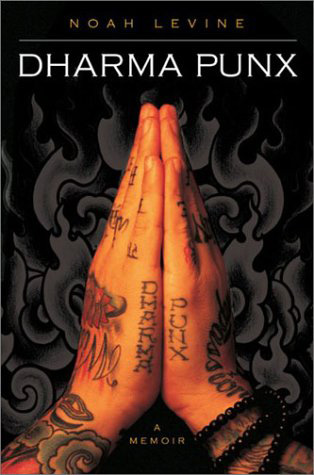
Dharma Punx is the title of a book published back in 2003 by Noah Levine (son of Stephen Levine) which documented his tough life as a drinking, drug-addicted punk rock jerk. After running out of stimulants and depressants and getting stuck in jail, Noah considered ending his life but turned towards meditation and healing as a means to pull himself out of this state of confusion and drama.

The book reads like the lives of many on the wrong path, but the ending is a happy one in that Noah turned things around, made peace with the ghosts of his past and decided to dedicate his life to helping and healing others.

As part of this service, Noah created the ‘Dharma Punx’ community to bring together those who either have walked a similar path of suffering or people who just appreciate punk music. He developed a series of teacher trainings to help cultivate facilitators in this Therevadan-oriented tradition and nationally groups have formed to sit, study and practice together.

Noah’s second book, “Against the Stream” was published in 2007 and is more of an instructive guide towards bringing Buddhism into daily life and has less of an autobiographical approach than his first book. This book spurred the development of the ‘Against the Stream Buddhist Meditation Society’ and the ‘Mind Body Awareness Project’ which are all committed to social action and activism in working with marginalized groups such at risk youth, the homeless and those who are incarcerated.

A great community of teachers motivated by the principles of socially engaged Buddhism has developed from these two organizations and super folks such as: Matthew Brensilver, Pablo Das, JoAnna Harper, Vinny Ferraro, Doug Achtert and Mary Stancavage all bring their specific flavour in delivering the Buddha’s teachings.

The punk rock koan – What is the sound of one tattooed hand clapping?
I’ve always been the quirky one in the meditation hall. Not coming from the traditional stream-enterer path of hippydom (sorry boomers), it was sometimes hard to find folks with the same interests as me and to connect on a level beyond that of a practitioner with sore sitting bones. Yes it may sound superficial or strange that being amongst a group that are looking to discover no-self, I’m bobbing around looking for other band shirt wearing selves like myself.  Maybe it’s going back to that high school desire to fit in, but hearing these shared stories from the dharma punx can give us ‘weirdo punx’ some sense of feeling that we’re not alone in our experiences. At a young age, it’s easy to want to be included in something and rather than go down a path of negativity, I’m happy that the option of finding a ‘dharma gang’ is available to those who seek it out.

New voices from young practitioners carry on the Buddha’s teachings and ensure the flourishing of the dharma here in the West. I’m so happy that this generation of Gen X Buddhists is unwilling to water down the original teachings of the Buddha and places importance as much on practicing on the cushion as that of being involved in working with the suffering of others.

Check it out for yourself:

A video interview with Noah Levine:

A treasure-trove of recorded teachings available via iTunes :

http://itunes.apple.com/us/podcast/against-the-stream/id313540278

Quote of the Week: Thomas Merton

Posted on

Thomas Merton and HH the Dalai Lama

Every once in a while I like to shake things up and include quotes from buddhas, not necessarily “capital B Buddhists.” Trappist monk Thomas Merton (1915 – 1968) falls into that category. Like Rev. Martin Luther King, Jr., Merton was also a contemporary of His Holiness the Dalai Lama and the Ven. Thich Nhat Hanh, and made great contributions to Christian-Buddhist dialogue.

This quote comes from Merton’s book Conjectures of a Guilty Bystander (1968), and seems especially relevant in today’s wired world.

The rush and pressure of modern life are a form, perhaps the most common form, of its innate violence. To allow oneself to be carried away by a multitude of conflicting concerns, to surrender to too many projects, to want to help everyone in everything is to succumb to violence….

The frenzy of the activist neutralizes his work for peace. It destroys his own inner capacity for peace. It destroys the fruitfulness of his own work, because it kills the root of inner wisdom which makes work fruitful.

___________________________________

If you enjoyed this post, I invite you to visit my other website: The Liberated Life Project — a personal transformation blog with a social conscience.

Odds and Ends

Posted on

Graduation Day at Upaya Zen Center

Lots to catch you up on… I’ve been away for a while because I was occupied with Upaya Zen Center’s Buddhist Chaplaincy Program for an intense 10-day period. During this time, we graduated and ordained our very first group of chaplains: thirteen brave souls who started in the program in 2008 and successfully completed all requirements, including a thesis-equivalent final project. And we welcomed 24 new students into the program.

It’s really quite an amazing program – part seminary training in Buddhist teachings and practice, part professional training in chaplaincy and servant leadership, and part mystery school. As one person put it, the program becomes a kind of karmic accelerator for one’s life. I’m honored to work with Roshi Joan Halifax in leading and shaping the program… and this year, I am putting myself in the training as well.

I continue to be in the middle of a busy stretch of life work. But a number of great socially engaged Buddhist items have crossed my desk and I want to pass them along to you. Here’s the shorthand version:

• Hozan Alan Senauke, founder of the Clear View Project, recently returned from a trip to India where he spent time with the “untouchable” communities of Maharastra. You can read his account of it here: “Buddhism Among India’s Most Oppressed: Notes & Impressions.”

• Ouyporn Khuankaew, an amazing, dynamic activist from Thailand, has been right here in Santa Fe for the past few weeks and I’ve loved getting to know her better. Her center, The International Women’s Partnership for Peace and Justice, is offering an event called “Women Allies for Social Change: Exploring Buddhism and feminism for personal and social transformation” in Chiang Mai, Thailand, this July. I’ve added it to the SEB Calendar on this blog.

Also, Ouyporn, Roshi Joan Halifax, and I are cooking up an idea to create a version of the Upaya Buddhist Chaplaincy Program for Thailand. Stay tuned for more developments on this initiative.

• Another project I’ve been involved with is helping to collect material for the companion website to the upcoming PBS documentary “The Buddha.” The show will be aired on April 7. There are a number of good articles there on socially engaged Buddhism, as well as many other topics.

• Finally, there’s been a lot in the news lately about Burma and Thailand. If you’re trying to sort it all out and have a better understanding of what’s going on in that part of the world, Danny Fisher’s Buddhist Beat column on the Shambhala Sun website is a good place to start.

And in case you’re wondering, I really don’t care about all this Tiger Woods/Buddhist news… my only wish for him as well as for everyone else: May all beings be free from suffering.

A Trio of Marvelous Engaged Buddhist Talks

Posted on

Jimmy Santiago Baca

We’re in a rich stretch of time here at Upaya Zen Center, where I direct the Buddhist Chaplaincy Program. On Sunday, we graduated 13 chaplains, and we’re currently training 43 students in our second and third cohorts. I’ll write more about all that soon.

For now, I thought you might enjoy three powerful dharma talks given here at Upaya over this past month. Upaya provides these as a service to the community; any donation you feel inspired to give to support these offerings is greatly appreciated.

Ouyporn Khuankaew on Feminism and Buddhism for Transformation
Ouyporn is the founder of the International Woman’s Partnership for Peace and Justice in Thailand. She begins by speaking about her motivation for becoming a peace activist and feminist. Ouyporn also discusses the meaning and importance of engaged Buddhism in Thailand.

Jimmy Santiago Baca on “Seeing it to the End (And All the Stops In Between)
Jimmy Santiago Baca begins with a variety of compelling stories related to his life in prison and the way in which writing and reading became an important part of his life at that time. He moves on to discuss his book “A Place to Stand”, and his present work teaching literacy in prisons.

Eve Ensler on “The Future is Girl”
Eve Ensler begins by speaking about the process of writing her new book, I’m an Emotional Creature. She also explores a variety of topics including the pressures on girls to conform, the importance of social change, and her work in the Congo.