RSS Feed

Author Archives: Maia

The Protest Chaplains: A new paradigm in chaplaincy during a time of social transformation (Part 1)

Posted on

I’ve been absent for a while from the Jizo Chronicles… my focus over the past two months has been on completing the Upaya Buddhist Chaplaincy Program (that’s been my journey over the past two years). Two weeks ago, I presented my thesis and then graduated and received lay ordination as a chaplain on March 11th.

I thought you might enjoy learning about what I’ve been spending my time on over the past few months, so over the next several posts I am publishing my thesis–which I believe is very relevant to socially engaged dharma.

At the end of October, I traveled to Boston to interview four of the Protest Chaplains who were present on the first day of OWS in New York City (September 17, 2011). All four were from Harvard Divinity School. I also spent time at the Occupy Boston campsite as a participant-observer (that’s my anthropology background coming out!). All this material informed my thesis.

Part 1, posted here, offers background on the concept of “Protest Chaplain” as well as the Occupy Wall Street Movement. If any of you would like the entire thesis as a Word document, let me know and I’m happy to share it with you. May it be of benefit.

Read the rest of this entry

Interview: Katie Loncke

Posted on

Katie Loncke (photo by Alan Senauke)

This is the fourth in our series of interviews with inspiring and interesting socially engaged Buddhists of our time. Previous guests have been Ven. Bhikkhu BodhiArun (author of the blog Angry Asian Buddhist), and Roshi Joan Halifax.

Today I’m very happy to share this space with Katie Loncke, who among many other things is the mind and heart behind the blog kloncke.com, which she describes as “a public interactive journal where I share my thoughts on Buddhism, radical politics, and how I am trying to live both.” (And where you can some times find some pretty fantastic recipes!)

I have been admiring Katie’s blog ever since I started the Jizo Chronicles, and finally got the chance to meet her last winter during a visit to the San Francisco Bay Area. In person, Katie has the same warmth and deep intelligence that shows up on her blog, and she challenged me (in a loving way) to think about how socially engaged Buddhism can be a more effective vehicle for change and justice.

I hope you enjoy getting to know Katie through this conversation.

The Jizo Chronicles: Where do you call home?

Katie: Born and raised in Sacramento, California; currently nesting in Oakland.

JC: What are you reading right now?

Katie: A few things.  Another Buddhist woman-of-color Marxist friend and I just finished the Introduction to Reading Capital Politically by Harry Cleaver, as a preparation to read Volume I of Marx’s Capital together.  Cleaver’s framework is really compelling, as he advocates using a strategic lens (rather than a philosophical or even economic one) from the perspective of the working class, which isn’t a distinction I ever heard reading Marx in college.

For a socially-engaged Buddhist study group with some folks at the Berkeley Zen Center, I’m excited to dive into a collection of correspondence letters between Gandhi and political leader Dr. B. R. Ambedkar.  Here in dominant U.S. culture, and especially among convert Buddhists, it would seem almost like heresy to criticize Gandhi.  But a lot of my political South Asian friends are not too keen on him.  So I’m really curious to learn more about the disagreements around the political and/or spiritual issues of the time, especially from a figure as compelling as Ambedkar.

Then, literature-wise, I’m slowly sipping Nikky Finney’s award-winning book of poems, Head Off and Split (gives me chills; I fell in love with her, as did many people, after watching her incredibly moving acceptance speech for the National Book Award).  And also a collection of short stories by Richard Ford, which I love for their crisp, down-to-earth observations of Midwestern working-class settings.

Finally, I’m constantly reading all kinds of articles online, culled from my friends’ Facebook feeds: dhamma pieces in Tricycle; news; political analysis.  It’s like a new treasure-trove every morning!

JC: Who inspires you – Buddhist teachers, activists, writers, artists…

Katie: Oh, goodness — the list would be long!  Just to narrow it down, let me offer a few groups that inspire me.

I think many of us have been inspired by the #Occupy / Decolonize movement, especially here in Oakland.  And of course the Arab Spring uprisings that kind of incited this new wave of imagination and irreverence for law enforcement, which I appreciate.  In figuring out how to build on the momentum, and incorporate this fire in sustainable ways, I really like the model of collective direct action groups — specifically the Seattle Solidarity Network, which bands working-class and poor people together to win specific demands from hyper-exploitative bosses and landlords.  They’ve won close to thirty fights in the past few years, and built some community confidence which I think has contributed to the impressive verve of Occupy Seattle.

Groups that link structural and interpersonal violence, and confront racism and gender hierarchy directly, I also love.  Here in the Bay, Communities United Against Violence (CUAV) does wonderful work.

In the Buddhist world, I’m super inspired by groups that offer teachings completely on a dana basis, and invite a lot of volunteer work.  I think this is somewhat endemic to traditional Asian Buddhist communities.  The main ways I’ve experienced it are through Vipassana meditation centers in the S. N. Goenka school (I lived and served at one such center in Spain for a few months), and through the East Bay Meditation Center.  Both places have been very welcoming to really diverse communities of practitioners (at my last Vipassana retreat, discourses were translated into Burmese, Vietnamese, Hindi, and Khmer — and students themselves also spoke Farsi, Brasilian Portuguese, Spanish, so many languages!), and I think that the dana / volunteer structure really supports that.

Revolutions and mass movements inspire me.  I feel mudita around the recent successful general strike in Nigeria, which restored the oil subsidies.  Waves of strikes in China, hella dope.  Of course there are big names in mass movements, and in some ways it’s wonderful to have heroes, but I’m equally inspired by the way that people get up early every day, try to eke out a living under capitalism, and meanwhile try to take care of each other, organize, and pursue freedom.  That’s wonderful.

JC: What social issue is close to your heart right now?

Katie: I mentioned the Seattle Solidarity Network; I’ve been fascinated and encouraged by the (re-)emergence of solidarity networks for casualized or “precarious” workers.  These are typically “at-will” employees in low-wage jobs, often part-time or temporary with little or no benefits, and scant career prospects at any particular company.  Without a common industry or large shop floor to form the basis of a union, these precarious workers are finding other ways to build their strength in numbers.

I’ve spent the last year trying to form a brand-new solidarity network here in Oakland, for precarious workers and unemployed people, and it’s so wonderful to see the delight and astonishment on people’s faces when they meet perfect strangers who have shown up to support them in their struggle.  Not out of charity, but out of solidarity: asking them, in turn, to support us when we need backup.  It’s really very moving.  A security guard shows up for a domestic worker’s fight, then they both go together to a mass action against police brutality.  A hotel worker shows up for a Whole Foods worker; strangers support someone fighting a bank that’s foreclosing on their home. And over time we work together, organize together, trying to realize and build our own collective power.

JC: How does your dharma practice inform your involvement on that issue?

Katie: On a micro-level, of course, the patience, mindfulness, clear-sightedness and compassion that tend to develop naturally through dharma practice have been a big help to me, and would be to any organizer, I think.  There are a few of us in the solidarity network here who practice meditation, and others have expressed interest in learning, or sitting together.  I dream of getting a sitting group going for anti-capitalist Buddhists, called the Bay Area Radical Sangha.  This might be the year!

On a larger scale, exploring interdependence has really shaped the way I understand solidarity.  I don’t have to “know” someone in order to comprehend that we are connected — spiritually, and through local and global systems.  The workers at the Foxconn factories in China, who face penalties of twelve years in prison for attempting to unionize, probably helped produce this laptop I’m typing on.  And they must continue to work under unbearable conditions; otherwise, they and their families won’t eat.  But their situation won’t improve, necessarily, if I give up my laptop, or stop buying Apple products.  Instead (in my opinion) I am called to practice compassion and solidarity by supporting the actual struggles of the workers, and similar struggles of workers and peasants not only abroad but in the U.S. as well.  (For a beautifully written, Buddhist-informed examination of struggles in the U.S. among Certified Nursing Assistants, I’d encourage everybody to read this piece.  And get ready to support increasing organization of workers in the health care industry!)

Ultimately I believe that a commitment to non-harming means tapping into the interdependence that already exists, but which is laden with structural violence, and transforming it into a new, more loving mode of interdependence.  One based on the premise that ordinary people, just like you and me, are capable of working together to run society!  Historically it has only been the wealthy upper classes and owners who direct the pace and style of production in order to maximize profits.  But I actually think that the regular people of the world could do a much better job of running things.  All kinds of people: queers, women, people of color, the young, the old, fat people, people with various religious beliefs, people with all kinds of abilities and skills and contributions.  I have faith in us.  We will do an excellent job at ensuring universal food, clean water, shelter, clothing, medicine, education — all of these — once we have collective control over the reproduction of humanity.  And solidarity is key not only to this re-imagined society, but to the process of getting there.

JC: If you could invite people to join you in taking one action on that issue, what would it be?

Katie: Well if you’re interested in starting a solidarity network in your town, by all means check out this helpful guide from SeaSol, which lets you know how to get started.  But for those who don’t have that kind of time, I’d encourage folks to explore solidarity through collective direct action like joining a picket line.

Though I’d attended plenty of protests, most of which were symbolic (stop the war, demand reproductive justice, etc.), I had never stood on a picket line before two years ago.  Since then I’ve organized pickets, and also walked with nurses, Red Vines candy makers, university students, hotel workers, former Whole Foods workers — all kinds of people fighting for better job conditions.  It’s given me a much deeper appreciation for one way that people work together to reclaim their bodies, the labor-power of their bodies, in interrupting business-as-usual.  With all the austerity measures and company cutbacks happening all over the country and the world, and all the organized resistance bubbling up, it should not be too hard to find a picket line to join!

JC: What else would you like people to know about you?

Katie: I think it might be useful to say that even though I practice Marxism, and have some pretty strong opinions about politics and social justice, I also love dialoguing with people — not just shutting down debate and thinking that I have all the answers.  I say this because Marxists can get a pretty bad rap as dogmatic and cultish weirdos, lol!  But I — and the communities I run with — we’re just doing our best to engage some big questions that many people have been engaging for a long time — and that you yourself are also engaging here on Jizo Chronicles. How do we create a society that produces for collective need and well-being, rather than privatized profit?  A society where ordinary people exercise direct co-operative control over the places where they live and work every day?  Where no individuals can “own” the resources that everyone — including non-human animals and the earth’s ecosystems — relies on to survive and thrive?

The word I use for this kind of reimagined society is communism.  I know that word is triggering for a lot of people, and especially for those who’ve had close dealings with so-called “communist” regimes that are actually state-capitalist or basically dictatorships.  But that’s not what I mean by it.

Working toward real communism, like vowing to liberate all beings from suffering, may seem futile, but it is not.  We take it seriously.  We even make plans, though we don’t presume to know exactly how everything will happen.  This stuff is complex!

Anyway, thank you so much, Maia, for asking me these simple but powerful interview questions.  It’s been an honor and a real treat.

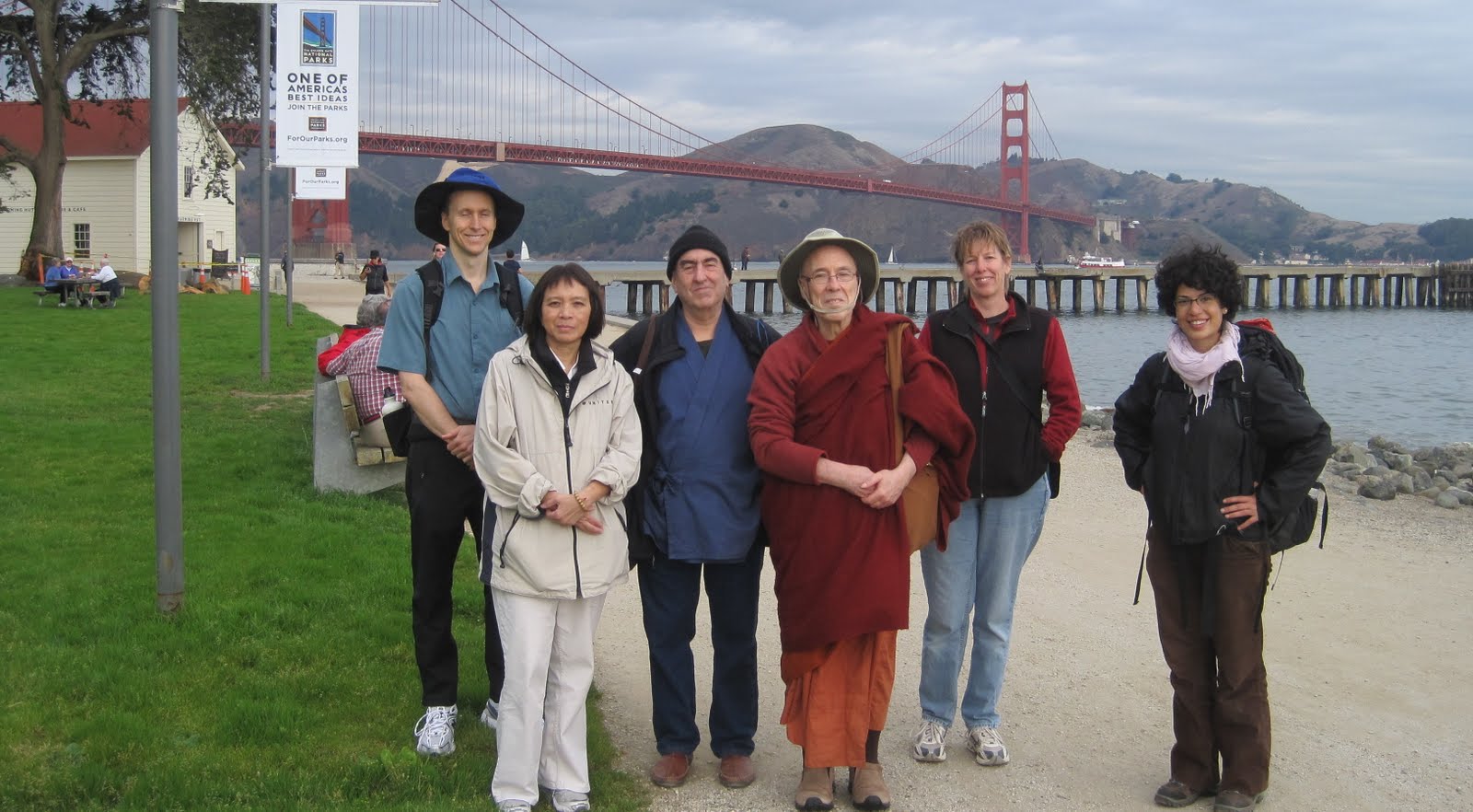
A bunch of engaged Buddhists out for a walk.... L to R: Jeff Hardin, Kim Behan, Alan Senauke, Bhikkhu Bodhi, Maia Duerr, Katie Loncke

2011: The Year in Engaged Buddhism

Posted on

Day 31 at Occupy Wall Street (photo by David Shankbone)

Last December, I published a round-up of highlights from the year in socially engaged Buddhism. Here I continue that tradition and take a look back at 2011. As always, I welcome reader comments about important events or trends that I’ve missed. The Jizo Chronicles is always a much better blog when it’s co-created with my readers!

  • Early in the year, issues of gender, power, and sexual relations in the dharma world were very much in the spotlight. In August, 2010, The New York Times published a story about the sexual improprieties of Zen teacher Eido Shimano. This set off a volley of letters and articles from within the Buddhist community that continued into January 2011, including this one from Roshi Joan Halifax.  Just a few weeks later, the same issue arose with Genpo Merzel and over the summer, within a Chicago Theravadin temple as well. Clearly, this topic is very much alive for all of us and needs to continue to be addressed in an open and constructive way in our sanghas. (By the way, one little-known resource for grappling with these matters is the book Safe Harbor: Guidelines, Process, and Resources for Ethics and Conduct in Buddhist Communities by Hozan Alan Senauke.)
  • In February and March, thousands of people congregated in the Wisconsin Statehouse in to protest the draconian budget cuts being proposed by Governor Walker. Among them were members of sanghas from Madison and other parts of the state, holding a space for equanimity and compassion. This uprising of “people power” and grassroots democracy foreshadowed the Occupy movement that would emerge in fall of 2011.
  • On March 11, the northern region of Japan was hit first by an earthquake with an 8.9 magnitude and then by a huge tsunami. The area was devastated by these dual natural disasters, and then came the worst news – waters from the tsunami had flooded nuclear reactors in Fukushima, triggering a nuclear meltdown. As always, the good folks from the Tzu Chi Foundation, a Buddhist-based relief organization, were on the ground offering assistance almost immediately. Buddhists from around the world contributed to help relieve the suffering, and Joanna Macy and Thich Nhat Hanh offered wise words.
  • Also in March, the Buddhist Council of the Midwest named Ven. Pannavati-Karuna as the winner of the “Women and Engaged Buddhism Prize.” Ven. Pannavati founded “My Space,” a nonprofit organization in North Carolina dedicated to providing a positive youth development program for homeless and at-risk youth.
  • Thai Buddhist activist Sulak Sivaraksa was the recipient of the 28th Niwano Peace Prize, awarded in Tokyo in May. The award was given “in recognition of his contribution to a new understanding of peace, democracy and development and to environmental preservation based on the core principles of his Buddhist faith.”
  • September 17 marked the beginning of Occupy Wall Street, which would soon explode into a global Occupy movement. Though voices from the Buddhist community were sparse in the first few weeks of the movement, by October more dharma practitioners were expressing solidarity with the spirit and values of Occupy. Tenzin Robert Thurman showed up at Zuccotti Park to talk about “a cool revolution,”  I penned this article with Roshi Joan Halifax which appeared in the Huffington Post, and Michael Stone and Ethan Nichtern organized Buddhist teachers and practitioners to sign onto this letter of support.
  • Another highlight of October was the bi-annual International Network of Engaged Buddhists conference, held this year in Bodh Gaya, India. The theme was “The Future of Buddhism: From Personal Awakening to Global Transformation,” and speakers included Anchalee Kurutach, Alan Senauke, Mangesh Dahiwale, Roshi Joan Halifax, Jeyanthy Siva, and Sulak Sivaraksa. 
  • Throughout 2011, an important background story was Aung San Suu Kyi’s increasing involvement in the political scene of Burma (Myanmar). Since her release from house arrest in November, 2010, Suu Kyi has taken part in numerous dialogues about the situation in her country, both with Burmese officials and with international journalists and diplomats (including U.S. Secretary of State Hillary Clinton). For some commentary on this development and the current conditions in Burma, see Hozan Alan Senauke’s piece, “Burma Back at the Crossroads.”

In my own life, I’ve loved continuing to work closely with Roshi Joan Halifax on co-directing Upaya’s Buddhist Chaplaincy Training Program, which I think of as a bodhisattva academy. This was a landmark year in which the Association of Professional Chaplains recognized our program as the equivalent of 42 graduate credits. I’ve been taking the program myself as student these past two years, am currently writing my thesis on the Protest Chaplains of the Occupy Movement, and if all goes well I will be ordained as a lay chaplain next March.

Because of my increased investment of time at Upaya this year, I’ll be posting less original material on the Jizo Chronicles in 2012. However, I will continue with my interview series here, as well as keeping the Calendar of Events updated. You can find more of my reporting on socially engaged Buddhism by looking over at Upaya’s blog.

And I’d love it if you’d check out my Liberated Life Project site and subscribe to it if you feel moved.  That’s where most of my original writing is going these days. I think of it as a “no-self, no-improvement” blog, in true dharma fashion : )

May all beings be happy, safe, and free in 2012…

Maia

Seasons Greetings

Posted on

In the snow a single twig of plum blossoms!
The whole universe is plum blossoms.

~Dogen

___________________

Wishing all my readers a blessed holiday season…
May all beings dwell in peace, joy, and sufficiency this coming year.

~Maia

Why I’m Involved in the Occupy Movement

Posted on

On the Occupy Santa Fe panel with Tania Chavez, Ryan Hinson, and Robert McCormick

This past week, I was invited to be on a panel (along with three other people) at our local Unitarian Universalist Church and to speak about my perspective on the Occupy Movement.

Here are the questions that we were invited to address:

  • If you have a history of activism, talk a little about that first.
  • What brought you to the Occupy generally and Occupy Santa Fe in particular
  • What have been your primary roles in Occupy Santa Fe
  • What are your greatest hopes for Occupy
  • What are your greatest concerns about Occupy
  • Where do you think the Occupy movement is headed

If you’re still on the fence about this movement, I encourage you to read on.

One of my big messages to the audience at the UU church was: get involved. I can think of no reason why anyone who has an income of less than $100,000 a year would not benefit from investing your time and energy in this movement in order to help midwife a systemic shift from greed and competition toward generosity and cooperation.

And even if you are one of the folks who is blessed with a higher income, I strongly believe that you will benefit as well. How truly happy can any of us be when we live in a society that has as much economic injustice and disparity as ours does? This movement will not really succeed until 99% becomes 100%.

Make no mistake – this work is as much internal as it is external. This, to me, is the intersection with socially engaged Buddhism. Think of the world in terms of the three poisons: greed, hatred, and delusion. The Occupy Movement is all about addressing the harm caused by corporate greed — but this is not separate from addressing the seeds of greed that live within each of us. There’s a lot more to say about that, of course, but I’ll save that for another post.

So, here’s what I offered to the UU panel this week:

If you have a history of activism, talk a little about that first.

First, I have to say that I’m not particularly fond of the term “activist.” I think it has a way of excluding people who might be inspired to take action, but think of “activists” as a different kind of people who wear Birkenstocks and patchouli. I think a better term is “people who care.” Because ultimately, I think all of us care about the world we live in and probably want to make it better for ourselves and our loved ones.

Having said that, my own path to becoming a more caring person started when I was in my 20s and I worked as a mental health counselor in New Haven, CT. I witnessed how many of my clients were suffering not only because of their psychiatric challenges, but often more so because of the system they had to live in… a lack of affordable housing, abysmal medical and psychological care for those who had no resources, social stigma.

Over and over, I saw my clients ending up back in state mental hospitals – not so much because of their illness, but because it was simply too difficult to survive in that environment.

I went on to get a graduate degree in anthropology and that helped me to understand the situation I had witnessed from a more systemic perspective. I began to see how structural violence unfolds and plays out in our economic system, our health care system, and other locations. So often in our culture, individual people get blamed – for not working hard enough, for not being tough enough, it goes on and on. When you look at a whole system, you realize it’s bigger than any one person and that these systems do have an effect on the way we live our life. That’s not to remove individual responsibility entirely, but it’s not the whole story.

I became very involved in social change work in Buddhist communities and I worked at the Buddhist Peace Fellowship, a national nonprofit based in the SF Bay Area, for many years. I was part of the movement to end the war in Iraq and was arrested for civil disobedience at the start of the war, in March 2003.

What brought you to the Occupy generally and Occupy Santa Fe in particular?

Like many of us, I think, I have had a deep sense that something was wrong in the country, and in the world, for many years now. For me, that’s taken the form of addressing the rampant militarism in our country, the wars in Iraq and Afghanistan, and also trying to address diversity issues and educate myself about how racism, classism, and other kinds of oppression play out in our lives. But my activism has felt very fragmented because I felt like all of these were just part of the problem, and somehow we weren’t coming at the thing in a holistic way.

When the Occupy movement came along, it took me a couple of weeks or so to fall in love with it, but I finally did because my sense was that something in this movement was connecting all the dots. You could sense it when you watched the people in Zucotti Park as they held meetings and struggled valiantly with being a true participatory democracy.

I believe the Occupy movement has the potential to link people together across diverse groups, because all of us are being so dramatically impacted by one thing: corporate greed (and if we trace the source of this back even further, we begin to see how pervasive are the destructive effects of colonization).

What have been your primary roles in Occupy Santa Fe?

I’ve been to several GA meetings and participated in several of the actions and marches in October. I’ve also been helping to reach out to faith communities in Santa Fe and get them involved, as part of the Outreach and Inclusivity working group. I’m a firm believer that the most effective social change movements have spiritual and religious leaders supporting them at their core, and so that’s where I feel I can most effectively plug in. Last month I took a trip to Boston to visit the Occupy site there and to learn more about all that they’ve been doing to cultivate the faith and spirituality dimension of this movement (including the “Protest Chaplains”).

What are your greatest hopes for Occupy?
What are your greatest concerns about Occupy?
Where do you think the Occupy movement is headed?

My greatest hope for Occupy is, on one level, that there can be some economic justice achieved and that we can right some of the wrongs that have happened over the past two decades. It is simply wrong, for example, that a CEO like Charles Prince of Citigroup has had absolutely no consequences for overseeing massive and intentional securities fraud. It is wrong that corporations like Bank of America are able to use so many tax loopholes.

But on a deeper level, I think Occupy can be much more than that.

I really see Occupy as a laboratory for our future society. I love what one person said to me. She said she thinks of the word “demonstration” quite literally – that we are demonstrating an alternative way to live on the planet. Another way to think of it is through the profound words from Mahatma Gandhi: “Be the change you wish to see in the world.”

And so that’s what is going on as we watch the Occupy campsites figure out ways to take care of all the people who live there, to make sure everyone has food and healthcare, to create sacred spaces for people to come together even if they may not agree on everything.

Some have critiqued the movement for not having made clear demands. There actually is a clearly articulated platform that names what is wrong with the current system and puts forth some alternatives. But maybe even more importantly, we need to realize that the change we are envisioning may not be possible within the current system. Charles Eisenstein writes about this eloquently in his piece, Occupy Wall Street: No Demand is Big Enough.

We have no idea where this dimension of Occupy is going, and in a lot of ways it’s the most tricky thing that we’re doing, because we all carry our old baggage with us, both psychological and collectively.

And that’s really my greatest concern, especially in relationship to Occupy here in Santa Fe. We’d be fooling ourselves if we didn’t see how the Occupy site here and our group is a microcosm of our community. We are dealing with all the same divisive issues that our community as a whole deals with – homelessness, addiction, divisions between those who have lots of money and those who don’t, racism, and more.

So how well we are able to navigate through those divisions with love and kindness (and to be keenly aware of our own tendencies toward greed, anger, and delusion) will make the difference in the success of this Movement.

If I have one big hope for OSF and the Occupy Movement at large, I think it’s best summed up in this quote that comes from Francisco “Pancho” Ramos Stierle, the young man who was recently arrested while meditating at the Occupy/De-colonize Oakland site:

“Our victory is not about putting the right kind of people in power,
but putting the right kind of power in people.”

__________

So those are my current thoughts about the Occupy Movement. How about you?

Two Good Things for Jizo Chronicle Readers

Posted on

This short post is just to let you know about two things I created recently that you might be interested in —

• A free e-book called “Collected Words” — I compiled some of my favorite pieces of writing over the years and am giving it away to celebrate my birthday (which was last Sunday). There are a number of essays on engaged Buddhism in the book, which is available for download on my other blog, The Liberated Life Project.

“Fully Engaged!” — a toolkit for small nonprofit organizations who are looking for help with marketing. There’s a special 25% discount on the kit until 7 pm (Pacific Time) tomorrow, November 30th.

We’ll return to our ‘regular programming’ in the next post — thanks for reading!

May you be well,

Maia

Bodhisattvas of Great Strength…

Posted on

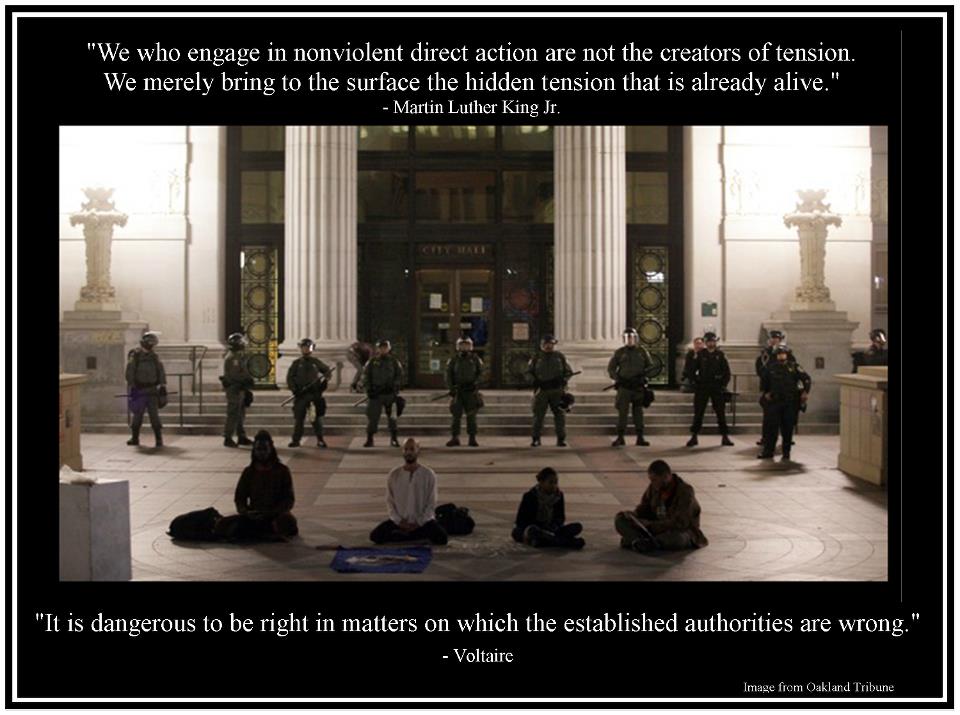
Photo from Oakland Tribune

 During the short aeons of swords,

 They meditate on love,

 Introducing to nonviolence

 Hundreds of millions of living beings.

 In the middle of great battles

 They remain impartial to both sides;

 For bodhisattvas of great strength

 Delight in reconciliation of conflict.

 In order to help the living beings,

 They voluntarily descend into

 The hells which are attached

 To all the inconceivable buddha-fields.

—Vimalakirti Sutra

Photo taken in Oakland, CA, Nov 14, 2011; Francisco “Pancho” Ramos-Stierle and friends, sitting in meditation in front of the City Hall, prior to being arrested.

Holiday Shopping 2011: Donkeys, Dharma, and more

Posted on

[Originally posted on The Jizo Chronicles the past two years; this has always been a popular post, so I’m offering it again with some updates.]

There are all kinds of ways to deal with the upcoming holiday shopping season. One is to buy nothing on the day known as “Black Friday,” an action pioneered by Adbusters. Gary Gach gives a  dharma perspective on “What Would Buddha Buy?” (the answer: not too much, not too little).

Another approach is to take part in the cycle of giving and receiving, but to do it in a way that may be of benefit to others. Generosity is, after all, one of the basic Buddhist virtues.

If living beings knew the fruit and final reward of generosity and the distribution of gifts, as I know them, then they would not eat their food without giving to others and sharing with others, even if it were their last morsel and mouthful.
~ Avadana Jataka

I am a big donkey lover. I’m not sure I can even tell you why, but I am. So, last holiday season, I was tickled pink when a friend of mine sent me a donkey as a gift. The only catch was that my donkey was actually given to a farmer in Darfur, on my behalf, through Oxfam America. It turns out that donkeys are a key piece of helping farmers there to become more self-sufficient. The donkeys can transport materials, help with cultivating the fields, and they can also be hired out to others. It was one of the best gifts I’ve ever received.

If you’re looking for a way to give a gift that does more than gather dust and may make a difference in someone’s life, here’s a list of suggestions starting with two that have an impact in Buddhist countries:

• Adopt a Monk or Nun from Burma’s Saffron Revolution
The Clear View Project invites you to “Adopt a Monk” to help bring attention to the false imprisonment of the monks and nuns in Burma. The Assistance Association for Political Prisoners of Burma (AAPPB), reports that when the international community shines a light of attention on particular prisoners, their lot improves.  When one prisoner’s life improves, hope is restored.

• Sponsor a Tibetan Nun
Through this sponsorship program, the Tibetan Nuns Project supports over 700 nuns living in northern India. For less than $1 per day, sponsors can provide a nun’s basic necessities. One hundred percent of sponsorship money goes directly to India to meet the nuns’ living expenses. The TNP also makes a great calendar you can purchase on their website as well.

• The Fifth Annual Shambhala Sun Auction
The Shambhala Sun Foundation is an independent non-profit operating in the United States and Canada. The Foundation has a deep commitment to presenting the perspectives of all genuine Buddhist traditions through its publications (Shambhala Sun and Buddhadharma) and other ventures. This online auction starts on December 1st and ends on Dec. 11. Some of the items up for bid include signed books from Alice Walker, retreats at Upaya Zen Center and the Barre Center, and zafu and zabuton sets.

• Seva Foundation’s Gifts of Service
Through Seva, your gift can help restore sight to a blind person in Tibet, Nepal, India, Cambodia or Guatemala, or support other projects that alleviate suffering caused by poverty and disease. Seva works with local people to create sustainable solutions.

• Oxfam America
Oxfam America – the givers of the aforementioned donkey – is an international relief and development organization that creates lasting solutions to poverty, hunger, and injustice. Besides the donkey, other gifts include mosquito nets for a family in Africa, a dozen chicks that will provide eggs and income for an HIV/AIDS-infected household, and support for indigenous craftswomen

• Changing the Present
Changing the Present is a clearinghouse of gifts that “change the world.” Shop here to give everything from an afternoon of tutoring for inner city kids to funding a loan for a widow in India to start her own business. Nonprofits can also register on this site so that more people can learn about their cause.

• Equal Exchange
Equal Exchange is the largest Free Trade company in the US. You can buy organic coffee, tea, sugar, cocoa, and chocolate bars produced by democratically run farmer co-ops in Latin America, Africa, and Asia.

• The Womens’ Peace Collection
The Womens’ Peace Collection an enterprise that fully supports women in regions of conflict and post-conflict as mothers, peace builders and skilled artisans. Their website features handmade jewelry, textiles, and other gifts from around the world, including “dolls of compassion” crafted by Karenni women living in a refugee camp on the Thai-Burma border.

• Lulan Artisans: Contemporary designs fused with ancient weaving techniques to create extraordinary hand-woven textiles, apparel, and products for the home. Your purchase helps to support more than 650 weavers, spinners, dyers and finishers in weaving cooperatives in Cambodia, Laos, Thailand, Vietnam and India.

• No Sweat: Union-made footwear and casual clothing. “Our gear is produced by independent trade union members in the US, Canada, and the developing world. We believe that the only viable response to globalization is a global labor movement.”

• The Global Center for Cultural Entrepreneurship’s blog has a good list of “Ten Places to Buy Gifts That Support Women Artisans”

And here’s a great column, “The Gifts of Hope,” by Nicholas Kristof published in the Dec. 18, 2010 New York Times.