RSS Feed

Category Archives: Quotes

Quote of the Week: Thomas Merton

Posted on

Thomas Merton and HH the Dalai Lama

Every once in a while I like to shake things up and include quotes from buddhas, not necessarily “capital B Buddhists.” Trappist monk Thomas Merton (1915 – 1968) falls into that category. Like Rev. Martin Luther King, Jr., Merton was also a contemporary of His Holiness the Dalai Lama and the Ven. Thich Nhat Hanh, and made great contributions to Christian-Buddhist dialogue.

This quote comes from Merton’s book Conjectures of a Guilty Bystander (1968), and seems especially relevant in today’s wired world.

The rush and pressure of modern life are a form, perhaps the most common form, of its innate violence. To allow oneself to be carried away by a multitude of conflicting concerns, to surrender to too many projects, to want to help everyone in everything is to succumb to violence….

The frenzy of the activist neutralizes his work for peace. It destroys his own inner capacity for peace. It destroys the fruitfulness of his own work, because it kills the root of inner wisdom which makes work fruitful.

___________________________________

If you enjoyed this post, I invite you to visit my other website: The Liberated Life Project — a personal transformation blog with a social conscience.

Quote of the Week: Maha Ghosananda

Posted on

A previous “Quote of the Week” featured Maha Ghosananda — the Gandhi of Cambodia. You can see his biography from that post here. Thanks to Larry Yang’s website, I just came across these wonderful words:

I do not question that loving one’s oppressors — Cambodians loving the Khmer Rouge — may be the most difficult attitude to achieve. But it is a law of the universe that retaliation, hatred, and revenge only continue the cycle and never stop it. Reconciliation does not mean that we surrender rights and conditions, but rather that we use love in our negotiations. It means that we see ourselves in the opponent — for what is the opponent but a being in ignorance, and we ourselves are also ignorant of many things. Therefore, only compassion and mindfulness can free us.

Quote of the Week: Jarvis Jay Masters

Posted on

I don’t have much typing speed today because my fingers are recovering from some dog bites, the result of an instinctive (and not so smart) move to try to break up two fighting dogs. As one friend said, peacemaking can be risky!

No one knows this better than Jarvis Masters, the Buddhist practitioner and San Quentin inmate from whom this week’s quote comes.

Jarvis has spent the past 29 years (since he was 19 years old) in San Quentin, one of California’s highest security prisons. For many of those years, he has been on Death Row, though he did not murder anyone. (You can read more about his story here.)

Jarvis began studying Buddhism while incarcerated and in 1989 took vows from Chagdud Tulku Rinpoche. He also practiced writing during his time inside as well, and is the author of two books: Finding Freedom: Writings From Death Row, and That Bird Has My Wings.

Jarvis is one of the best writers I know. I had the honor of corresponding with him when I edited The Mindfulness Bell and Turning Wheel and appreciated the kindness in his letters to me. His life has not been easy, but he’s put himself wholeheartedly into it, whether he is being a peacemaker with other inmates, joking with his guards, or sitting in his cell. He brings his Buddhist practice and mindfulness to every situation, surely one of the most challenging settings in which to be an ‘engaged Buddhist.’

This comes from Jarvis’ first book, Finding Freedom:

When I first entered the gates of San Quentin in the winter of 1981, I walked across the upper yard holding a box called a “fish-kit” filled with my prison-issued belongings. I saw the faces of hundreds who had already made the prison their home. I watched them stare at me with piercing eyes, their faces rugged and their beards of different shades-all dressed in prison blue jeans and worn, torn coats-some leaning against the chain fences, cigarettes hanging from their lips, others with dark glasses covering their eyes.

I will never forget when the steel cell door slammed shut behind me. I stood in the darkness trying to fix my eyes and readjust the thoughts that were telling me that this was not home-that this tiny space would not, could not be where I would spend more than a decade of my life. My mind kept saying, “No! Hell no!” I thought again of the many prisoners I had seen moments ago standing on the yard, so old and accustomed to their fates….

After the first days had passed, I decided to decorate my walls with photographs from the National Geographic magazines. The landscapes of Malaysia and other parts of the world had enormous beauty, and I gladly pasted photos of them everywhere. These small representations of life helped me to imagine the world beyond prison walls.

Over the years, I collected books and even acquired a television and radio-windows to the outside world. And I pasted many thousands of photographs on the wall. The one that has made my prison home most like a sanctuary to me is a small photograph of a Buddhist saint that a very dear friend sent to me. It has been in the center of my wall for a number of years.

I now begin every day with the practice of meditation, seated on the cold morning floor, cushioned only by my neatly folded blanket. Welcoming the morning light, I realize, like seeing through clouds, that home is wherever the heart can be found.

___________________________________

If you enjoyed this post, I invite you to visit my other website: The Liberated Life Project — a personal transformation blog with a social conscience.

Quote of the Week: Bernie Glassman

Posted on

Bernie Glassman is both an iconoclast as well as a steeped-in-tradition Zen master, in the White Plum lineage of Taizan Maezumi Roshi.

Brooklyn-born and bred, Bernie studied engineering and mathematics and worked for a number of years as an aeronautical engineer for McDonnell-Douglas. The book The Three Pillars of Zen by Philip Kapleau inspired him to study and practice Buddhism. Bernie received dharma transmission from Maezumi Roshi in 1976 and then inka in 1995.

Bernie’s output over the past three decades has been amazing. He started the Greyston Bakery in 1982 in Yonkers, NY, which eventually grew into the Greyston Foundation — an array of social services to the surrounding neighborhood that was based in Zen principles and aimed to empower all who were part of its mandala. He also started the Zen Peacemakers, devoted to the exploration and practice of socially engaged Buddhism. One of the main practices of the Zen Peacemakers is “Bearing Witness” — retreats that invite participants to intimately enter into the stream of reality of those who are homeless or in other situations of suffering.

Bernie’s latest project is “Zen Houses.” These will be small, Buddhist-based residential communities around the world that focus on serving the needs of members of that area.

This quote is from Bernie’s book Bearing Witness: A Zen Master’s Lessons in Making Peace:

When we bear witness, when we become the situation — homelessness, poverty, illness, violence, death — the right action arises by itself. We don’t have to worry about what to do. We don’t have to figure out solutions ahead of time. Peacemaking is the functioning of bearing witness. Once we listen with our entire body and mind, loving action arises.

Loving action is right action. It’s as simple as giving a hand to someone who stumbles or picking up a child who has fallen on the floor. We take such direct, natural actions every day of our lives without considering them special. And they’re not special. Each is simply the best possible response to that situation in that moment.

Quote of the Week: Roshi Joan Halifax

Posted on

For this week’s quote, I’m very happy to feature my friend and root teacher Roshi Joan Halifax. Roshi has led a remarkable life, one filled with adventure, great humor, intelligence, creativity, compassion, and, most of all, friends.

Trained as a cultural anthropologist, Roshi has spent time with indigenous people in Africa, Tibet, and Mexico. During the Sixties, she was deeply involved in Civil Rights and anti-war movements.

Roshi began practicing Buddhism with Korean Zen master Seung Sahn, and through the years has also studied with Ven. Thich Nhat Hanh and Roshi Bernie Glassman. When Glassman Roshi gave her inka in 1998, she became the first female dharma successor in the White Plum lineage.

Roshi Joan has created many engaged Buddhist institutes and programs including the Ojai Foundation, Upaya Zen Center and Institute, the Being With Dying program that has pioneered work in contemplative end-of-life care, and the Upaya Buddhist Chaplaincy Program. And that’s just to name a few. I’ve often thought that a day in Roshi’s life is the equivalent to about a year in mine, in terms of her creative output and the number of people she reaches through her work.

She is  very passionate about the intersection of neuroscience and meditation and serves on the board of the Mind & Life Institute. Roshi is also one of the most digitally accessible dharma teachers around – she’d be happy to have you follow her on Facebook and Twitter.

This quote is an excerpt from Roshi’s book The Fruitful Darkness, published in 1993. It’s a beautiful book, blending Buddhism, tribal wisdom, and deep ecology – one well worth putting on your reading list.

Many Buddhists have believed that the Bodhisattva Avalokiteshvara (enlightened hero of compassion) is beyond gender. According to the Lotus Sutra, this deity transforms the body and becomes a female, male, soldier, monk, god, or animal to save various beings from suffering. When he/she looked out into the world and saw the immense suffering of all beings, he/she shed tears of compassion….

…The eyes of Kanzeon see into every corner of Calcutta. The ears of Kanzeon hear all the voices if suffering, whether understandable to the human ear, or the voices of felled cedar and mahogany or struggling sturgeon who no longer make their way up Mother Volga to spawn. The hands of Kanzeon reach out in their many shapes, sizes, and colors to help all forms of beings. They reach out from the ground of understanding and love….It is understood that the craft of loving-kindness is the everyday face of wisdom and the ordinary hand of compassion. This wisdom face, this hand of mercy, is never realized alone, but always with and through others. The Buddhist perspective shows us that there is no personal enlightenment, that awakening occurs in the activity of loving relationship.

Quote of the Week: Buddhadasa Bhikkhu

Posted on

Buddhadasa Bhikkhu (1906 – 1993) is one of the founders of modern socially engaged Buddhism, and was a key person in the reformation of 20th century Thai Buddhism.
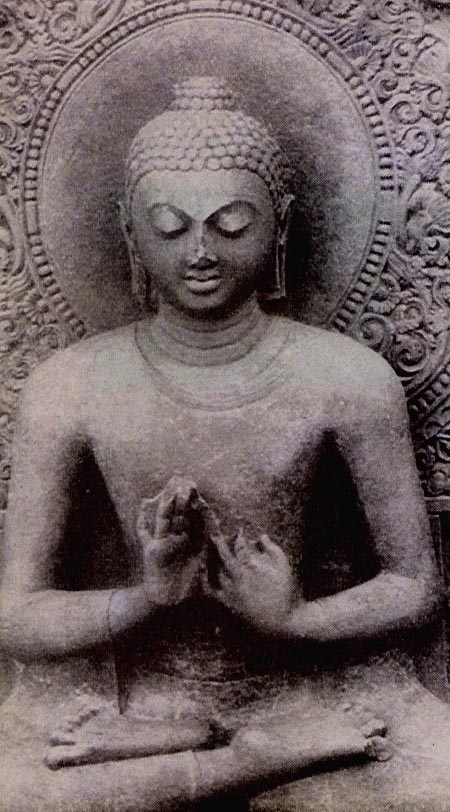
Born in Thailand (then called Siam), Buddhadasa became a monk in 1926. However, he soon became very concerned by the corruption of the monastic sangha and its preoccupation with money, politics, and comfort. He returned to the rural area of his birth and founded the forest monastery Suan Mokkh, which means “Garden of Liberation.”

Through Suan Mokkh, his talks, and his books, Buddhadasa strove to practice a Buddhism that was closer to the spirit of its original source. He once wrote, “People…have become attached to and view Buddha as a god instead of seeing him as a human being who attained enlightenment and had great compassion for others. They are not aware that Buddha teaches that anyone can follow his path and find the way out of suffering by and for themselves.”

He was very ecumenical in his understanding of Buddhism, and also reached out to members of other religions including Christians, Muslims, Hindus, and Sikhs.

Buddhadasa’s teachings, and especially his emphasis on interdependence, inspired a generation of Thai social activists and artists, including Sulak Sivaraksa and many of the monks who have protected Thai forests.

This week’s quote from Buddhadasa comes from Donald K. Swearer’s essay “The Three Legacies of Buddhadasa Bhikkhu” (in The quest for a just society: the legacy and challenge of Buddhadasa Bhikkhu, ed. by Sulak Sivaraksa).

The entire cosmos is a cooperative. The sun, the moon, and the stars live together as a cooperative. The same is true for humans and animals, trees and soil. Our bodily parts function as a cooperative. When we realize that the world is a mutual, interdependent, cooperative enterprise, that human beings are all mutual friends in the process of birth, old age, suffering and death, then we can build a noble, even heavenly environment. If our lives are not based in this truth, then we shall all perish.

To learn more about Buddhadasa and his legacy, visit this website.

Quote of the Week: Dr. Martin Luther King, Jr.

Posted on

January 15 would have been Martin Luther King Jr.’s 81st birthday. I wonder what the world might be like today had he not been assassinated in 1968.

Dr. King’s teachings and politics were more radical than the Disney-fied version of him that tends to be put forward on the commemoration of his birthday. When he was only 23, he wrote to his wife-to-be, Coretta Scott: “I imagine you already know that I am much more socialistic in my economic theory than capitalistic.” His ability to link apparently disparate issues like race, economics, war, and technology, as well as to build bridges between groups of people, made him a potent leader. In fact, after King’s 1963 speech at the March on Washington, FBI Assistant Director Louis Sullivan charged that King was “The most dangerous and effective Negro leader in the country.”

Although Dr. King was himself a Baptist minister, he developed a relationship with, and a deep respect for, Vietnamese Buddhist teacher Ven. Thich Nhat Hanh; King nominated Thay for the Nobel Peace Prize in 1967. And the heart of King’s teaching transcends any one religion – it’s a clear testimony to the truth of our interconnectedness and the power of love to overcome hate. Which sounds quite a bit like the basic teachings of the Buddha, actually.

Rather than try to summarize Dr. King’s amazing life here, here are a couple of good sources to learn more about him:

I could have chosen one of Dr. King’s many quotes on our interconnection – that would make sense for a Buddhist blog, and many have highlighted those quotes. Instead, here’s one that fully exemplifies his passion for peace and justice, as well as his love for his country. The quote is from a speech given on February 25, 1967:

Those of us who love peace must organize as effectively as the war hawks. As they spread the propaganda of war, we must spread the propaganda of peace. We must combine the fervor of the civil rights movement with the peace movement. We must demonstrate, teach and preach until the very foundations of our nation are shaken. We must work unceasingly to lift this nation that we love to a higher destiny, to a new plateau of compassion, to a more noble expression of humaneness.

Martin Luther King, Jr., was a bodhisattva extraordinaire.

Quote of the Week: Shakyamuni Buddha

Posted on

Yes, this week’s quote is from the original engaged Buddhist, Siddhartha himself. This time we’ll leave out the bio, as I think you know who he is. Here’s the quote, as it appears in the Dhammapada:

“Hatred does not cease by hatred, but only by love; this is the eternal rule.”

To go off on a little side road — a few weeks ago one of the big news stories was President Obama’s acceptance of the Nobel Peace Prize. In his otherwise gracious acceptance speech, the president said, “A non-violent movement could not have halted Hitler’s armies.” This is an argument that many people make when they talk about the possibility of nonviolence as a force for change in the world.

Michael Nagler, a scholar at UC Berkeley and founder of the Metta Center for Nonviolence, does a great job in explaining the holes in this argument and telling the story of a nonviolent resistance action in Germany during World War II that actually did work in this post on Yes! Magazine’s website.

So it seems that Siddhartha was on to something. Nonviolence is not easy, it’s not magic, but it can and has worked in the course of history.

****************

Blog news: I’m taking a little time off from writing the rest of this week to re-charge my batteries. When I return, I’ll be getting ready to participate in a “Buddhist Blog Swap.” I’ll be doing a guest post on Adam Johnson’s blog “Home Brew Dharma” and my blog will be honored to post an entry by Shane Hennesy, the author of the blog “Zenfant.” Should be fun!

Have a wonderful. peaceful new year!

___________________________________

If you enjoyed this post, I invite you to visit my other website: The Liberated Life Project — a personal transformation blog with a social conscience.