RSS Feed

Yearly Archives: 2010

Quote of the Week: Bernie Glassman Roshi

Posted on

Bernie Glassman (photo from http://www.zenpeacemakers.org)

Last week’s big news was the Symposium for Western Socially Engaged Buddhism, organized by the Zen Peacemaker Community. Later this week, I’ll post a collection of articles about the Symposium.

The guiding light behind the Zen Peacemakers is Bernie Glassman Roshi, whose short bio appears in a previous “Quote of the Week.”  Today’s quote from Glassman Roshi nicely dissolves the duality that we can sometimes create when we think of the term “Engaged Buddhism.”

Roshi starts by asking a question:

“How did [the Buddha] benefit mankind by sitting in meditation?”

Then he goes on to answer it:

“This is a problem with the term ‘engaged Buddhism’ in a broad sense… Anything one is doing to make themselves whole in their own life, or realizing the Way, or becoming enlightened—whatever term you would use—these are all involved in service, because if we realize the oneness of life, then each person is serving every other person and is reducing suffering.

…if you keep on practicing, even in the cave, there is no way of not working on social issues, only the method might be different.”

–Bernie Glassman, quoted by Christopher Queen in Engaged Buddhism in the West (2000)

Radical Dhamma: Engaged Buddhism Starts on the Cushion But it Can’t End There

Posted on

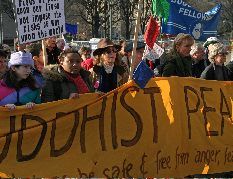
Buddhist Peace Delegation, Washington DC, 2007

This past Monday, we had a memorial service for Robert Aitken Roshi at the Upaya Zen Center temple. We were on the last morning of our seven-day Buddhist Chaplaincy Training intensive, and I’d just been blessed to spend the week with 38 chaplaincy students, Roshi Joan Halifax, Sensei Fleet Maull, and Jimmy Santiago Baca, all of us exploring “Dharma at the Edge.”

Roshi Joan asked me to say a few words about Aitken Roshi during the service. As I prepared to do that, I remembered just how radical Aitken Roshi was in his life and in his Buddhist practice. As I recounted before on this blog, I got a chance to spend three days with him back in 2005. I’ve never forgotten his encouragement to me to ensure that the Buddhist Peace Fellowship would not forget its radical, anarchist roots, and to keep placing ourselves in harm’s way if need be for the protection of all beings and of the Earth.

Some time after my trip to Hawai’i to meet Roshi, he sent me a gift in the mail – a copy of the book Death in the Haymarket: A Story of Chicago, the First Labor Movement, and the Bombing that Divided Gilded Age America. This was characteristic of his great generosity as well as his desire to educate fellow Buddhists about the mechanics of radical social change and anarchism. I still can hear his strong voice in my head: “It’s not enough to sit on the cushion.” Roshi’s heroes were people like Dorothy Day, Emma Goldman, Philip Berrigan, Daniel Ellsberg, and Kathy Kelley (of Voices in the Wilderness).

Yesterday, I came across a wonderful piece of writing from sister blogger Katie Loncke. She writes:

As Buddhists and dhamma practitioners, I would love to see us having more conversations about what compassion and social change actually look like: locally, on the ground, in practice.  Because it’s too easy for us to invoke these words — compassion, inner work, social change — and assume that everyone is on the same page.

The truth is, we’re not all on the same page.  And it’s not until after the event is over, on the subway ride home, when a gaggle of us start discussing in detail the relationship between inner and outer work, that these fundamental differences emerge, sharp and cold, like mountain peaks, from the soothing golden fog of Buddhist unity.

Katie then goes on to outline five points where she digresses from “spiritual liberalism”:

1.  Mystified Mechanism. When we start doing the inner work of developing compassion and insight, our outer social justice work will automatically get good.

How?  Sometimes folks talk about spirituality helping to reduce burnout, or converting the motivation of anger into the motivation of compassion.  But while both are wonderful benefits, neither speaks to the testable effectiveness of the particular outer work itself.

2. Healing As (Total) Resistance. Smiling at strangers on the subway is resisting militarism.

Well, I disagree.  Our healing work, spiritual work, and structural resistance work ought to inform each other, but they are not interchangeable substitutes.  Mandela didn’t inspire a movement and challenge the status quo just by praying compassionately for the liberation of the oppressor. (Though he did that, too.)

3. Social Change Relativism. Together, a growing movement is working for peace and justice in the world.  From green business to prison meditation to high-school conflict resolution programs on MTV, signs of hope and change abound.

Are all forms of progressive activism equally useful?  No.  But the shorthand of social change frequently obscures this fact.  Coupled with a feel-good engagement paradigm, the ‘every little bit helps’ idea makes it very difficult to hold each other accountable for our political work and its actual outcomes.

4. Root vs. Radical. Radical political agendas fail to grasp the root cause of oppression: dualism.  And ultimately, the best ways of overcoming dualism are through meditation and small-scale, intimate, interpersonal, compassion-building exercises.

Even if dualism is the “root cause” of oppression, that doesn’t make it the best or most actionable point for resistance, always.  Besides: why is this idea of dualism so pervasive and tenacious, anyway?  In large part because of the political and material structures (i.e. schools, economies, hierarchical religious institutions) that train human beings.  Without changing the power relations governing those material structures, there’s little hope of giving non-dualistic living, and appreciation for inter-being, a real shot on a global scale.      

5. Bhudd-opian Visions. Gandhi said it best: “Be the change you wish to see in the world.”

Often, this gets construed to mean: build the best alternative society you can, and slowly it will change the entire society.  Especially in Buddhist communities that prize extended retreat time, a decade of study with a realized Asian master, and this sort of removal from everyday householder society, there’s a danger of trying to build our sanghas into utopias, and assuming that they will automatically radiate peace and well-being into the world.  Might be true on an individual or small-group level, but why should we believe that we can scale up well-being from personal transformation to world peace, without specific strategies for tackling enormous material systems?

I think these are really important questions, and I bow in gratitude to Katie for bringing them forward. On the same morning I came across Katie’s article, I also happened upon this piece on Transformative Organizing (TO) from this year’s US Social Forum. I’ll write more on this in another post, but in a nutshell, “TO is about creating deep change in how we are as people, how we relate to each other, and how we structure society. It brings together approaches to transformative change, ideological development, and impactful grassroots organizing to create a new paradigm for organizing.”

The interesting thing to me is how TO starts from the basis of effective organizing, and enfolds both inner and outer transformation from there. Too often, I think that many of us as engaged Buddhists give short shrift to the dimension of outer transformation, as well as the challenges in our relationships with each other, especially when there are power inequities based on race, class, and gender. It’s kind of like a spiritual/political bypass.

Meanwhile, in Montague, MA, this week, hundreds of people are attending the Engaged Buddhist Symposium at the Zen Peacemaker Institute. I wonder if these conversations are happening there as well, if people are exploring where the radical edge of dharma lies, and how we as practitioners in this day and age, living in this profoundly broken yet beautiful world, can really get down in the dirt with all beings.

If you’re at the Symposium, or if you have thoughts about all this, I’d love to hear your voice in the comments below.

Robert Aitken Roshi: Travel Safely and Swiftly

Posted on

Robert Aitken Roshi died yesterday evening in Honolulu, Hawai’i, at the age of 93 … he was truly one of the guiding lights of socially engaged Buddhism.

May we carry on his legacy in a way that would honor him.

We are born in a world in which all things nurture us. As we mature in our understanding of the Dharma, we take responsibility for pratitya-samutpada and continually divert our infantile expectations of being nurtured to an adult responsibility for nurturing others.

from “The Morning Star: New and Selected Zen Writings” by Robert Aitken Roshi


Bhikkhu Bodhi Goes to Washington

Posted on

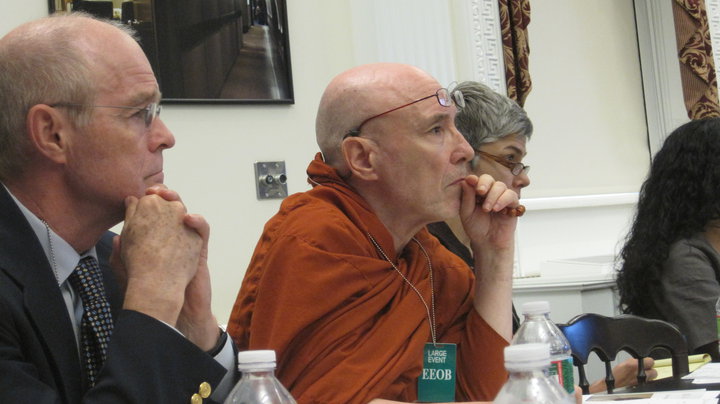
Bhikkhu Bodhi at the White House, July 26, 2010

I’m a fan of Bhikkhu Bodhi in real life, and also on his Facebook page. That’s how I heard about this story which he posted on Facebook this past Thursday, July 29. Buddhist Global Relief is the organization that Bhikkhu Bodhi founded in 2008, dedicated to the mission of providing relief to the poor and needy throughout the world regardless of nationality, ethnicity, gender, or religion.

Buddhist Global Relief at White House Meeting on Interfaith Action Against Poverty

This past month, Buddhist Global Relief (BGR) received a unique honor in being requested to join a task force on interfaith action to alleviate poverty and combat illness around the world. The first meeting of the task force took place at the White House on July 26th. The task force is intended to spearhead the Global Initiative for Faith, Health and Development, an international project guided and organized by the Center for Interfaith Action (CIFA), based in Washington. The Global Initiative was launched in response to President Obama’s call for the world’s religions to collaborate on issues of humanitarian concern. Its objective is to produce a strategic framework for advancing and multiplying inter-religious cooperation on action against global poverty and illness.

The task force brings together the world’s most prominent faith-based relief organizations for the purpose of designing the framework. In appointing the task force, CIFA wanted to broaden the range of the Global Initiative by including delegates from other religions besides the three Abrahamic faiths—Judaism, Christianity, and Islam. After a careful review, they chose BGR as the most suitable Buddhist organization to serve in this role. Though BGR has been in existence for only two years, the organizers were impressed by its significant achievements and the broad reach of its programs during such a short period of activity.

CIFA invited BGR chairperson Ven. Bhikkhu Bodhi and executive director Kim Behan to participate in the first meeting of the task force, held at the White House on the afternoon of July 26th. The meeting opened with words of welcome and encouragement from Rev. Josh Dubois, head of the Office of Faith-Based and Neighborhood Partnerships under President Obama. The conveners of the meeting then gave a broad presentation of CIFA’s plans to increase interfaith collaboration, illustrated by detailed charts and diagrams. This was followed by a lively exchange of views and comments from the members of the task force, with appreciated contributions from Ven. Bodhi and Kim Behan.

In the course of several future meetings, the task force will design a strategy to strengthen the contribution of the religious sector to poverty alleviation and global development. The next meeting will be held on October 4th at the United Nations in New York. This will be followed by a two-day session in November, to be held at the Washington National Cathedral and the White House. At this session, the participants will finalize the design of the strategic framework. The hope is that the framework will create a clear plan of action for different faith communities to work together in addressing the problems of poverty, hunger, and disease.

We at BGR feel privileged to be able to share in this worthy effort. We believe this appointment marks a significant recognition of BGR’s attempts to address the plight of the poor around the world. We hope that by participating actively with other faith-based organizations, we can make a significant difference in the lives of the marginalized sector of humanity.

July 29: Buddhist Love Delegation in New Mexico (and a lot of background story)

Posted on

This Thursday evening, July 29, I’ll be joining with my friend Russ Russell, a Zen priest with the Desert Mirror sangha, to offer a Buddhist presence at the Interfaith Vigil for Immigration Reform in Albuquerque. If any of you reading this are in or near Albuquerque, I hope you’ll join us. Send me an email at maia [at] gmail.com and we’ll figure out how to find each other.

If you’ve been reading The Jizo Chronicles for a while, you’ll know that I’ve been writing about the situation in Arizona ever since the passage of SB 1070, the anti-immigrant bill. This Thursday, the bill goes into effect, which is the reason for the interfaith vigil (as well as a much larger event in Phoenix).

Why does this matter to me so much? I’ve been wondering about that. You know how some issues just grab us and won’t let go, but they don’t have that same effect on other people? This seems to be one of them. I’ve been blogging, tweeting, and Facebook-ing about this, proposing the idea of a Buddhist “Love” Delegation to Phoenix, and a few people responded. But for the most part it doesn’t seem to touch the same nerve in other (mostly white) people that I know.

Then I remembered Mrs. Sanchez. I grew up in Southern California, just outside of Los Angeles. I went to a small Catholic school where I was in the minority – a good 75% of my class was Chicano/a, and I was one of the few white girls. My best friend was Pattie Sanchez and most weekends I would hang out at Pattie’s house. Mrs. Sanchez introduced me to tamales and enchiladas, and watched over me just like I was Pattie’s sister. The Sanchez’s celebrated every milestone along with me and my parents… from First Communions to graduations to family births and family deaths. Their house was really my second home, and they were my family. Mrs. Sanchez was like my second mom.

So I think at some sub-conscious level I’ve been holding Pattie and Mrs. Sanchez and so many of the other people I grew up with in my heart as I’ve been reading about SB 1070 and the likely consequences of it. As I wrote in an earlier post, I feel impassioned to speak out about SB 1070 because:

  • It’s mean-spirited… the opposite of lovingkindness.
  • It’s a massive display of white privilege. The bill mandates law enforcement officers to determine people’s immigration status based on “reasonable suspicion.” What exactly does that mean? If you have brown skin, you’re a suspect. Hey, how about me? I might be an illegal German/Slovenian immigrant. But would anyone ever think of that? Bingo. Racial profiling.
  • It will create a climate of distrust, and will almost certainly prevent people from reporting crimes to the police out of fear of being deported.
  • It’s redundant… the federal government is already responsible for enforcing immigration laws (for better or worse). The way I see it, even if you think that the immigration system in this country needs a major overhaul, this bill is still offensive and injust. (See this excellent interview with Rev. James Ishmael Ford, a Zen priest and a Unitarian Universalist minister, for his take on the bill.)

I’ve had to go through my own process to discern how to respond to this issue, and I want to share some of it with you because I think it’s a good illustration of socially engaged Buddhist practice, at least I understand it.

My first thought was to head to Phoenix on July 29 to join the Day of Non-Compliance there. But I struggled with this plan. There were a lot of factors to consider – it would be a big trip to take in terms of time and money, not to mention the carbon footprint. I thought perhaps I could take the train from Santa Fe to Flagstaff and then get a bus down to Phoenix. All of this felt like pushing against the river, especially in light of the fact that just a few days later, I need to be on full-duty for our core training time in the Upaya Buddhist Chaplaincy Program.

But I was willing to do this even if it felt like it was a big stretch. Then I looked at my ego… how much did I want to be in Phoenix, perhaps participating in civil disobedience, simply to satisfy my identity as “an engaged Buddhist”? I’m not immune to having a big ego and being righteous.

But then again, on the other hand, it truly did feel important to offer solidarity to people in Arizona who will be affected by this bill.

Every day of the past month I’ve gone back and forth with this, not being able to fully commit to going but also not being able to decide it was out of the question. Only in the last week did I finally become clear that I wouldn’t go to Phoenix but would instead make a donation to support Alto Arizona, the group that is doing much of the organizing around this day and immigrant rights.

The day after I made the donation, I saw the news about the Albuquerque vigil on July 29 via Twitter. Finally, the “appropriate response” took shape. Albuquerque is much closer to home – only an hour away. This was a way to take action that felt more sustainable in terms of time, money, my own energy level, and travel. I emailed Russ and she responded back almost immediately that she would join me.

Activist movements are often filled with people who are martyrs to a cause, and with the expectation that we should be martyrs to a cause or we’re not really doing anything worthwhile. I’m not sure this belief system really helps a situation. It’s not that I think we should never get out of our comfort zone… in fact I’m sure that if we don’t, no real change occurs and we never challenge our own ideas of power.

But I also believe that we need to find ways to take action that generate joy and connection, not further suffering. This, to me, is what is at the heart of socially engaged Buddhism.

I have no idea if I got it “right” on this one, but I am looking forward to being in Albuquerque this Thursday night with my dharma friend and “standing on the side of love,” as the Unitarian Universalists put it. Maybe we’ll see you there.

Buddhist Chaplains Love the Gulf (guest post)

Posted on

Grand Isle Graveyard, photo by Penny Alsop

Here’s the latest update from Penny Alsop, who I’ve mentioned and quoted several times before in The Jizo Chronicles.

Penny has initiated the “Chaplains Love the Gulf “ project and is coordinating a trip in August so that “the people and environmental region of the Gulf can receive the benefit of compassionate presence of a contingent of chaplaincy students.”  Penny took a scouting trip to Grand Isle, LA, this month to begin that work. This is her report.

_________________________________________

More Love

by Penny Alsop

This past weekend I set out for Grand Isle, LA to begin our project, to research some details and to see for myself how my beloved Gulf coast and the people of Louisiana are faring since oil has taken over their lives in this most despicable way.  Lives have been turned upside down, every which way and even those who are making good money like the three fellows I met from Texas who work twelve hours per day, in twenty minute intervals, in hazmat suits in the sweltering Louisiana sun to wash the oil off of boom, would much prefer to be at home with their families.

The fellow that I spoke to on Dauphin Island, AL, a supervisor for BP, said seeing the oil in the form of tar balls on that island is breaking his heart. He hoped it would move on somewhere else, pausing as he seemed to realize that if that were the case, someone else’s heart would be breaking, right along with his. Later that evening my waitress said that business was slower than usual and that there were no tourists at all on the island “since the oil”, but because there were so many workers there instead, she was still making fairly good money. When the workers leave, as she’s heard they soon will, it’s going to be different story entirely.

In Grand Isle, there are hundreds of people working to clean up this mess. And the National Guard. And humvees parked at brightly painted beach front houses. And backhoes and front end loaders just feet from the shoreline. Huge pieces of rough plywood, hand painted in tall black letters announce in no uncertain terms that the beach is closed. The local sheriff enforces this by parking himself next to the sign. To cross the plastic orange construction fencing is a felony. Electric blue kiddie pools filled with chemicals meant to decontaminate boots exposed to oil I’m told, sit unsecured in front of the same fence. Dark clouds of ’something’ float in the salt water and huge swaths of black stuff has seeped into the sand. All visible only from a distance or from the one pier open in the state park. Small bands of workers scoop up three shovel fulls of blackened sand into plastic bags and toss them aside to be picked up and stacked in the plastic bag mountains at the staging area where huge white tents shelter hundreds of folding metal chairs.

My innkeeper tells me that she hasn’t been to the beach “since the oil”. She can’t bear to look. She’s more worried about the dispersant that is being sprayed each night. She wants to live a long life. She has grandbabies. Doreen greeted me with a tired, wary smile in a marina motel laundry room. No, she didn’t have any rooms available at the moment, maybe later in the month. Business is okay since lodging is at a premium but other people are losing their jobs. The marina is silent. No boats coming in or going out except to handle boom. The port is closed. Tears fill her eyes when she says that she’s afraid of losing her job. “Thank you, baby” she says, as I hug her neck.

They man who is responsible for drilling the relief well, the one that will be used to plug the blown out well permanently, has a perfect record. He’s never missed a target, this mechanical engineer. He’s working with bore-hole uncertainty as he guides the drill. Bore-hole uncertainty means that one really doesn’t know for certain where the drill or the target is at any given time. Wherever one may think that the drill is, is a momentary knowing. It can be displaced by unmapped and unanticipated obstructions, at any second. Reading the signals right in front of one’s face, in real-time and being able to choose the most appropriate path in response to the conditions at hand, is what’s called for. If one goes into this effort thinking that one knows what all the variables are, sure of one’s self, one is very likely to fail to hit the target.

No one wants this. No one would have chosen to have crude oil wash up on the beaches or engulf sea turtles, pelicans, shrimp and people’s lives. But here we are with no clearly identified enemy or single cause for this catastrophe. Instead there is layer upon layer of complexity; interwoven need and desire. It’s impossible to sort out where one starts and another leaves off. What is blindingly apparent is that this is an opportunity to look deep into each other’s eyes and proclaim as loudly or as quietly as the situation calls for, that I will not give up. I will not leave you to fend for yourself. I will not turn away. I will look to see what is needed and I will give that very thing.

For those of us who love the Gulf, this is our chance to love it and all her near and far inhabitants, all the more.

3 Smart Girlz is coordinating the deployment of a group of students from Upaya’s chaplaincy program to Louisiana the week of August 19 – 26th. They will be with some of the people hardest hit by the Deepwater Horizon disaster, bearing witness, serving in compassionate ways and with their presence. If you would like to participate, please contact penny (at) 3smartgirlz.com. If you would like to make a contribution to help offset the expenses of this trip, we gratefully welcome your partnership! You may send a check to 3 Smart Girlz, LLC, 400 Capital Circle SE, Suite 18154, Tallahassee, Fl 32301 or use the Paypal button here. Partner contributions are used 100% directly on expenses incurred by the chaplains.

Quote of the Week: Bhikkhu Bodhi

Posted on

An American Buddhist monk, Ven. Bhikkhu Bodhi is both a scholar and a truly engaged Buddhist. Perhaps best known for translations of the Pali Canon (one of my favorite books is his anthology In the Buddha’s Words published by Wisdom), he has been issuing a call to action to Buddhists around the world over the last few years.

In 2007, Bhikkhu Bodhi wrote an essay for Buddhadharma magazine titled “A Challenge to Buddhists,” in which he took American Buddhism to task for being excessively inwardly-focused. Not long after that, he and a group of his students and friends founded Buddhist Global Relief to provide aid to the poor and needy around the world. This is one monk who walks his talk.

This quote comes from an essay in BGR’s Spring 2010 “Helping Hands” newsletter:

Buddhism offers us two complementary perspectives to guide us in our engagement with the world. One pertains to our way of understanding things; the other pertains to our relationship with living beings. These two perspectives are respectively the wisdom of selflessness and universal compassion. Though distinct, the two are closely bound together, mutually embracing and reinforcing. In their integral unity they provide the most effective remedy to the contemporary crisis brought about by blind self-interest and the threat it poses to our planet’s fragile eco-system, economic security, and equitable relations among people and nations.

Updates on Gulf Coast and Arizona

Posted on

Two stories that I’ve been following with particular interest over the past couple of months have been the Gulf Coast Oil Spill and the passage of SB1070 in Arizona. Perhaps it’s because both strike me as situations in which our interconnectedness is front and center.

No matter how hard we try, we can’t escape from the fact that along with BP, all of us are in some way responsible for the oil spill that is decimating countless miles of ocean, habitat for water creatures, and livelihood for residents of that area.

And Arizona — immigration is a complex issue. But by labeling some humans as “illegal” and creating laws that cannot but help discriminate against certain groups of people, we are looking right in the face of what the Buddha points to as a prime source of suffering: the delusion that we are separate from one another.

So I’ve been covering responses from Buddhists to both of these events… “bodhisattvas in the trenches.” Here’s the latest update:

The Gulf Oil Spill

Penny Alsop, a student in the Upaya Buddhist Chaplaincy Program, is currently in Grand Isle, Louisiana, on a reconnaissance trip to see what is needed. She plans to return to that area August 19 – 27 and bring a group of volunteer Buddhist chaplains from the U.S. and Canada. She writes:

Coastal communities have been holding their breath for months now:  waiting for oil to land, fearful of both short- and long-term impacts, and waiting for help.  We know good will come from sending chaplains to land on the same shores in suffering communities.  Their gifts of presence and witness will be of service during their visits to the Gulf, and they will bring back real stories of the region to their home communities.

…More volunteers are welcome, as are business partners and individual sponsors.  Our collective outreach can be powerful. If you would like more information about how to join this project, contact Penny directly at penny@3smartgirlz.com.

You can read more about Penny’s efforts here.

Arizona

A couple of weeks ago, I wrote this post where I offered the idea of a Buddhist Love Delegation (riffing off the theme of “Standing on the Side of Love” that the Unitarian Universalists have created) to Arizona to take part in a July 29th “Day of Non-Compliance.” I also sent the idea out via email, Twitter, and Facebook. Only a few people wrote back to me, so it seems like the energy may not be there for this right now.

But if you are interested in going, take a look at this website and see what the UU’s are organizing. They are doing great work to speak out about this situation, as is the organization Alto Arizona.

And if a Buddhist Love Delegation does indeed form to head to Phoenix on July 29, you will be the first to know!